Highlight
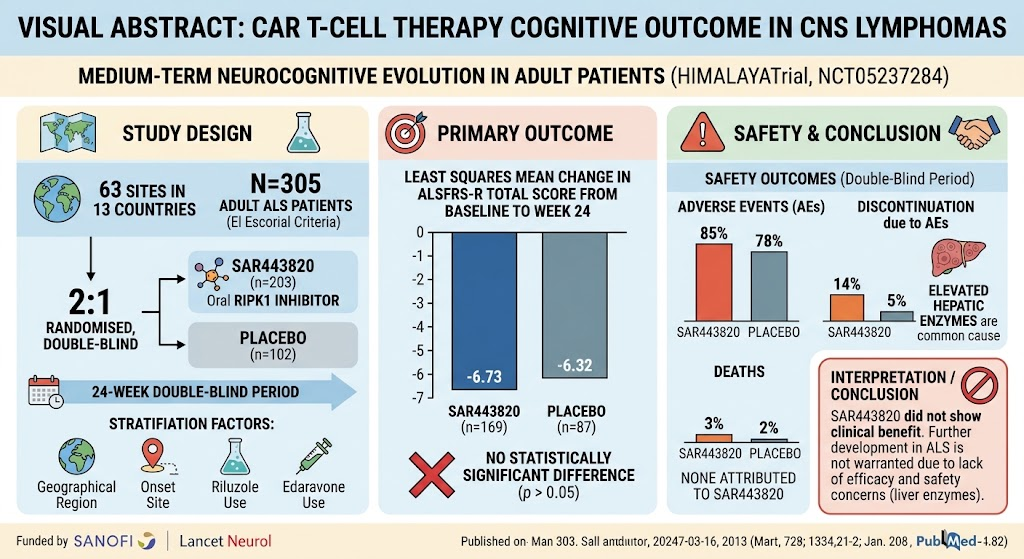
- CAR T-cell therapy for CNS lymphoma shows promising cognitive outcomes up to 12 months post-treatment.
- Despite a high incidence (63%) of acute neurotoxicity, midterm neurocognitive function was stable or improved in most patients.
- Significant improvements were observed in global cognitive assessments (MoCA) and language function at 6 and 12 months.
- Longer-term follow-up is necessary to confirm sustained cognitive benefits and safety.
Study Background
Central nervous system (CNS) lymphomas are aggressive malignancies that impose a significant clinical challenge due to their location and impact on brain function. Traditional therapies include high-dose chemotherapy and radiotherapy, which often result in neurotoxicity and cognitive decline. Chimeric antigen receptor (CAR) T-cell therapy, a novel immunotherapy approach harnessing patient-derived T-cells engineered to target lymphoma cells, has demonstrated promising efficacy in refractory CNS lymphoma with manageable acute neurotoxicity. However, data on the medium- and long-term neurocognitive outcomes following this treatment remain sparse, a critical gap given the brain involvement in these patients. Understanding cognitive trajectories is vital for patient counseling, rehabilitation planning, and assessment of treatment safety beyond acute phases.
Study Design
This retrospective cohort study was conducted at Pitié-Salpêtrière Hospital, including patients with isolated CNS lymphomas treated with CAR T-cell therapy between June 2021 and April 2024. The cohort consisted of 30 patients (43% female, 57% male; median age 61 years, range 30-82) who underwent routine neuropsychological assessments evaluating multiple cognitive domains: language, memory, executive functions, visuospatial abilities, and overall cognitive status. Evaluations were conducted at baseline (prior to treatment, without tumor progression), 6 weeks (W6), 6 months (M6), and 12 months (M12) post-therapy. The primary endpoint was the change in Montreal Cognitive Assessment (MoCA) score between baseline and 12 months. Secondary outcomes included domain-specific cognitive scores and the relationship between acute neurotoxicity severity and cognitive trajectories. Paired Student’s t-tests assessed differences from baseline, with significance set at p<0.05.
Key Findings
At baseline, patients exhibited moderate cognitive impairment, with MoCA scores averaging 23.5 (range 11-29), and 34%-80% demonstrating deficits across key domains. Acute neurotoxicity was common, affecting 19 patients (63%), with 6 (20%) experiencing grade ≥3 severity.
Early cognitive trajectories varied; by 6 weeks, 70% maintained or improved their MoCA scores, while 30% worsened. Notably, the occurrence and severity of acute neurotoxicity correlated significantly with these early cognitive patterns (p=0.003, 95% CI 1.78 to 1,227.01), suggesting neurotoxicity influences short-term cognitive outcomes.
Importantly, at 6 months, MoCA scores improved significantly compared to baseline (mean 24.7 vs 22.6, p=0.002, 95% CI 0.92–3.37) and further improved at 12 months (mean 25.4 vs 22.1, p<0.001, 95% CI 2.12–4.92). Language abilities showed statistically significant gains at 12 months (Z-score improved from -0.6 to -0.1; p=0.02), while memory, executive functions, visuospatial skills, and anxiety/depression scores were stable or showed non-significant improvement.
These findings indicate that despite initial neurotoxicity, CAR T-cell therapy does not result in medium-term cognitive decline; rather, cognitive functions can stabilize or improve, possibly reflecting tumor control and recovery from acute inflammatory effects.
Expert Commentary
This study offers valuable midterm cognitive outcome data that complements the growing evidence of CAR T-cell therapy’s efficacy in CNS lymphoma. The finding of cognitive improvement despite considerable initial neurotoxicity challenges prior concerns that CAR T-cell-associated neurotoxicity could portend lasting cognitive deficits. The use of comprehensive neuropsychological testing across multiple cognitive domains strengthens the clinical relevance of these observations.
However, several limitations warrant consideration. The retrospective design and relatively small, single-center sample limit generalizability. Neuropsychological assessments may be influenced by unmeasured confounders such as concurrent medications, mood disorders, or rehabilitation interventions. The lack of a control group treated with conventional therapies precludes direct comparison of cognitive outcomes across modalities. Future prospective studies with larger cohorts and longer follow-up periods are necessary to confirm the durability of these improvements and to investigate underlying mechanisms.
Conclusion
In patients with CNS lymphoma undergoing CAR T-cell therapy, midterm neurocognitive follow-up reveals a reassuring profile of cognitive stability or improvement despite a high incidence of acute neurotoxicity. Particularly, global cognition and language function improved significantly at 6 and 12 months. These findings support the neurocognitive safety of CAR T-cell therapy in this vulnerable population and highlight the potential for cognitive recovery after initial treatment-related inflammation.
Continued surveillance and functional assessments are essential to optimize long-term patient outcomes and to refine supportive care strategies in this emerging treatment paradigm.
Reference
Mersali S, Chapelle R, Ribeiro M, Weiss N, Psimaras D, Le Guennec L, Birzu C, Hoang-Xuan K, Boussen I, Baron M, Morel V, Uzunov M, Friser V, Choquet S, Houillier C. Medium-Term Cognitive Outcome in Patients With CNS Lymphomas Treated With Chimeric Antigen Receptor T-Cell Therapy. Neurology. 2026 Oct 27;107(8):e218561. doi: 10.1212/WNL.0000000000218561. Epub 2026 Oct 2. PMID: 42826379.