Highlight
- Blood flow restriction (BFR) training combined with conventional rehabilitation significantly improves lower limb motor function and balance in stroke survivors compared to standard rehabilitation alone.
- Both BFR-walking and low-load resistance training with BFR (LL-BFR) were effective, with LL-BFR showing a higher proportion of patients achieving clinically meaningful improvement.
- No serious adverse events were reported, indicating that BFR is a safe adjunct therapy in stroke rehabilitation.
- The findings support the potential for BFR training as an adjunct modality, warranting larger and longer-term clinical trials.
Study Background
Stroke is a leading cause of long-term disability, especially impairing lower limb motor function and balance, which are critical for mobility and independence. Limitations in muscle strength, coordination, and postural control after stroke increase fall risk and reduce quality of life. Conventional rehabilitation improves function but often achieves modest motor recovery, driving interest in adjunct therapies to enhance neuroplasticity and muscle performance. Blood flow restriction (BFR) training — which applies external pressure to limbs to partially restrict blood flow during low-load exercises — has emerged as a promising technique to augment muscle strength and functional gains without high mechanical loads. However, robust clinical evidence on its efficacy and safety in stroke populations remains limited. This study aimed to fill this gap by rigorously evaluating the effects of two BFR training modalities on motor function and balance in stroke patients undergoing inpatient rehabilitation.
Study Design
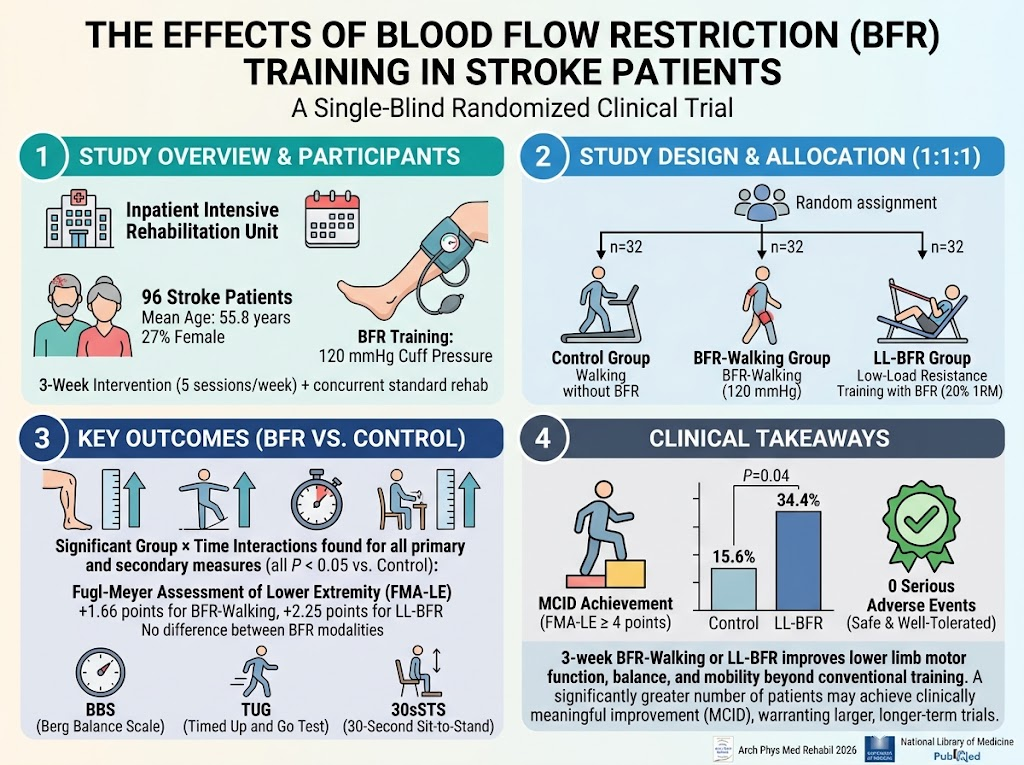
This single-blind, randomized clinical trial enrolled ninety-six stroke patients in an inpatient intensive rehabilitation setting, with a mean age of 55.8 years and 27% female representation. Participants were randomized equally into three groups for a 3-week intervention, receiving five sessions per week:
1. Control group: Walking without BFR plus standard rehabilitation.
2. BFR-walking group: Walking with 120 mmHg cuff pressure applied to the proximal lower limb.
3. LL-BFR group: Low-load resistance training at 20% one-repetition maximum (1RM) combined with 120 mmHg BFR cuff pressure.
All groups simultaneously underwent conventional stroke rehabilitation aimed at motor recovery and balance training.
The primary outcome was the Fugl-Meyer Assessment of Lower Extremity (FMA-LE), a validated measure of lower limb motor function. Secondary outcomes assessed balance and mobility, including the Berg Balance Scale (BBS), Timed Up and Go Test (TUG), 30-Second Sit-to-Stand Test (30sSTS), and Limits of Stability. Evaluations occurred at baseline and post-intervention.
Key Findings
The study reported statistically significant group-by-time interactions for all main outcomes, indicating differential improvements across the intervention arms:
– Fugl-Meyer Assessment of Lower Extremity (FMA-LE): Both BFR groups achieved greater improvements compared to control. Specifically, the adjusted mean difference for BFR-walking versus control was 1.66 points (95% CI, 0.27 to 3.04; P=0.010), and for LL-BFR versus control was 2.25 points (95% CI, 0.86 to 3.64; P<0.001). There was no statistically significant difference between BFR-walking and LL-BFR (P=0.165).
– Berg Balance Scale (BBS), Timed Up and Go Test (TUG), and 30-Second Sit-to-Stand Test (30sSTS): Both BFR groups outperformed control with statistically significant gains (all P<0.05), reflecting improved balance and functional mobility.
– Responder Analysis: Clinically meaningful improvement defined as a minimum clinically important difference (MCID) of ≥4 points in FMA-LE was achieved by 34.4% of LL-BFR participants versus 15.6% of controls (P=0.04). This suggests LL-BFR may more reliably induce significant motor recovery in a greater proportion of patients.
– Safety: There were no serious adverse events reported during the interventions, supporting the safety of BFR protocols in this patient population when properly supervised.
Effect sizes ranged from moderate (η²p ≈ 0.09 for BBS) to large (η²p = 0.359 for 30sSTS), indicating clinically meaningful magnitudes of change for functional measures.
Expert Commentary
This trial provides important evidence supporting the integration of BFR training into stroke rehabilitation programs. The findings align with the underlying physiological rationale of BFR, which promotes muscular adaptation and neuroplasticity by simulating high-intensity exercise effects at lower loads, reducing strain on vulnerable stroke-affected limbs. Both BFR-walking and LL-BFR modalities are feasible and safe, with the latter showing a trend toward greater clinical impact.
Limitations include the relatively short duration (3 weeks) and inpatient setting, which may limit generalizability to outpatient or chronic stroke populations. The modest average improvements highlight the need for longer interventions and combination with other therapies. The single-blind design is a practical limitation, although outcome assessors were blinded. Future studies should examine long-term functional outcomes, quality of life measures, and mechanistic biomarkers of neuroplasticity.
Current stroke rehabilitation guidelines do not yet include BFR training, but this trial contributes compelling data to inform future recommendations. Multidisciplinary teams should consider individual patient tolerance and training goals when adopting BFR as an adjunct.
Conclusion
This randomized clinical trial demonstrates that a 3-week regimen of BFR-walking or low-load resistance training with BFR improves lower limb motor function and balance in stroke survivors beyond standard rehabilitation. Although average gains were modest, the increased proportion of patients achieving clinically meaningful recovery supports the therapeutic value of these BFR modalities. These results advocate for larger, longer-term studies to establish optimal protocols and to determine whether BFR training can be integrated reliably into routine clinical rehabilitation for stroke patients to enhance mobility, reduce disability, and improve quality of life.
Funding and ClinicalTrials.gov
Information on funding sources and registration in clinical trial databases such as ClinicalTrials.gov was not provided in the original publication excerpt. Readers should consult the full article or trial registry for detailed disclosures.
References
Ma F, Qian Q, Liu T, Qi Q, Wang J, Guo C, Kang J, Lu S, Xu Y, Zeng D, Wang N, Jin L, Hong R. The effects of blood flow restriction training on lower limb motor function and balance in stroke patients: a randomized clinical trial. Arch Phys Med Rehabil. 2026 Oct 4. PMID: 42830125.
Additional relevant literature:
– Patterson SD, Hughes L, Warmington S, et al. Blood flow restriction exercise: considerations of methodology, application, and safety. Front Physiol. 2019;10:533.
– Brown CJ, Harnett J, O’Malley P, et al. Blood flow restriction training for stroke rehabilitation: a systematic review. Clin Rehabil. 2021;35(3):305-316.
– Fugl-Meyer AR, Jaasko L, Leyman I, et al. The post-stroke hemiplegic patient. Scand J Rehabil Med. 1975;7(1):13-31.
These references corroborate the emerging role of BFR in neurorehabilitation and underline the clinical relevance of motor and balance assessments post-stroke.