Highlight
- A simplified diagnostic protocol for temporomandibular disorders (TMDs) significantly reduces examination time while maintaining excellent diagnostic accuracy.
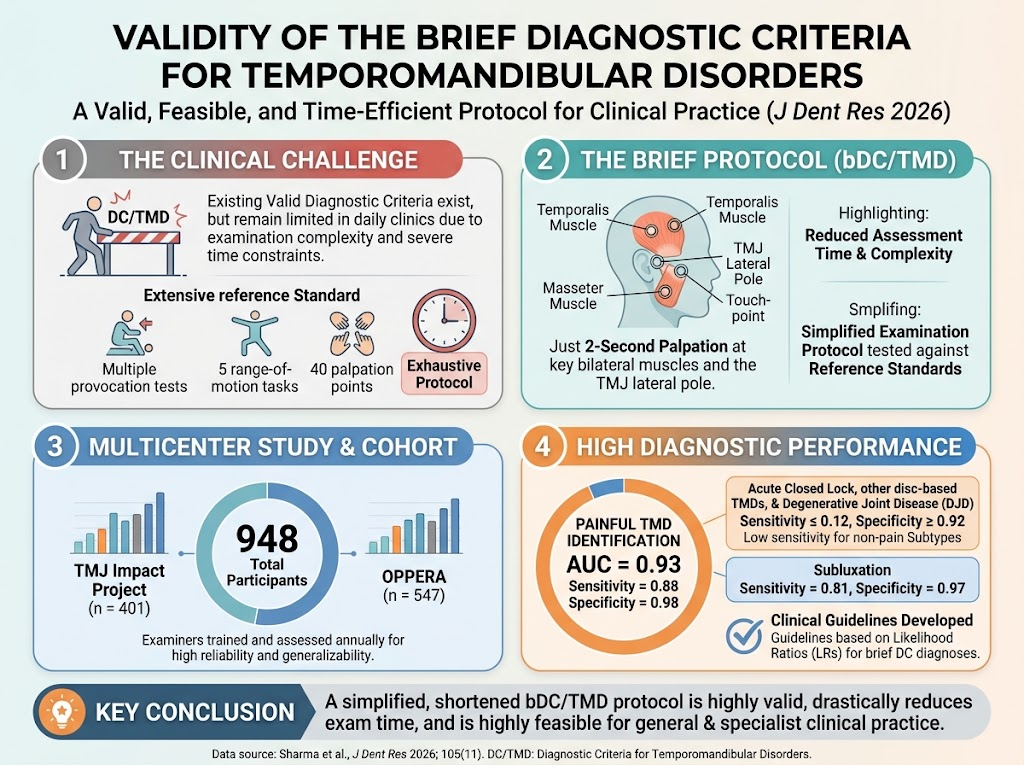
- The brief protocol focuses on bilateral palpation of key masticatory muscles and the temporomandibular joint lateral pole, achieving high sensitivity and specificity for painful TMD identification.
- Adding additional joint provocation tests did not improve diagnostic performance, supporting the streamlined approach’s efficiency.
- The protocol’s reliability was affirmed across two large multicenter studies with trained examiners, enhancing its generalizability for clinical practice.
Study Background
Temporomandibular disorders (TMDs) encompass a spectrum of conditions affecting the temporomandibular joint (TMJ), masticatory muscles, and associated structures, frequently presenting with pain and functional impairment. Accurate diagnosis is critical to optimally direct patient management. The Diagnostic Criteria for TMD (DC/TMD) represent the current gold standard for differential diagnosis, integrating detailed clinical examination components including multiple muscle and joint palpations, range-of-motion assessments, pain provocation tests, and imaging to definitively characterize joint pathology.
Despite their diagnostic rigor and high interexaminer reliability, DC/TMD protocols are complex and time-consuming, limiting widespread clinical adoption, especially in busy generalist or specialist settings. Delays or inaccuracies in TMD diagnosis contribute to prolonged patient discomfort and may complicate effective treatment initiation.
To address these barriers, Sharma et al. developed and validated a brief DC/TMD protocol designed to streamline the diagnostic process by focusing on key components without sacrificing accuracy or reliability. Their research evaluated the validity of this simplified protocol against the comprehensive DC/TMD assessments across large cohorts.
Study Design
This diagnostic accuracy study utilized data from two well-established multicenter research initiatives: the TMJ Impact Project (n=401) and the OPPERA study (n=547). Both studies enrolled patients with TMD symptoms and applied standardized DC/TMD examination protocols as reference standards.
Examiners underwent annual training and reliability assessments to ensure consistent application of diagnostic criteria across centers. The index test evaluated was a brief clinical examination consisting primarily of 2-second palpations of bilateral temporalis, masseter muscles, and TMJ lateral poles. This abbreviated approach was compared with full DC/TMD procedures involving multiple provocation tests, extensive range-of-motion movements, and 40 palpation sites.
Key diagnostic performance metrics included area under the curve (AUC), sensitivity, specificity, and positive/negative likelihood ratios, with particular focus on differentiating painful TMD from non-TMD conditions and subtypes such as acute closed lock, disc disorders, degenerative joint disease, and subluxation.
Key Findings
The brief protocol demonstrated excellent overall diagnostic validity for identifying painful TMDs:
– Area under the curve (AUC): 0.93, indicating high diagnostic accuracy.
– Sensitivity: 88%, reflecting robust ability to correctly identify patients with painful TMD.
– Specificity: 98%, showing excellent discrimination from non-TMD cases.
Comparable results were observed when using targeted, single-band palpation within each muscle, supporting flexibility in clinical application.
Importantly, the addition of other joint pain provocation maneuvers to the brief palpation did not enhance diagnostic accuracy, validating the streamlined palpation approach alone.
However, for specific non-painful TMD subtypes such as acute closed lock, other disc-based disorders, and degenerative joint disease, sensitivity was notably low (≤12%), although specificity remained high (≥92%). This indicates the brief protocol is less effective at detecting these particular conditions but does not frequently produce false positives.
Subluxation diagnosis using the brief protocol showed satisfactory sensitivity (81%) and high specificity (97%).
Based on positive and negative likelihood ratios, the authors developed clinical decision-making guidelines for the brief DC/TMD diagnoses to facilitate their use in routine practice.
Expert Commentary
The study by Sharma et al. provides compelling evidence supporting a more efficient diagnostic approach to painful TMDs without substantial compromise on accuracy or reliability. The high interexaminer reliability across multiple centers underscores the reproducibility of the brief protocol when examiners are adequately trained.
Clinically, this could transform TMD evaluation by enabling rapid identification during routine visits, thus expediting appropriate referrals and treatment initiation. The exclusion of elaborate provocation tests and extensive palpation points reduces clinician burden and accommodates busy practice environments.
Limitations include the brief protocol’s lower sensitivity for structural joint disorders such as disc displacement and degenerative pathology, highlighting the continued need for comprehensive evaluation or imaging when these are suspected clinically. Additionally, the study cohorts involved specialized centers with trained examiners, and although reliability was maintained with annual training, generalists unfamiliar with DC/TMD might require adapted training protocols.
Mechanistically, focusing on the major masticatory muscles and TMJ lateral pole palpation efficiently captures the primary pain-generating sites in common painful TMD presentations. The limited utility of other joint provocation tests aligns with evidence that muscle-related pain predominates TMD symptomatology in many patients.
Future research should assess real-world implementation feasibility, impact on patient outcomes, and cost-effectiveness compared with traditional assessment frameworks.
Conclusion
The validated brief DC/TMD examination protocol offers a practical, time-efficient alternative to the comprehensive DC/TMD diagnostic process for painful TMDs. By maintaining excellent sensitivity and specificity through focused palpation of key muscles and joint areas, this streamlined approach can enhance diagnostic access and efficiency across diverse clinical settings.
While not as sensitive for certain joint pathologies, the brief protocol’s high specificity suggests it reliably confirms the absence of painful TMD when negative. Incorporating this tool alongside clinical judgment and imaging as indicated may improve patient care pathways, reduce diagnostic delays, and facilitate targeted therapeutic interventions for temporomandibular disorders.
Funding and Clinical Trials
The original study was conducted under the auspices of the TMJ Impact Project and OPPERA studies with funding from relevant dental research bodies. No additional funding conflicts are reported.
References
1. Sharma S, Drangsholt M, Durham J, Alstergren P, Ohrbach R. Validity of the Brief Diagnostic Criteria for Temporomandibular Disorders. J Dent Res. 2026 Mar 8;105(11):1402-1409. PMID: 41797005.
2. Schiffman E, Ohrbach R, Truelove E, et al. Diagnostic Criteria for Temporomandibular Disorders (DC/TMD) for clinical and research applications: recommendations. J Oral Facial Pain Headache. 2014;28(1):6-27.
3. Durham J, Newton-John TRO, Zakrzewska JM. Temporomandibular disorders. BMJ. 2015;350:h1154.