Highlight
This study evaluates the relationship between hamstring strain severity, sciatic nerve involvement as seen on MRI, and time to return-to-sport (RTS) in NCAA Division I American football players. Key findings demonstrated that higher British Athletics Muscle Injury Classification (BAMIC) grades and complete sciatic nerve involvement are significant predictors of prolonged RTS.
Partial sciatic nerve involvement does not significantly delay RTS compared to no nerve involvement. These results emphasize the importance of including sciatic nerve status in the initial imaging assessment and rehabilitation planning of acute hamstring injuries (HSI) in elite athletes.
Study Background
Hamstring strain injuries are among the most common muscular injuries affecting athletes, particularly in sports requiring high-speed running and rapid directional changes such as American football. In the National Collegiate Athletic Association (NCAA), hamstring strains contribute to significant time lost from competition and training, impacting both individual athletic performance and team outcomes.
While the British Athletics Muscle Injury Classification (BAMIC) system is widely used to stratify hamstring injury severity based on MRI findings—including the extent and location of muscle damage—the role of adjacent structures like the sciatic nerve in influencing recovery timelines remains inadequately understood.
The sciatic nerve runs posteriorly alongside the hamstring muscle group, and its involvement by injury-related edema may complicate symptoms and recovery. This study addresses this gap by investigating whether sciatic nerve involvement observable on MR imaging correlates with return-to-sport durations in collegiate football players.
Study Design
This investigation utilized data from a prospective cohort study involving NCAA Division I American football players who sustained acute hamstring strain injuries. The study included 96 distinct HSIs in male athletes (mean age 20 ± 1.58 years).
Each injury was imaged with MRI soon after occurrence and reviewed by a musculoskeletal radiologist. The injuries were graded according to BAMIC criteria, which categorizes muscle injury severity into progressively higher grades based on MRI evidence of muscle fiber disruption and edema.
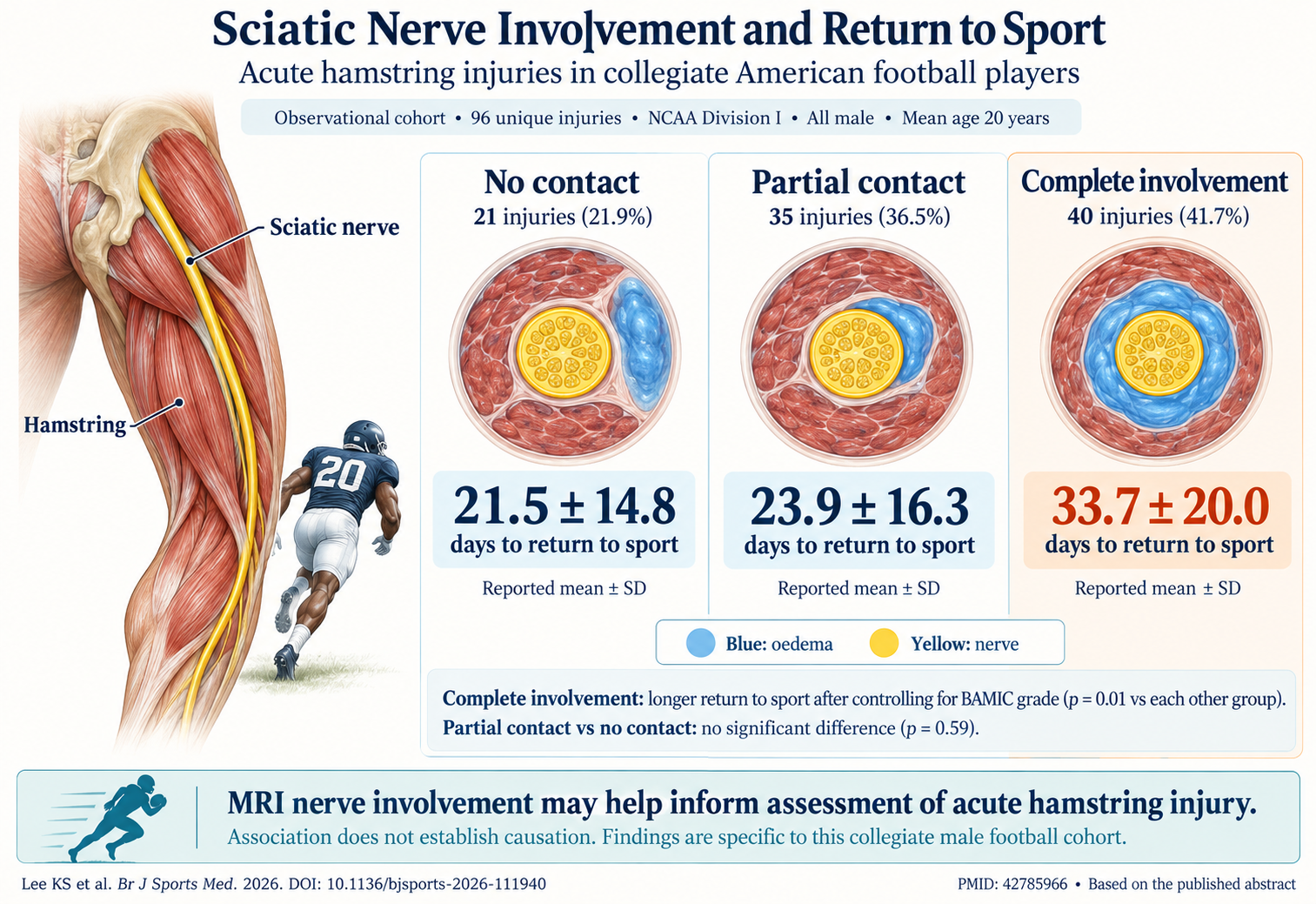
Sciatic nerve involvement was assessed by imaging-detected surrounding edema and classified as:
- No contact: the nerve is free of edema
- Partial involvement: nerve contacted by edema
- Complete involvement: nerve circumferentially surrounded by edema
Primary outcomes included the correlation of BAMIC grade and sciatic nerve involvement with the number of days missed until full return to sport (RTS). Statistical analyses comprised Spearman rank correlations, mixed-effects modeling to control for confounding variables, and chi-square tests for associations.
Key Findings
The study found a statistically significant positive correlation between increasing BAMIC grade and longer RTS (Spearman’s r=0.29, p=0.004), confirming that higher radiologic severity predicts prolonged recovery.
Sciatic nerve involvement was prevalent, observed in 78.1% (75/96) of cases: 36.5% had partial involvement and 41.7% complete involvement. Only 21.9% showed no nerve involvement. The extent of nerve involvement increased alongside BAMIC grade (p<0.001), indicating that more severe muscle injuries are more likely to implicate the nerve.
After controlling for BAMIC grade, complete sciatic nerve involvement was significantly associated with longer RTS (mean 33.7 ± 20 days) compared with no nerve involvement (mean 21.5 ± 14.8 days; p=0.01) and partial involvement (mean 23.9 ± 16.3 days; p=0.01). Partial involvement did not significantly extend RTS compared to no involvement (p=0.59).
Expert Commentary
These findings highlight the clinical importance of evaluating sciatic nerve involvement when interpreting MRI in acute hamstring strain injuries, especially for high-performance athletes.
The delayed RTS seen with complete nerve involvement likely reflects neurogenic pain, altered neuromuscular control, and possibly more extensive local tissue inflammation or damage. Incorporating nerve status into prognostic models may improve individualized rehabilitation planning and expectations.
Limitations of the study include the exclusive male collegiate football population, which may limit generalizability to other sports, female athletes, or non-collegiate levels. Longitudinal follow-up beyond initial RTS was not reported, so long-term functional outcomes remain unknown.
Future research could explore targeted therapeutic strategies addressing neural involvement, such as neurodynamic mobilizations or adjunct neuromodulatory interventions, to potentially reduce recovery time.
Conclusion
The study confirms that both increasing BAMIC grade and complete sciatic nerve involvement on MRI significantly delay return to sport following acute hamstring strain injuries in elite collegiate American football players.
Clinicians should consider sciatic nerve status in initial injury assessment and rehabilitation planning. Recognition of nerve involvement underscores a more complex injury mechanism and may necessitate more individualized and prolonged recovery protocols.
This research advances our understanding of hamstring injury severity and neural involvement, contributing to evidence-based strategies aimed at optimizing athlete recovery and reducing time away from sport.
Funding and ClinicalTrials.gov
This investigation was conducted as part of a larger prospective cohort study on collegiate football injuries. Specific funding sources and clinical trial registry details were not provided in the source article.
References
- Lee KS, Miller A, Mosiman S, Joachim MR, Heiderscheit B. Sciatic nerve involvement is associated with longer return to sport in collegiate American football players with acute hamstring injuries. Br J Sports Med. 2026 Sep 24. PMID: 42785966.
- Woodley SJ, Mercer SR. Hamstring muscle tears: mechanisms, risk factors and rehabilitation. Sports Med. 2005;35(3):243-261.
- Reurink G, Goudswaard GJ, Moen MH, et al. Comparison of clinical and magnetic resonance imaging measures to predict time to return to play following acute hamstring injuries in elite athletes. Am J Sports Med. 2014;42(6):1336-1344.
- Pollock N, James SL, Lee JC, Chakraverty R. British athletics muscle injury classification: a new grading system. Br J Sports Med. 2014;48(20):1347-1351.