Highlight
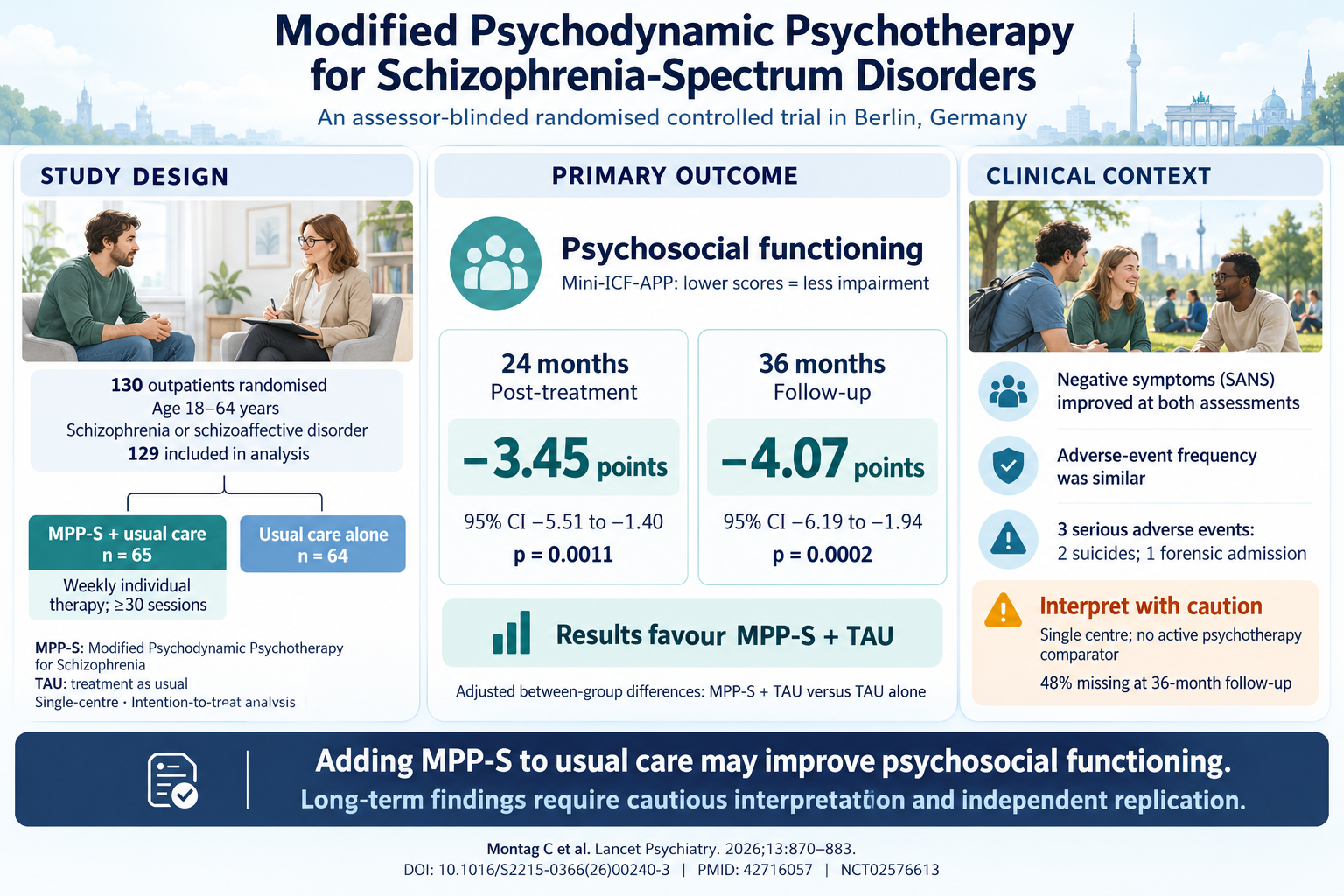
1. Modified Psychodynamic Psychotherapy for Schizophrenia (MPP-S) plus treatment as usual (TAU) significantly improved psychosocial functioning over 24 and 36 months compared with TAU alone.
2. This randomized controlled trial (RCT) establishes long-term efficacy and safety of a tailored psychodynamic intervention for schizophrenia-spectrum disorders.
3. The manualised MPP-S approach targets interpersonal vulnerabilities inherent to schizophrenia, a domain often resistant to improvement with pharmacotherapy alone.
4. Adverse event rates were comparable between treatment groups, supporting the intervention’s clinical safety profile.
Study Background and Disease Burden
Schizophrenia-spectrum disorders represent severe, chronic psychiatric illnesses characterized by positive symptoms (hallucinations, delusions), negative symptoms (apathy, social withdrawal), and cognitive dysfunction. Despite advances in pharmacotherapy and psychosocial interventions, patients frequently endure persistent deficits in interpersonal and psychosocial functioning, impeding quality of life and community integration. Psychodynamic psychotherapy, a treatment modality emphasizing unconscious processes and interpersonal patterns, has a longstanding clinical history but limited controlled evidence supporting its efficacy in schizophrenia-spectrum disorders. Addressing this gap, the current study assessed the impact of a Modified Psychodynamic Psychotherapy for Schizophrenia (MPP-S) designed to meet the specific interpersonal and psychological needs of this population.
Study Design
This prospective, single-centre, assessor-blinded, parallel-group randomized controlled trial was conducted at the Psychiatric University Hospital of the Charité at St Hedwig Hospital, Berlin, Germany. Participants included 130 outpatients aged 18-64 years with clinical diagnoses of schizophrenia or schizoaffective disorder. Exclusion criteria were organic brain disorders, somatic illnesses affecting cerebral function, and current or past substance misuse requiring specialized addiction treatment.
Eligible participants were randomized 1:1 into two arms: the intervention group receiving MPP-S (minimum 30 therapy sessions) plus treatment as usual (TAU), versus the control group receiving TAU alone. TAU encompassed standard psychiatric care including medication management and psychosocial support.
Outcome assessors were blinded to treatment allocation to reduce detection bias; however, therapists and participants were not blinded due to the nature of the psychotherapeutic intervention. The primary endpoint was psychosocial functioning measured by the Mini International Classification of Functioning, Disability and Health Rating for Limitations of Activities and Participation in Psychological Disorders (Mini-ICF-APP). Assessments occurred at baseline, 24 months (post-treatment), and 36 months (follow-up). The trial was preregistered at ClinicalTrials.gov (NCT02576613) and adhered to intention-to-treat principles, employing linear mixed models to accommodate missing longitudinal data.
Key Findings
Between October 2015 and December 2021, 130 individuals were randomized: 65 to MPP-S plus TAU and 64 to TAU alone; one participant withdrew consent for data analysis. Baseline characteristics were balanced between groups.
The primary outcome demonstrated statistically and clinically significant improvements in psychosocial functioning for the MPP-S plus TAU group compared to TAU alone. Specifically, adjusted between-group differences in Mini-ICF-APP scores were -3.45 (95% CI -5.51 to -1.40, p=0.0011) at 24 months and -4.07 (95% CI -6.19 to -1.94, p=0.0002) at 36 months, favoring the intervention. These findings suggest that the modified psychodynamic approach conferred sustained benefits in functional capacities the patients can perform in daily life and social roles.
Adverse event rates were similar across groups, supporting the safety of MPP-S when combined with usual treatment. Serious adverse events included two suicides: one in the MPP-S group who had not begun psychotherapy, and one in the TAU group, as well as one forensic hospitalization in the MPP-S plus TAU arm, indicating such risks remain clinically relevant but were not evidently increased by the intervention.
Expert Commentary
This study provides robust randomized trial evidence for the efficacy of psychodynamic psychotherapy tailored to patients with schizophrenia-spectrum disorders, addressing a critical unmet need in psychiatric care. The manualisation and modification of the therapy to target specific interpersonal vulnerabilities represents a methodological advancement, enhancing treatment relevance and consistency.
While the study’s single-centre design may limit generalizability somewhat, the large sample size, long follow-up period, and blinded outcome assessment support the validity and clinical applicability of the findings. Importantly, the maintenance of gains at three years post-baseline underscores long-term therapeutic value, a key consideration given the chronicity of schizophrenia.
Mechanistically, MPP-S may improve psychosocial outcomes by facilitating insight, enhancing interpersonal understanding, and promoting adaptive relational patterns, complementing symptom-focused pharmacotherapy. Comparative efficacy versus other evidence-based psychosocial interventions (e.g., cognitive-behavioral therapy), or combined approaches, warrants future investigation. Furthermore, integration of patients’ lived experience in intervention development could strengthen patient-centeredness.
Conclusion
The addition of Modified Psychodynamic Psychotherapy for Schizophrenia to standard psychiatric care significantly improves psychosocial functioning in individuals with schizophrenia-spectrum disorders, with benefits sustained up to 36 months. These findings support the inclusion of psychodynamic approaches within comprehensive treatment paradigms for this challenging population, potentially enhancing long-term recovery and social integration outcomes. Further research to confirm generalizability, compare with alternative psychosocial therapies, and optimize delivery modalities is recommended.
Funding and Trial Registration
This research was funded by the Berlin Institute of Health, Deutsche Gesellschaft für Psychoanalyse, Psychotherapie, Psychosomatik und Tiefenpsychologie, International Psychoanalytic University Berlin, and Köhler-Stiftung. The trial is registered at ClinicalTrials.gov under identifier NCT02576613.
References
Montag C, Bröcker AL, Bayer S, et al. The efficacy of modified psychodynamic psychotherapy for patients with schizophrenia-spectrum disorders in Germany: a prospective, single-centre, assessor-blinded, parallel-group, randomised controlled trial. Lancet Psychiatry. 2026 Oct;13(10):870-883. PMID:42716057.
American Psychiatric Association. Diagnostic and Statistical Manual of Mental Disorders. 5th ed. Washington, DC; 2013.
Mueser KT, McGurk SR. Schizophrenia. Lancet. 2004;363(9426):2063-2072.
Leichsenring F, Rabung S. Effectiveness of long-term psychodynamic psychotherapy: a meta-analysis. JAMA. 2008;300(13):1551-1565.
Lincoln TM, Wilhelm K, Nestoriuc Y. Effectiveness of psychological interventions in schizophrenia: a meta-analysis of controlled studies. Psychol Med. 2007;37(10):1413-1428.