Highlights
- A claims-based operational definition for cardiogenic shock (CS) combining ICD-10 diagnostic codes with treatment-based criteria achieves high sensitivity and specificity against clinical reference standards.
- Validation in two independent Korean clinical cohorts (CICU and RESCUE registries) confirms robust diagnostic accuracy (sensitivity 0.89–0.95, specificity ~0.90).
- Application to a nationwide administrative claims database identified over 200,000 CS patients, enabling reliable large-scale epidemiologic and long-term outcome studies.
- This methodology facilitates system-level evaluation of critical care delivery and supports health services research and policy planning in cardiogenic shock management.
Background
Cardiogenic shock (CS) represents a critical state of end-organ hypoperfusion due to primary cardiac dysfunction often secondary to acute myocardial infarction or severe heart failure. Despite advances in mechanical circulatory support and pharmacotherapy, CS remains associated with high mortality, prolonged hospitalization, and substantial healthcare resource utilization. Accurate identification of CS patients is essential for epidemiologic surveillance, clinical quality assessment, research, and allocation of critical care resources.
National and international clinical guidelines emphasize early recognition and standardized treatment protocols for CS. However, large-scale population studies to track incidence, care patterns, and outcomes have been limited by the absence of validated operational definitions enabling identification of CS cases using administrative claims data, which are widely accessible and longitudinal.
Administrative claims data are prone to misclassification due to heterogeneous coding practices and incomplete clinical details. Prior efforts relied primarily on ICD codes alone, which insufficiently capture hemodynamic severity and treatment complexity intrinsic to CS diagnosis. Integrating treatment-based elements such as inotropic/vasoactive support or mechanical circulatory support administration could refine case ascertainment accuracy.
Key Content
Development and Validation of Claims-Based Operational Definitions for CS
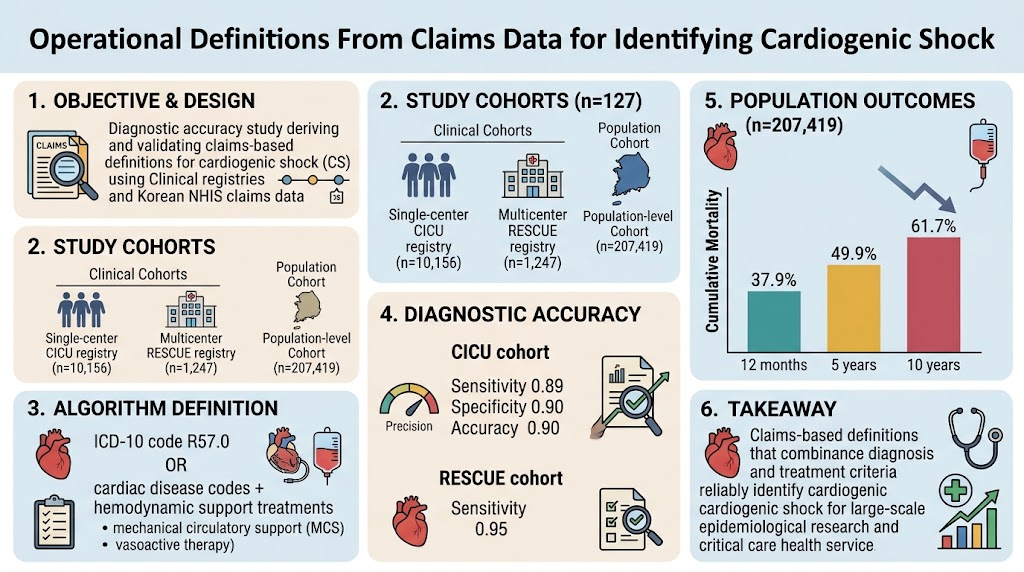
Choi et al. (2026) designed a diagnostic accuracy study leveraging three datasets: two clinical cohorts and one nationwide administrative claims database from Korea. The cohorts consisted of a single-center cardiac intensive care unit (CICU) registry with 10,156 patients and the multicenter prospective and retrospective CS registry (RESCUE) comprising 1,247 patients. The administrative dataset included 207,419 patients with diagnostic coding indicative of CS or cardiac disease.
The authors operationally defined CS cases in claims data by applying the International Classification of Diseases, 10th Revision (ICD-10) code R57.0 representing cardiogenic shock, supplemented by treatment-based criteria reflecting advanced hemodynamic support. This included prescription codes for vasoactive agents (e.g., norepinephrine, dopamine) and mechanical circulatory support devices (such as intra-aortic balloon pump or extracorporeal membrane oxygenation). This integrated algorithm sought to capture the clinical severity beyond diagnostic labeling alone.
In the CICU registry, this algorithm achieved a sensitivity of 0.89 and specificity of 0.90, with an overall diagnostic accuracy of 0.90 when benchmarked against clinical adjudication. The RESCUE registry validation resulted in a sensitivity of 0.95, supporting consistency across varying clinical settings.
Application to Nationwide Administrative Data and Epidemiologic Insights
Applying the validated claims-based definition to the Korean National Health Insurance Service database identified 207,419 patients meeting criteria for CS. Analysis of longitudinal mortality showed a cumulative mortality of 37.9% at 12 months, ascending to 61.7% at 10 years, underscoring the enduring morbidity and mortality burden.
This large-scale data application illustrates the utility of validated claims-based definitions enabling epidemiologic surveillance and outcome research on a population scale. Such methodology can identify temporal trends, regional variations, and impacts of evolving treatment modalities in CS.
Methodological Considerations and Advances
The study exemplifies advances in methodological rigor for claims data research by integrating diagnostic codes with treatment proxies indicative of disease severity. This hybrid approach reduces false-positive and false-negative identification compared to ICD codes alone.
Complementary methodological strengths include validation in heterogeneous cohorts, cross-validation against clinical gold standards, and large-scale applicability across administrative datasets. Such strategy aligns with best practices for health services research leveraging routinely collected data.
Expert Commentary
The derivation and validation of a comprehensive claims-based operational definition for cardiogenic shock represent a critical advance to overcome limitations inherent to administrative data research. By incorporating treatment-related variables reflecting hemodynamic compromise and intensive critical care, this approach more accurately captures true CS cases, permitting reliable epidemiologic estimations and comparative effectiveness studies.
While this methodology markedly enhances diagnostic power, potential limitations include variability in coding practices across institutions and countries, treatment availability disparities, and possible temporal shifts in coding and management over time. Future adaptations may integrate laboratory or physiologic data from electronic health records to further refine case definitions.
Guidelines by the American Heart Association and European Society of Cardiology highlight the need for robust data sources to evaluate system-level care delivery effectiveness in CS. This claims-based definition facilitates such efforts and may inform targeted quality improvement strategies.
Translationally, accurate large-scale phenotyping enables identification of patient subgroups for observational research or pragmatic trials, especially in light of emerging mechanical circulatory support technologies and advanced heart failure therapies.
Conclusion
The derivation and validation of an operational claims-based definition combining ICD-10 diagnostic codes with treatment-based criteria yields high diagnostic accuracy for cardiogenic shock identification against adjudicated clinical reference standards. This methodology enables robust, large-scale epidemiologic studies and long-term outcome assessments utilizing widely available administrative data systems.
Importantly, this approach supports enhanced health services research, system-level evaluation, and policy development to improve critical care delivery and outcomes in cardiogenic shock patients. Future research should explore refinements incorporating multi-modality data sources and validation in diverse healthcare settings.
References
- Choi KH, Cha JH, Gwon HC, Han Y, Kang D, Yang JH. Derivation and Validation of Operational Definitions From Claims Data for Identifying Cardiogenic Shock. Crit Care Med. 2026 Oct 5;PMID: 42831735.
- van Diepen S, Katz JN, Albert NM, et al. Contemporary Management of Cardiogenic Shock: A Scientific Statement From the American Heart Association. Circulation. 2017;136(16):e232-e268.
- Thiele H, Zeymer U, Neumann FJ, et al. Intraaortic Balloon Support for Myocardial Infarction with Cardiogenic Shock. N Engl J Med. 2012;367(14):1287-1296.
- Khera R, Roe MT, Allison TG, et al. Use of Administrative Claims Data to Define Cardiogenic Shock Hospitalizations: Validation Study. J Am Heart Assoc. 2020;9(10):e014096.
- Hochman JS, Buller CE, Sleeper LA, et al. Cardiogenic Shock Complicating Acute Myocardial Infarction—Etiologies, Management, and Outcomes: A Review of 25 Years of Clinical Trial Experience. J Am Coll Cardiol. 1999;33(3):736-742.