Highlight
This article summarizes a pivotal clinical neuroscience study investigating the neural correlates of cognitive workload in novice surgeons during simulated surgical tasks. Key findings include increased activation in the dorsolateral prefrontal cortex (DLPFC), premotor cortex (PMC), and supplementary motor area (SMA) with escalating cognitive load; differential brain activation patterns between surgeons who maintained performance and those who declined; and the potential role of the prefrontal cortex in mediating cognitive overload resilience in early surgical training.
Study Background
The modern surgical training environment demands rapid acquisition of complex psychomotor and cognitive skills. Cognitive workload — the mental effort required to perform a task — is a critical factor influencing surgical performance and patient safety. Excessive cognitive demand can provoke “cognitive overload,” whereby an individual’s capacity to process and integrate information is exceeded, leading to impaired performance. Previous studies have identified patterns of prefrontal cortex deactivation in senior surgical residents experiencing cognitive overload, but the neurocognitive signatures in novice surgeons, who are still developing foundational skills, remain insufficiently characterized. Understanding these neural responses is imperative for optimizing training methods and reducing errors.
Study Design
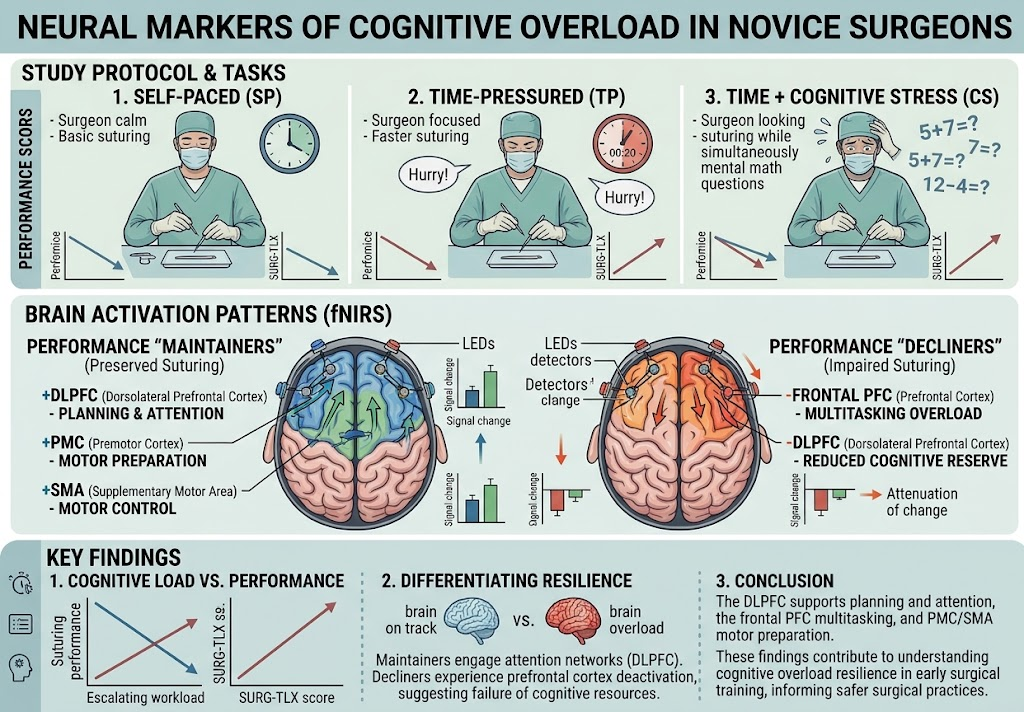
This observational study enrolled 20 novice surgical residents who performed a standardized suturing task under three escalating conditions of cognitive load: self-paced (SP), time-pressured (TP), and combined time and cognitive stress (CS). Cognitive stress was manipulated through additional mental challenges during task execution. Functional near-infrared spectroscopy (fNIRS), an optical neuroimaging technique, was employed to record cortical hemodynamics across the prefrontal and premotor areas, providing spatially localized data on oxygenated (HbO2) and deoxygenated hemoglobin (HHb) as proxies of neural activation.
Performance was quantitatively assessed using a validated suturing proficiency score. Subjective cognitive workload was measured through the SURG-TLX questionnaire, which gauges mental demand, physical demand, temporal demand, performance, effort, and frustration. Physiological stress was monitored via heart rate variability (HRV) to capture autonomic nervous system responses.
Key Findings
As task complexity increased from self-paced to time and cognitive stress conditions, subjective cognitive load showed a marked exponential increase (P < 0.00001), paralleled by a significant decline in suturing performance (P < 0.00001). Interestingly, HRV did not significantly differ across conditions (P = 0.5905), suggesting that autonomic stress markers were less sensitive or perhaps delayed indicators in this context.
Neuroimaging data revealed increased activation (HbO2 increase) in the dorsolateral prefrontal cortex (DLPFC), premotor cortex (PMC), and supplementary motor area (SMA) with escalating load. These regions are known to subserve executive functions such as planning, attention control, and motor preparation — integral to complex surgical tasks. The left DLPFC displayed divergent activation patterns between participants who maintained performance (“maintainers”) versus those who declined (“decliners”): maintainers exhibited increased oxygenated hemoglobin concentrations (HbO2.Ch20=10.8, P=0.005), indicative of enhanced recruitment, while decliners showed attenuated activation (HHbCh21=6.4, P=0.041), potentially reflecting reduced cortical engagement or early fatigue.
Additionally, decliners demonstrated greater frontal prefrontal cortex (PFC) deactivation during the simplest condition (SP), as measured by an increase in deoxygenated hemoglobin (HHb) in channel 57 (∆HHbCh57P=0.048 and ∆HHbCh57P=0.011). This deactivation may represent diminished capacity for multitasking and attention regulation, correlating with performance deterioration observed under increased load.
Expert Commentary
This study advances our neurofunctional understanding of how cognitive load modulates brain activity in novice surgical trainees. The observed augmentation of DLPFC and motor-related cortical areas underscores their pivotal roles in coping with increased task demands. Differential neural responses between maintainers and decliners suggest early neurobiological markers predictive of training outcomes and resilience to cognitive stress.
However, the absence of significant HRV changes prompts consideration of autonomic metrics in complex task paradigms, potentially indicating a dissociation between subjective cognitive burden and peripheral physiological stress responses in novices. Additionally, while fNIRS offers real-time cortical data with excellent temporal resolution and tolerability during task performance, its spatial coverage is more limited compared to modalities like fMRI.
Clinically, these findings support the implementation of personalized, neurocognitively informed training protocols. Trainees exhibiting early signs of cortical deactivation under moderate stress might benefit from targeted cognitive skills training, workload modulation, and stress management interventions to improve skill acquisition and patient safety.
Conclusion
Escalating cognitive workload in novice surgical residents produces distinct patterns of brain activation and deactivation within prefrontal and motor cortices, closely associated with performance outcomes. The capacity to sustain increased DLPFC activation during complex tasks appears critical for maintaining surgical performance and may serve as a biomarker of cognitive overload resilience. These insights provide a neurobiological foundation to inform safer and more effective surgical education strategies, emphasizing early identification and support for trainees at risk of cognitive overload.
Further research integrating multimodal neurophysiological measures and longitudinal follow-up will be vital to fully elucidate mechanisms of surgical skill mastery and optimize workload distribution in surgical training environments.
Reference
Caterson J, Goble MSL, Caddick V, Lin Z, Darzi A, Orihuela-Espina F, Leff DR. The Impact of Escalating Cognitive Workload on Novice Surgeon’s Brain Activation. Ann Surg. 2026 Aug 6. doi: 10.1097/SLA.0000000000007163. Epub ahead of print. PMID: 42557613.