Highlight
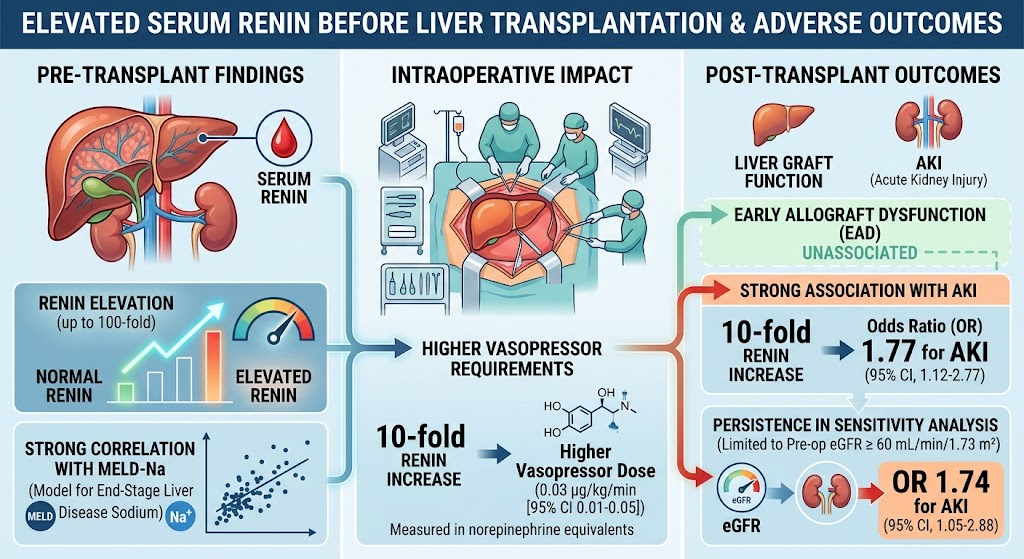
- Serum renin can be elevated up to 100-fold prior to liver transplantation in patients with cirrhosis.
- Preoperative renin levels strongly correlate with intraoperative vasopressor requirements during the dissection phase, measured in norepinephrine equivalents.
- Elevated renin predicts postoperative acute kidney injury independent of preexisting renal function, while no association with early allograft dysfunction was observed.
- Measurement of serum renin may guide individualized vasopressor strategies, including consideration of angiotensin II infusion during liver transplantation.
Study Background
Patients with end-stage liver disease undergoing liver transplantation frequently experience significant hemodynamic instability and are at elevated risk for postoperative complications, including acute kidney injury (AKI). Cirrhosis-associated circulatory dysfunction involves derangements in the renin-angiotensin-aldosterone system (RAAS), a pivotal regulator of vascular tone and sodium-water homeostasis. However, the role of renin—the rate-limiting enzyme initiating RAAS activation—in predicting perioperative hemodynamic demands and postoperative outcomes in liver transplant (LT) recipients has been insufficiently characterized. Understanding these associations could improve perioperative risk stratification and identify patients who might benefit from targeted therapies like angiotensin II vasopressor infusions to optimize hemodynamics and prevent AKI.
Study Design
This retrospective cohort study analyzed 138 adult patients with cirrhosis undergoing LT from deceased or living donors at a tertiary transplant center. Serum samples collected immediately before LT were assayed for renin concentration via enzyme-linked immunosorbent assay (ELISA). Extensive perioperative clinical data were extracted from a dedicated data warehouse. The primary endpoint was the intraoperative vasopressor dose required during the dissection phase of LT, quantified as norepinephrine equivalents and adjusted per kg body weight. Secondary endpoints included the incidence of postoperative acute kidney injury and early allograft dysfunction as measured by standard clinical criteria. Subgroup and sensitivity analyses accounted for baseline renal function as measured by estimated glomerular filtration rate (eGFR).
Key Findings
Serum renin levels exhibited remarkable elevation, reaching up to 100-fold above the normal reference range and showed a strong correlation with Model for End-Stage Liver Disease sodium (MELD-Na) scores, indicating worse liver function.
Notably, a 10-fold increase in serum renin concentration was associated with an increment of 0.03 µg/kg/min (95% CI, 0.01–0.05) in norepinephrine equivalent vasopressor dosage during the liver dissection phase, underscoring a direct relationship between RAAS activation and intraoperative hemodynamic support requirements.
Regarding postoperative outcomes, elevated renin was not predictive of early allograft dysfunction, suggesting that RAAS perturbations affect systemic hemodynamics more than initial graft function. However, a 10-fold rise in preoperative renin conferred a 77% increased odds of developing AKI post-liver transplantation (odds ratio [OR], 1.77; 95% CI, 1.12–2.77), a correlation that remained significant after limiting analysis to patients with preserved preoperative eGFR ≥60 mL/min/1.73 m2 (OR, 1.74; 95% CI, 1.05–2.88). This indicates that renin elevation predicts AKI even in patients without baseline renal impairment.
The strong association between elevated renin and vasopressor requirement suggests that RAAS activation is a key driver of vasodilatory shock physiology commonly encountered during LT. This positions renin measurement as a potential biomarker for identifying patients who may benefit from vasopressor agents that directly target the RAAS, such as angiotensin II infusions, which have shown promise in other vasodilatory shock states.
Expert Commentary
This study illuminates the mechanistic role of RAAS dysregulation in perioperative cardiovascular instability and renal complications during liver transplantation. The robustness of the association between elevated serum renin and both increased vasopressor requirement and AKI—independent of preexisting kidney function—provides both biological plausibility and potential clinical utility.
While early allograft dysfunction was not associated with renin levels, it is plausible that systemic hemodynamic instability and renal hypoperfusion driven by RAAS imbalance are more critical determinants of AKI than primary graft injury in this setting.
One limitation is the observational design, which precludes causal inference. Additionally, renin measurement is not yet routinely available in clinical practice, and standardized thresholds for intervention remain to be defined. Further prospective studies and interventional trials assessing RAAS-modulating therapies are warranted.
Conclusion
Elevated serum renin prior to liver transplantation identifies patients with advanced circulatory dysfunction who require higher intraoperative vasopressor support and are at increased risk of postoperative acute kidney injury. This biomarker may enhance perioperative risk stratification and inform personalized management strategies, particularly regarding vasopressor choice and timing. Incorporating renin assessment could enable early identification of patients who might benefit from angiotensin II infusion, potentially improving hemodynamic stability and renal outcomes after LT.
Funding and Clinical Trials
The study authors have not explicitly disclosed specific funding sources or clinical trial registry details within the primary publication.
References
- St Hilaire L, Tran A, Kothari RP, Adelmann D, Hellman J, Bokoch MP. Elevated Serum Renin Before Liver Transplantation Is Associated With Increased Intraoperative Vasopressor Requirements and Posttransplant Acute Kidney Injury. Transplantation. 2026 Aug 17. PMID: 42604980.
- Arroyo V, Gines P, Gerbes AL et al. Definition and diagnostic criteria of refractory ascites and hepatorenal syndrome in cirrhosis. Hepatology. 1996;23(1):164-176.
- Serpa Neto A, et al. Effects of activated renin-angiotensin system in management of refractory vasodilatory shock: a systematic review. Crit Care Med. 2017;45(10):e995-e1002.
- Angeli P, Bernardi M. Renin-angiotensin system and portal hypertension: pathophysiological implications and clinical perspectives. Arch Biochem Biophys. 2000;374(2):229-236.