Highlight
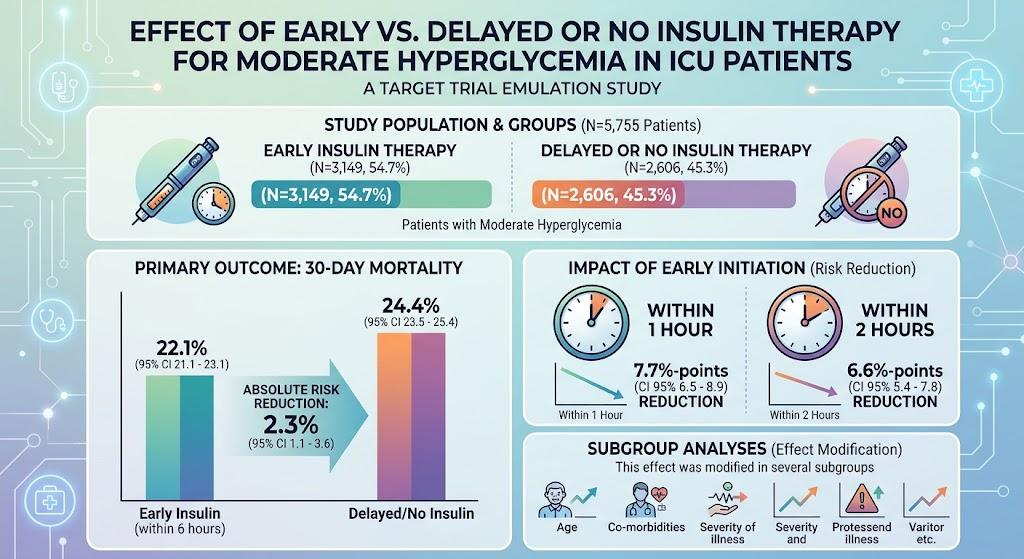
- Early insulin therapy within 6 hours of moderate hyperglycemia onset reduces 30-day mortality by 2.3% compared to delayed or no treatment in ICU patients.
- Initiating insulin within 1 to 2 hours following hyperglycemia yields markedly greater absolute mortality reductions, up to 7.7 percentage points.
- These findings, derived from a real-world target trial emulation of 5,755 ICU patients, underscore the importance of timely glucose control interventions in critical care.

- Mortality benefits varied across subgroups, suggesting potential patient-specific factors influence insulin therapy effectiveness.
Study Background
Hyperglycemia is a frequent metabolic disturbance in patients admitted to intensive care units (ICUs), often resulting from the stress response to critical illness. Elevated blood glucose levels in this setting have been linked to increased morbidity and mortality, yet optimal glycemic management remains controversial. Multiple randomized controlled trials (RCTs) in critically ill populations have evaluated strict versus liberal glucose control strategies with mixed results, leaving uncertainty particularly around the timing and necessity of insulin therapy in patients experiencing moderate hyperglycemia (blood glucose levels between 10 and 13.9 mmol/L). Given the risks associated with both hyperglycemia and hypoglycemia, understanding whether initiating insulin therapy early confers survival benefits is a critical unmet need in ICU clinical practice.
Study Design and Methods
This investigation utilized a multicenter target trial emulation design leveraging data from four ICUs at Karolinska University Hospitals (Solna and Huddinge campuses) over an 11-year span (2010-2021). Targeted minimum loss-based estimation (TMLE), a robust causal inference method, was employed to estimate the effect of early insulin therapy compared with delayed or no insulin treatment among acutely admitted adult ICU patients exhibiting moderate hyperglycemia (10-13.9 mmol/L). The primary endpoint was 30-day all-cause mortality. Early insulin therapy was defined as initiation within six hours of the first moderate hyperglycemic episode, while comparators included patients initiating insulin later or not receiving insulin at all. The analysis adjusted for multiple confounders and assessed effect modification among predefined subgroups to enhance external validity and explore patient heterogeneity.
Key Findings
Among 5,755 patients with moderate hyperglycemia, 3,149 (54.7%) received early insulin therapy, and 2,606 (45.3%) received delayed or no insulin therapy. The adjusted 30-day mortality rate was 22.1% (95% CI, 21.1-23.1) in the early treatment group compared to 24.4% (95% CI, 23.5-25.4) in the control group, corresponding to an absolute risk reduction of 2.3% (95% CI, 1.1-3.6). Notably, when insulin was initiated within 1 hour of moderate hyperglycemia onset, absolute mortality risk was reduced by 7.7 percentage points (95% CI, 6.5-8.9), and by 6.6 percentage points (95% CI, 5.4-7.8) when initiated within 2 hours. These results suggest a dose-response relationship between prompt insulin administration and survival benefit.
Subgroup analyses indicated that the mortality benefit varied depending on factors such as age, severity of illness, and baseline comorbidities, underscoring the importance of individualized glycemic management strategies. The study did not report significant safety concerns related to early insulin use, though hypoglycemia risk warrants ongoing vigilance in clinical practice.
Expert Commentary
This well-conducted target trial emulation provides compelling observational evidence supporting early insulin intervention in ICU patients with moderate hyperglycemia. While randomized trials remain the gold standard, this large, methodologically rigorous study addresses a critical knowledge gap regarding treatment timing, often limited in prior RCTs. The use of TMLE strengthens causal inference by adjusting for time-varying confounding and treatment switching common in ICU settings.
However, inherent limitations of observational data apply, including potential for residual confounding, selection bias, and limited granularity on insulin dosing and glucose variability. Further prospective trials are warranted to confirm these findings, elucidate optimal glucose targets, and define patient subgroups most likely to benefit. Mechanistically, timely insulin therapy may mitigate hyperglycemia-induced endothelial dysfunction, inflammation, and immune impairment, thereby improving outcomes.
Conclusion
This target trial emulation study highlights the clinical importance of early insulin therapy initiation within two hours of detecting moderate hyperglycemia in ICU patients. The significant reduction in 30-day mortality emphasizes that timing is a crucial factor in glycemic management during critical illness. These findings provide a strong rationale for revising glucose management protocols to incorporate prompt insulin treatment and warrant prospective validation in randomized controlled trials.
In summary, early insulin initiation appears to be a promising, actionable intervention to improve survival in critically ill patients experiencing moderate hyperglycemia, bridging evidence gaps in current intensive care endocrinology practice.
Funding and ClinicalTrials.gov
The study was conducted as part of institutional research activities at Karolinska University Hospitals. Specific grant or funding details were not disclosed in the abstract. The trial emulation utilized existing clinical data without a patient registry registration number reported.
References
- Gantzel CL, Yazdanfard PDW, Sørensen KK, et al. Effect of early versus delayed or no insulin therapy for moderate hyperglycemia in ICU patients: A target trial emulation. Chest. 2026 Aug 16; PMID: 42604667.
- Marik PE, Bellomo R. Stress hyperglycemia: an essential survival response! Crit Care. 2013;17(2):305.
- Finfer S, Chittock DR, Su SY, et al. Intensive versus conventional glucose control in critically ill patients. N Engl J Med. 2009;360(13):1283-1297.
- van den Berghe G, Ghijsen V, et al. Insulin therapy in critically ill patients: The impact of timing and glucose targets. Curr Opin Crit Care. 2020;26(6):551-559.