Highlight
- This international study validates four temperature-trajectory sepsis subphenotypes originally identified in the US within a large Chinese ICU cohort.
- The hypothermic subphenotype (HT) shows the highest mortality and is characterized by persistent immune suppression and coagulation abnormalities.
- Longitudinal immune (CRP, IL-6, lymphocytes, monocyte HLA-DR) and coagulation markers differ significantly between subphenotypes.
- Immunoglobulin therapy demonstrates heterogeneous effects, conferring mortality benefit predominantly in the HT subphenotype.
Study Background
Sepsis, a life-threatening organ dysfunction caused by a dysregulated host response to infection, remains a significant challenge in intensive care medicine globally. Despite advances in supportive care, sepsis mortality remains high, partly due to the clinical and biological heterogeneity of the syndrome. Traditional ‘‘one-size-fits-all’’ treatment strategies have not produced consistent benefits, fueling interest in precision medicine approaches that identify sepsis subphenotypes for targeted therapy. Temperature trajectories during sepsis have been suggested as a clinically accessible biomarker to classify patients into distinct subphenotypes with differing outcomes. However, international validation and characterization of these subphenotypes with comprehensive immune and coagulation profiles are lacking. This study addresses this gap by validating a temperature-trajectory sepsis model in a Chinese cohort and exploring its implications for immunoglobulin therapy.
Study Design
This retrospective cohort study analyzed data from adult ICU patients with suspected infection at a tertiary-care hospital in China. Patients were classified into four temperature-trajectory subphenotypes based on their longitudinal fever patterns: hyperthermic slow resolvers, hyperthermic fast resolvers, normothermic, and hypothermic (HT). The study characterized immune and coagulation biomarkers over time, including C-reactive protein (CRP), interleukin-6 (IL-6), lymphocyte counts, monocyte human leukocyte antigen-DR (HLA-DR), coagulation times (prothrombin time [PT], activated partial thromboplastin time [aPTT]), platelet counts, fibrinogen, hemoglobin levels, and red blood cell (RBC) transfusion requirements. After using propensity score matching to account for confounders, the researchers assessed the interaction between subphenotypes and immunoglobulin therapy on 30-day mortality.
Key Findings
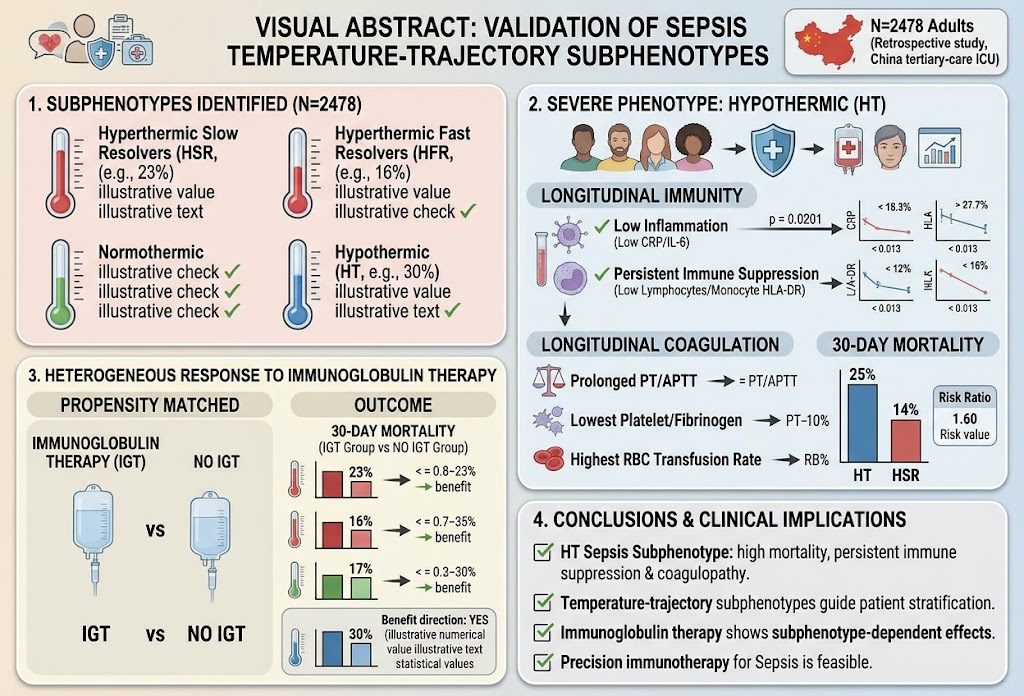
A total of 2478 patients were included and assigned to four subphenotypes: hyperthermic slow resolvers (567, 23%), hyperthermic fast resolvers (397, 16%), normothermic (780, 31%), and hypothermic (HT, 734, 30%). The HT subphenotype showed the highest 30-day mortality rate at 25%, consistent with previous US cohorts.
Longitudinal immune profiling revealed distinct patterns:
– The HT group exhibited the lowest inflammatory response, indicated by low and rapidly declining CRP and IL-6 levels.
– Immune suppression was notable in the HT subphenotype, with persistently low lymphocyte counts and reduced monocyte HLA-DR expression, markers associated with impaired adaptive immunity.
Coagulation dynamics also differed significantly:
– The HT subphenotype had prolonged PT and aPTT times indicating coagulopathy.
– They exhibited the lowest platelet counts and fibrinogen levels, along with lower hemoglobin, reflecting consumptive coagulopathy and bleeding risk.
– This group required the highest rates and doses of RBC transfusions, underscoring clinical severity and hemorrhagic complications.
Regarding immunoglobulin therapy, the study demonstrated a clear heterogeneous treatment effect:
– In the HT subphenotype, immunoglobulin therapy was associated with a significant reduction in 30-day mortality (hazard ratio 0.47, p = 0.03).
– No consistent benefit was observed in other subphenotypes, highlighting the importance of patient stratification in guiding immunotherapy.
Expert Commentary
This study robustly validates temperature-trajectory subphenotypes in an ethnically distinct ICU population, reinforcing the reproducibility and potential global applicability of this stratification approach. The observed immune suppression and coagulopathy in the hypothermic group provide biological plausibility for their higher mortality and support targeted immunomodulatory treatment. Immunoglobulin may enhance pathogen clearance or modulate immune dysfunction in this subgroup.
Notably, hypothermia as a phenotypic marker delineated a group with profound immune and coagulation derangements, aligning with prior research linking hypothermia with adverse sepsis outcomes. The longitudinal biomarker profiling adds granularity to our understanding of sepsis heterogeneity beyond static measurements.
Limitations include retrospective design, potential residual confounding despite propensity adjustment, and lack of mechanistic exploration. Immunoglobulin preparation details and dosing regimens were not deeply explored, which may influence outcomes. Future prospective, randomized studies are warranted to confirm benefits and optimize patient selection.
Conclusion
This international validation establishes temperature-trajectory as a clinically meaningful sepsis subphenotyping tool that identifies distinct immune and coagulation profiles. The hypothermic subphenotype, marked by immune suppression and coagulopathy, carries the highest mortality and may benefit from immunoglobulin therapy. These findings advance precision medicine in sepsis by enabling biologically informed patient stratification and targeted treatment strategies, potentially improving outcomes. Further prospective research is needed to refine these approaches and integrate them into routine critical care practice.
Funding and ClinicalTrials.gov Information
The original publication does not provide specific funding details or clinical trial registration.
References
1. Wang L, Pei F, Gu B, et al. International Validation of Temperature-Trajectory Sepsis Subphenotypes With Longitudinal Immune and Coagulation Patterns and Its Implications for Immunoglobulin Therapy. Crit Care Med. 2026;54(9):2335-2349. doi:10.1097/CCM.0000000000000000
2. Seymour CW, Kennedy JN, Wang S, et al. Derivation, Validation, and Potential Treatment Implications of Novel Clinical Phenotypes for Sepsis. JAMA. 2019;321(20):2003-2017. doi:10.1001/jama.2019.5791
3. Hotchkiss RS, Monneret G, Payen D. Sepsis-Induced Immunosuppression: From Cellular Dysfunction to Immunotherapy. Nat Rev Immunol. 2013;13(12):862-874. doi:10.1038/nri3552
4. Vincent JL, Opal S, Marshall JC, Tracey KJ. Sepsis Definitions: Time for Change. Lancet. 2013;381(9868):774-775. doi:10.1016/S0140-6736(13)60270-5