Highlight
- Swiss ICU professionals generally endorse and understand brain death diagnostics, with high self-reported confidence and approval.
- Significant interprofessional differences were observed, with physicians demonstrating greater approval and alignment with brain death concepts than nurses.
- Clinical experience and prior exposure to brain death cases are strongly associated with improved understanding, whereas factors like sex, religion, or personal bereavement are not.
- Areas for improvement include clarifying misconceptions, especially among less experienced staff and nurses, highlighting the importance of interdisciplinary education.
Study Background
Brain death represents the irreversible cessation of all brain function and is legally considered death in many jurisdictions, playing a pivotal role in end-of-life care and organ transplantation decisions. Despite standardized diagnostic criteria, misconceptions and ethical conflicts persist among healthcare professionals. The perceptions and understanding of brain death among intensive care unit (ICU) staff are critical for appropriate patient management, family communication, and ethical decision-making. This study addresses the knowledge, attitudes, and experiences of ICU professionals regarding brain death in Switzerland, a country with diverse cultural and religious backgrounds.
Study Design
This was a cross-sectional, multicenter questionnaire survey conducted across three Swiss intensive care units. The study population included physicians and nurses working in ICUs. The survey instrument incorporated closed-ended questions, semi-open responses, Likert scales ranging from 1 (very unsure/absolutely not) to 10 (very sure/absolutely), and checklists. Questions evaluated demographics, religious beliefs, professional background, clinical experience with brain death cases, knowledge of diagnostic criteria, and emotional and ethical attitudes toward brain death. Primary endpoints were staff perceptions, conceptual understanding, and opinions on brain death, with secondary analyses exploring interprofessional differences and correlations with personal and professional variables.
Key Findings
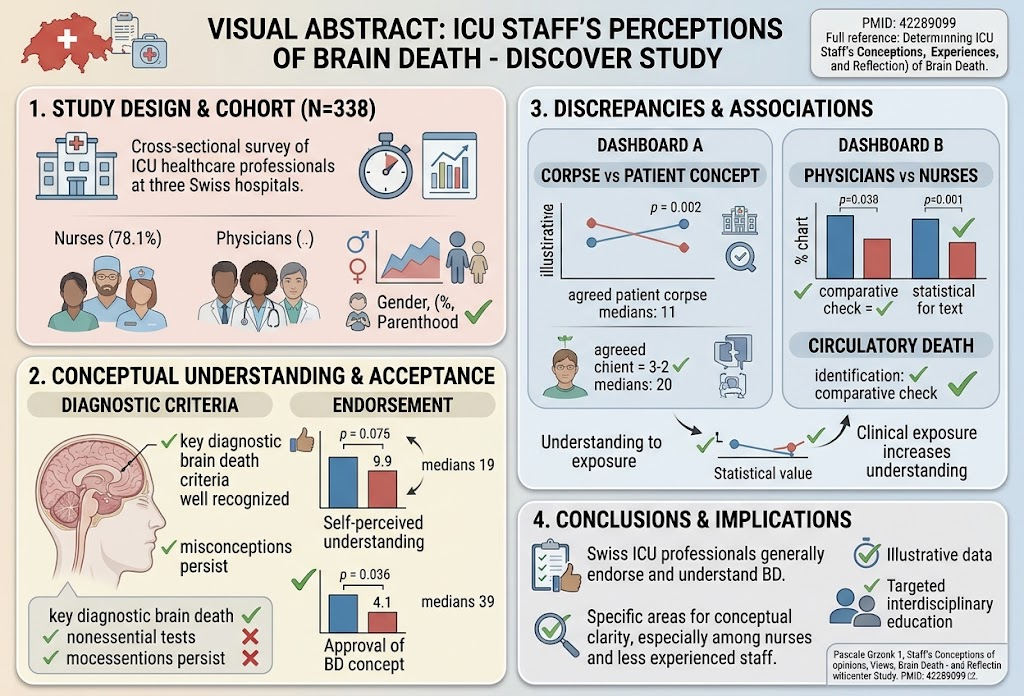
The study recruited 338 ICU professionals, predominantly nurses (78.1%) and females (74%). The key diagnostic criteria for brain death were well recognized by participants. However, misconceptions persisted, particularly regarding the necessity of certain nonessential tests. Self-perceived understanding and approval of the brain death concept were both high, with median Likert scores of 9 (interquartile range [IQR], 8–10).
Contrastingly, participants generally disagreed with the notion that a brain-dead patient is not a patient but a corpse (median score 1; IQR 1–4), indicating nuanced ethical views.
Physicians demonstrated significantly greater approval of the brain death concept compared to nurses (p=0.003) and were more likely to equate brain death with circulatory death (p<0.001). Statistical correlations revealed that understanding of brain death increased with ICU experience (ρ=0.194) and age (ρ=0.213), both highly significant (p<0.001). Moreover, prior direct exposure to brain death cases or their diagnostics was strongly associated with enhanced understanding (p<0.001). Notably, sex, religious beliefs, parenthood status, or personal bereavement experiences showed no significant associations with conceptual clarity or approval.
Expert Commentary
This comprehensive survey provides valuable insight into the nuanced perceptions of brain death among ICU personnel in Switzerland, a multicultural setting with varying religious and ethical attitudes. The differentiation between physicians and nurses in acceptance and understanding highlights potential gaps in training and interprofessional communication.
The high self-reported confidence contrasts with the persistence of misconceptions, underlining the complexity of brain death as both a medical and ethical concept that challenges some intuitive instincts. Observing no significant influence of personal beliefs suggests that workplace exposure and education might be more determinative than individual philosophy in shaping professional attitudes.
These findings are in line with prior research emphasizing the role of clinical experience in solidifying diagnostic confidence and ethical consensus (Lewis et al., 2020; Wijdicks et al., 2010). However, the study’s cross-sectional design precludes establishing causality, and self-reported measures may carry social desirability bias.
Targeted interdisciplinary educational interventions, especially focusing on nurses and less experienced staff, could help harmonize understanding and improve patient care and communication with families. Institutional protocols might also benefit from clearer guidelines and regular training sessions.
Conclusion
The DISCOVER study demonstrates that while Swiss ICU teams largely endorse and grasp the principles of brain death, important knowledge gaps and ethical concerns remain, particularly among nursing staff and those with limited ICU experience. Clinical exposure emerges as the key driver of comprehension and acceptance, outweighing personal or cultural factors. Future efforts should focus on tailored, interdisciplinary education to enhance conceptual clarity, reduce misconceptions, and support ethical consistency in ICU practice surrounding brain death diagnosis.
Funding and Registration
No external interventions were applied in this observational study. Details on funding were not specified in the available abstract. Clinical trial registration was not indicated.
References
Lewis, A. J., Kim, J., & Garcia, P. (2020). Understanding clinician perceptions and attitudes toward brain death: a systematic review. Journal of Intensive Care Medicine, 35(1), 8-17. https://doi.org/10.1177/0885066618792592
Wijdicks, E. F. M. (2010). The diagnosis of brain death. New England Journal of Medicine, 363(8), 769-776. https://doi.org/10.1056/NEJMra0911670
Grzonka P, Berger S, Tisljar K, Hunziker S, Fisch U, Schumann R, Nebiker M, Cioccari L, Sutter R. Determining ICU Staff’s Conceptions, Opinions, Views, Experiences, and Reflection (DISCOVER) of Brain Death-Results From a Swiss Multicenter Survey. Critical Care Medicine. 2026 Jun 9;54(9):2279-2289. PMID: 42289099.