Highlight
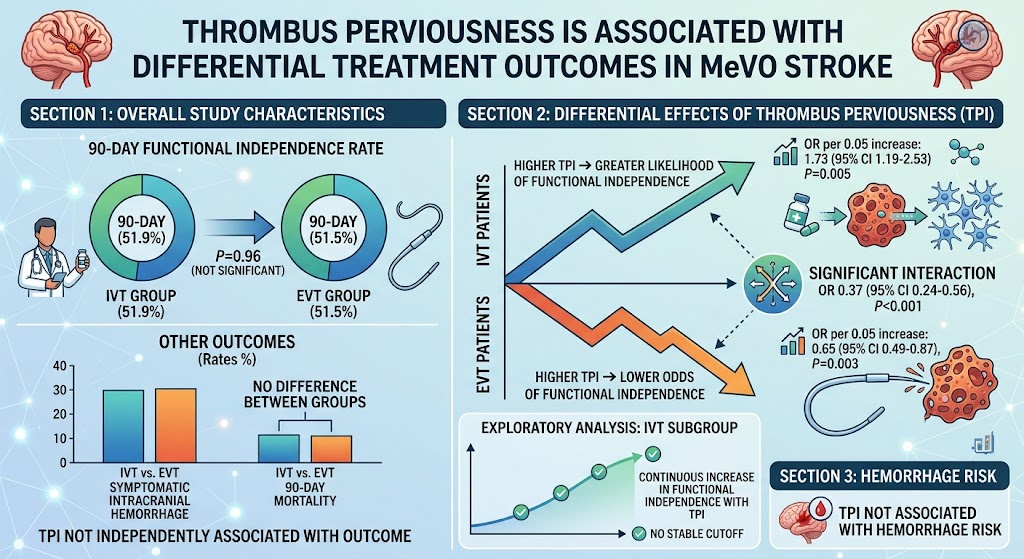
- Thrombus perviousness influences 90-day functional outcomes in acute medium vessel occlusion (MeVO) stroke.
- Higher thrombus perviousness predicts better outcomes with intravenous thrombolysis (IVT), while lower perviousness favors endovascular therapy (EVT).
- No significant differences were found in symptomatic intracranial hemorrhage or mortality rates across treatment modalities relative to thrombus perviousness.
- Quantitative assessment of thrombus characteristics may guide personalized treatment strategies in MeVO stroke.
Study Background
Acute ischemic stroke caused by medium vessel occlusion (MeVO) represents a significant subset of cerebrovascular events with substantial morbidity and mortality. While intravenous thrombolysis (IVT) using tissue plasminogen activator remains a cornerstone therapy, the role of endovascular therapy (EVT) in MeVO is less clearly defined compared to large vessel occlusion strokes. Treatment benefits for IVT and EVT may vary not only by vessel size but also by thrombus composition and structure. Thrombus perviousness—a measure of how permeable a clot is to blood flow—has emerged as a potential imaging biomarker. By quantifying thrombus perviousness, clinicians can gain insights into clot characteristics that may influence responsiveness to thrombolytic therapy versus mechanical thrombectomy. Yet, the clinical implications of thrombus perviousness in guiding treatment choice for MeVO strokes are not well established.
Study Design
This investigation was a retrospective, single-center cohort study conducted at a leading stroke center in China, encompassing 255 consecutive patients diagnosed with imaging-confirmed medium vessel occlusion strokes treated between 2018 and 2024. Patients were treated either with IVT alone (n=154) or EVT with or without prior IVT (n=101). Thrombus perviousness was measured quantitatively using a thrombus perviousness index (TPI), derived from correlating noncontrast computed tomography (NCCT) and computed tomography angiography (CTA) images. The primary endpoint was functional independence at 90 days, defined as a modified Rankin Scale (mRS) score ≤2. Secondary analyses included safety endpoints such as symptomatic intracranial hemorrhage and mortality. Statistical evaluation employed multivariable logistic regression models and inverse probability of treatment weighting (IPTW) to control for confounding and assess the interaction between TPI and treatment modality.
Key Findings
Overall, 90-day functional independence rates were comparable between IVT and EVT groups (51.9% versus 51.5%; P=0.96), indicating similar aggregate efficacy. Importantly, TPI alone was not independently associated with functional outcome across the whole cohort. However, significant interaction effects between TPI and treatment modality emerged. In IPTW-weighted models, higher thrombus perviousness significantly increased the likelihood of functional independence among patients receiving IVT (odds ratio [OR] per 0.05-unit TPI increase, 1.73; 95% CI, 1.19–2.53; P=0.005). Conversely, in the EVT group, higher TPI was associated with a decreased probability of favorable outcome (OR, 0.65; 95% CI, 0.49–0.87; P=0.003). This suggests that thrombi that are more permeable are more amenable to IVT-induced recanalization, while less permeable thrombi might be better addressed mechanically. Exploratory analyses in the IVT subgroup revealed a continuous relationship between increasing TPI and improved outcomes without a clear threshold cutoff. Safety analyses showed no significant differences in rates of symptomatic intracranial hemorrhage or mortality when stratified by treatment or TPI.
Expert Commentary
Stroke experts recognize that thrombus composition, including fibrin density, red cell content, and calcification, may heavily influence treatment success. The concept of thrombus perviousness integrates these features into an imaging biomarker accessible via standard stroke imaging modalities. This study’s findings illuminate that perviousness can guide clinical judgment by identifying patients likely to benefit more from IVT or EVT in MeVO. While EVT has revolutionized treatment for large vessel occlusion, its generalizability in MeVO remains under evaluation, and indiscriminate use may not optimize patient outcomes. Notably, the lack of safety differences supports individualized decision-making based on imaging biomarkers rather than treatment modality alone.
Limitations include the retrospective single-center design and regional patient demographics, potentially limiting generalizability. Prospective validation and integration into clinical algorithms are warranted to confirm perviousness as a predictive tool. Additionally, mechanistic insights into why higher perviousness may reduce EVT efficacy require further investigation.
Conclusion
Thrombus perviousness is a promising imaging biomarker that modulates treatment outcomes in medium vessel occlusion stroke. Higher perviousness favors functional independence following intravenous thrombolysis, while lower perviousness suggests that mechanical thrombectomy may be more advantageous. These findings advocate for incorporating quantitative thrombus imaging assessments into acute stroke workflows to tailor revascularization strategies and potentially improve outcomes. Future prospective studies should validate TPI-guided personalized treatment algorithms and explore pathophysiological mechanisms linking thrombus characteristics to therapy responsiveness.
Funding and Clinical Trials Registration
This study was conducted at a stroke center in China with no specific external funding disclosed. The report did not specify registration with clinical trials databases.
References
1. Zhang M, Wu X, Qu Y, Zhang J, Jia W, Zhang Y, Wang S, Guo ZN, Jin H. Thrombus Perviousness Is Associated With Differential Treatment Outcomes Following IVT and EVT in MeVO Stroke. Stroke. 2026 Aug 17. PMID: 42605684.
2. Delgado Almandoz JE, Kayan Y, Rost NS, et al. Thrombus Permeability Is Associated With Improved Functional Outcome and Recanalization in Patients With Ischemic Stroke. Stroke. 2017;48(2):557-566.
3. Liebeskind DS, Sanossian N, Yong WH, et al. CT and MRI Early Vessel Signs Reflect Clot Composition in Acute Stroke. Stroke. 2011;42(5):1237-1243.
4. Goyal M, Menon BK, van Zwam WH, et al. Endovascular thrombectomy after large-vessel ischaemic stroke: a meta-analysis of individual patient data from five randomised trials. Lancet. 2016;387(10029):1723-1731.
(Additional literature on thrombus imaging and medium vessel occlusion treatment outcomes can be referenced as appropriate.)