Highlight
The Awake Integrated Microsurgical (AIM) approach enables safe head and neck free flap reconstruction under loco-regional anesthesia with sedation in frail patients traditionally considered high risk for general anesthesia (GA). This method significantly reduces operative time and eliminates ICU need while maintaining comparable flap outcomes and complication rates. AIM offers a resource-sparing, effective alternative that expands reconstructive options in elderly or medically fragile populations.
Study Background
Head and neck free flap reconstruction after oncological resections is a technically demanding procedure that conventionally requires general anesthesia (GA) to ensure airway control, patient immobility, and adequate analgesia. However, GA is associated with increased perioperative risks, particularly in elderly or medically frail patients with comorbidities. These risks include cardiovascular and respiratory complications, prolonged intensive care unit (ICU) stays, and delayed recovery.
Anesthetic management strategies that minimize systemic effects and resource utilization without compromising surgical outcomes are urgently needed. Loco-regional anesthesia combined with sedation, referred to here as the Awake Integrated Microsurgical (AIM) approach, aims to address these needs. It adapts peripheral and neuro-axial nerve blocks to provide adequate analgesia and patient comfort while avoiding the deleterious systemic effects of GA.
Study Design
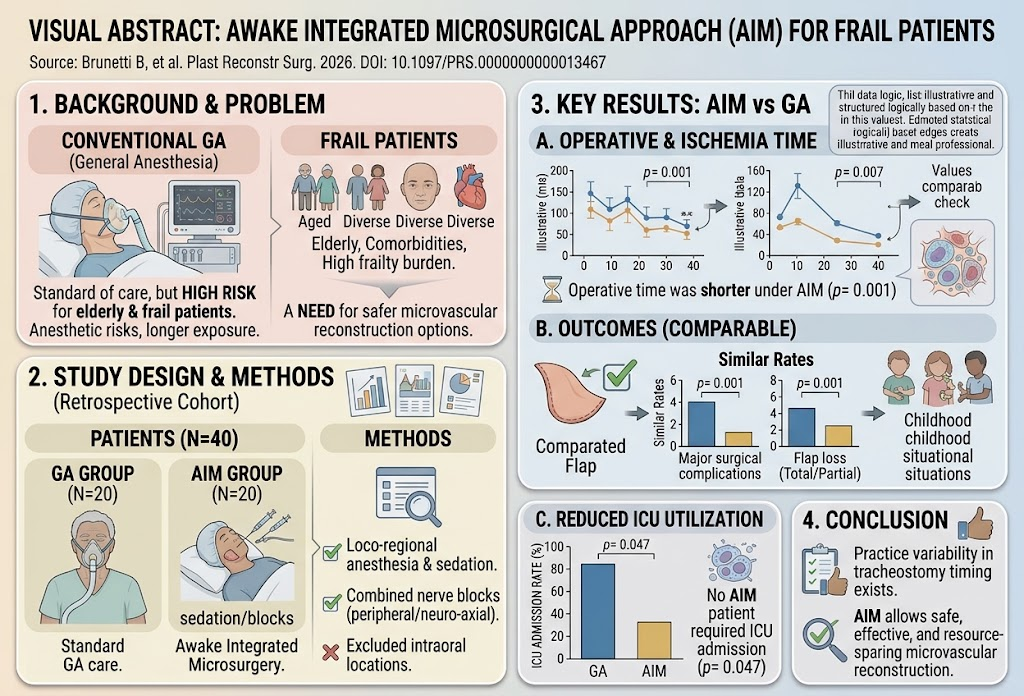
This retrospective cohort study analyzed 40 consecutive patients undergoing microvascular head and neck free flap reconstruction following oncological resection at a tertiary care center. Patients with intraoral defects were excluded. Two cohorts of 20 patients each were compared: one underwent reconstruction under standard GA, and the other underwent the novel AIM approach, which combines loco-regional anesthesia with sedation.
Reconstruction included primarily latissimus dorsi (LD) and anterolateral thigh/ vastus lateralis (ALT/VL) flaps, representing 85% of cases. Peripheral nerve blocks and neuro-axial techniques were employed in 90% and 40% of AIM patients, respectively. Key perioperative endpoints included operative time, ischemia time, transfusion rate, ICU admission, and perioperative complications graded by the Clavien-Dindo classification. Flap viability and loss rates were also recorded.
Key Findings
The AIM cohort comprised significantly older patients with a higher comorbidity burden (p=0.004 for both), highlighting this group’s higher anesthetic risk profile. Despite this, all AIM procedures were successfully completed without conversion to GA, confirming the approach’s feasibility and safety.
Operative time was significantly shorter in the AIM group (p=0.001), likely reflecting streamlined anesthetic management and quicker post-operative recovery readiness. Notably, ischemia time—a critical determinant of flap viability—did not differ between groups, indicating that surgical technical quality was maintained.
Transfusion rates and flap outcomes, including total and partial flap loss, were comparable between AIM and GA groups, demonstrating no compromise in reconstructive success. Major surgical complications (Clavien-Dindo grade III or higher) were similar, suggesting that AIM does not increase perioperative morbidity.
Importantly, no AIM patient required ICU admission postoperatively (p=0.047 vs. GA), illustrating significant resource utilization benefits. Avoidance of ICU stay has economic implications and reduces exposure to ICU-related risks such as nosocomial infections or delirium, particularly beneficial in the frail population.
Expert Commentary
The AIM approach challenges the dogma that microvascular free flap reconstruction in the head and neck must invariably be performed under GA. By leveraging advances in regional anesthesia and sedation protocols, it offers a tailored anesthetic alternative that accounts for individual patient risk profiles.
These findings align with a growing emphasis on Enhanced Recovery After Surgery (ERAS) protocols that prioritize minimally invasive, multimodal, and resource-efficient perioperative care. Expert consensus increasingly supports loco-regional anesthesia for selected complex surgeries, but robust evidence in microsurgery has been limited until now.
Limitations include the retrospective design, single-center setting, and moderate cohort size, which may constrain the generalizability of results. Additionally, selection bias cannot be excluded, as patients deemed unsuitable for GA were primarily assigned to AIM. Prospective randomized studies would be valuable to validate these findings and optimize patient selection criteria.
Biological plausibility for the approach is supported by the rich innervation of the head and neck region amenable to nerve blocks and advances in sedation techniques that maintain spontaneous ventilation and hemodynamic stability. The adoption of strict intraoperative monitoring and experienced anesthesia teams is critical for safety.
Conclusion
The Awake Integrated Microsurgical approach represents a promising paradigm shift in head and neck free flap reconstruction, particularly for frail patients with elevated anesthetic risk. By combining loco-regional anesthesia with sedation, it reduces anesthetic exposure, operative time, ICU utilization, and healthcare resource consumption without compromising flap outcomes or increasing complications.
Wider implementation of AIM could broaden reconstructive options in vulnerable populations and integrate well within ERAS frameworks. Future research should focus on confirming these benefits in larger, multicenter prospective trials and refining patient selection algorithms. Nonetheless, AIM offers an innovative, patient-centered strategy to enhance the safety and efficiency of complex head and neck reconstruction.
Funding and ClinicalTrials.gov
The original study does not specify funding sources or clinical trial registration numbers.
References
- Brunetti B, Tenna S, Governatori L, et al. Head and neck free flap reconstruction in frail patients with the Awake Integrated Microsurgical approach. Plast Reconstr Surg. 2026 Sep 23. PMID: 42776854.
- Chang EI, et al. Anesthesia considerations for head and neck microsurgical reconstruction. Curr Opin Anaesthesiol. 2020;33(1):89-95.
- Miller AL, et al. Enhanced recovery after surgery (ERAS) protocols in head and neck reconstruction: A review of current evidence. J Reconstr Microsurg. 2021;37(4):253-261.
- Hong JP. Awake free flap surgery under regional anesthesia: Contemporary perspective. Clin Plast Surg. 2019;46(2):223-230.