Highlights
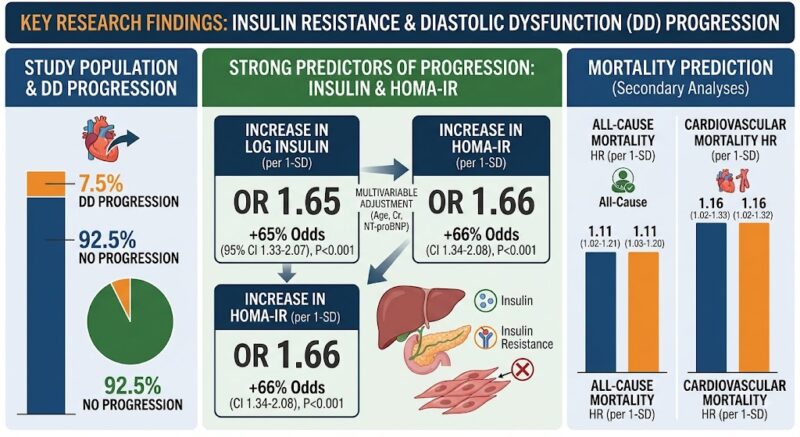
- Elevated endogenous insulin and insulin resistance independently predict progressive diastolic dysfunction (DD) over four years, preceding overt diabetes onset.
- Insulin dysregulation associates with increased long-term all-cause and cardiovascular mortality, even after adjusting for body mass index and other confounders.
- Metabolic perturbations may initiate myocardial stiffening and impaired relaxation in early preclinical stages, offering a potentially actionable window to prevent heart failure with preserved ejection fraction (HFpEF).
- Findings suggest integration of insulin resistance assessment in cardiovascular risk stratification and highlight the need for therapeutic strategies targeting metabolic abnormalities to halt DD progression.
Background
Heart failure with preserved ejection fraction (HFpEF) constitutes nearly half of heart failure (HF) cases and is characterized by diastolic dysfunction (DD), especially myocardial stiffening and impaired ventricular relaxation. Diabetes mellitus is a recognized risk factor for HFpEF; however, the temporal association and mechanistic role of antecedent metabolic abnormalities such as hyperinsulinemia and insulin resistance remain less clear. Identifying early metabolic predictors of DD progression before overt hyperglycemia could enable preventive strategies targeting this high-risk population. This review synthesizes recent evidence, with focus on the Olmsted County Heart Function Study, and contextualizes findings within the broader pathophysiological and clinical landscape linking insulin dysregulation to cardiovascular outcomes.
Key Content
Chronological Development of Evidence Linking Insulin Resistance and Diastolic Dysfunction
Early observational studies in the 2000s highlighted that insulin resistance, even in non-diabetic individuals, correlated with echocardiographic markers of DD, prompting hypotheses that metabolic dysfunction may impair myocardial relaxation and compliance via mechanisms including myocardial fibrosis, microvascular dysfunction, and altered calcium handling. Prospective cohorts with long-term follow-up were limited.
A landmark 2026 Olmsted County cohort study by Adel et al. provided robust prospective data linking fasting endogenous insulin and homeostatic model assessment of insulin resistance (HOMA-IR) to DD progression over 4 years. Among 1191 middle-aged adults, 7.5% demonstrated worsening DD. Significant associations persisted after multivariate adjustment including age, renal function, and NT-proBNP. Notably, every 1-standard deviation increase in log-transformed insulin increased odds of DD progression by 65%. These data suggest insulin resistance as an antecedent driver of subclinical myocardial dysfunction.
Metabolic and Mechanistic Pathways
Experimental and clinical studies have elucidated multiple mechanisms by which hyperinsulinemia and insulin resistance impair myocardial diastolic function:
- Myocardial Stiffness: Insulin resistance promotes cardiomyocyte hypertrophy and interstitial fibrosis through increased transforming growth factor-beta signaling and extracellular matrix remodeling, increasing ventricular stiffness.
- Microvascular Dysfunction: Endothelial insulin resistance impairs nitric oxide bioavailability, fostering coronary microvascular rarefaction and ischemia, which compromise relaxation.
- Metabolic Shift: Insulin resistance alters substrate utilization, favoring lipotoxicity and mitochondrial dysfunction, reducing myocardial energy efficiency critical for diastolic performance.
- Inflammation and Oxidative Stress: Chronic low-grade inflammation and oxidative stress induced by insulin resistance augment myocardial damage and fibrosis.
These pathobiological insights integrate well with clinical observations, underscoring a convergent model wherein metabolic dysregulation drives progressive DD before diabetes actually develops.
Evidence by Disease Stage and Outcomes
From a clinical staging perspective, elevated endogenous insulin and HOMA-IR identify individuals in a prediabetic or early metabolic dysregulation state with an increased risk of DD progression. This progression presages overt HFpEF development, as DD is a hallmark criterion. Longitudinal follow-up extending beyond 10 years in the Olmsted cohort confirmed that baseline insulin and insulin resistance significantly predicted all-cause and cardiovascular mortality. Hazard ratios per 1-SD rise in insulin or HOMA-IR ranged ~1.11 to 1.16 after adjustment, confirming independent prognostic value.
Complementary studies have reported that insulin resistance correlates not only with DD but also incident heart failure hospitalization and adverse cardiovascular events independent of glycemic status. These findings highlight insulin resistance as a modifiable upstream risk factor.
Therapeutic Implications and Research Advances
Currently, HFpEF treatment remains challenging, with limited evidence-based pharmacotherapies specifically addressing DD progression. Given the emerging role of insulin resistance in early DD, metabolic-targeted interventions might offer novel prevention or delay strategies. Interventions such as lifestyle modifications, weight loss, and insulin sensitizers (e.g., metformin, GLP-1 receptor agonists, SGLT2 inhibitors) are under investigation for their cardiovascular benefits in at-risk populations.
Recent randomized controlled trials (e.g., EMPEROR-Preserved, DELIVER) demonstrated that SGLT2 inhibitors improve HF outcomes even in non-diabetic patients, suggesting benefits may relate partially to improved myocardial metabolism and diastolic parameters. However, specific trials focusing on insulin resistance reduction for DD prevention are warranted.
Expert Commentary
The study by Adel et al. significantly advances understanding of the metabolic antecedents to DD and HFpEF. The strength lies in the community-based design, comprehensive echocardiographic assessment, and longitudinal follow-up exceeding a decade for mortality and HF outcomes. Their findings importantly demonstrate that insulin resistance is not merely a diabetes-associated phenomenon but an independent risk marker predating symptomatic HF.
Clinicians should consider incorporating insulin resistance metrics, including fasting insulin and HOMA-IR, into cardiovascular risk profiling, particularly for middle-aged adults with metabolic syndrome features but normoglycemia. This approach can identify patients who may benefit from early interventions aimed at improving insulin sensitivity.
Nonetheless, challenges remain. The observational design cannot prove causality definitively, and residual confounding by other metabolic factors is possible. Furthermore, the precise mechanistic links require further elucidation through functional imaging, biomarker studies, and myocardial tissue characterization.
Therapeutic translation necessitates prospective interventional trials targeting insulin resistance with standardized diastolic function endpoints to establish causality and inform guidelines.
Conclusion
Accumulating evidence positions elevated endogenous insulin and insulin resistance as key predictors of progressive diastolic dysfunction and poor cardiovascular outcomes, independent of established risk factors and body mass index. These insights underscore the fundamental role of metabolic dysregulation in myocardial stiffening prior to overt diabetes and HFpEF manifestation.
Early identification and targeted management of insulin resistance represent promising strategies to delay or prevent DD progression and reduce long-term cardiovascular mortality. Future research should prioritize mechanistic studies and interventional trials to refine these approaches, ultimately improving cardiovascular health in at-risk populations.
References
- Adel FW, Gochanour B, Scott C, Singh J, Malsawmzuali JC, Ma X, Chen HH. Elevated Endogenous Insulin and Insulin Resistance Are Associated With Progressive Diastolic Dysfunction and Worse Cardiovascular Outcomes. Circ Heart Fail. 2026 Aug 10;e014410. PMID:42572892
- Shah SJ, Kitzman DW, Borlaug BA, et al. Phenotype-Specific Treatment of Heart Failure with Preserved Ejection Fraction: A Multiorgan Roadmap. Circulation. 2016;134(1):73-90.
- Lam CSP, Donal E, Kraigher-Krainer E, Vasan RS. Epidemiology and clinical course of heart failure with preserved ejection fraction. Eur J Heart Fail. 2018;20(10):1324-1332.
- Shaffer M, et al. Metabolic Dysfunction in Diastolic Heart Failure: Implications for Treatment. Circ Heart Fail. 2020;13(3):e006215.
- Santos-Gallego CG, et al. Targeting Metabolic Modulation for the Treatment of Heart Failure. Circ Res. 2019;124(1):258-268.
- Solomon SD, et al. Effect of Empagliflozin on Heart Failure Outcomes in Patients With Preserved Ejection Fraction: The EMPEROR-Preserved Trial. N Engl J Med. 2021;385(16):1451-1461.
- Andersen MJ, et al. GLP-1 Receptor Agonists in Cardiometabolic Disease: Effects on Cardiovascular and Renal Outcomes. J Am Coll Cardiol. 2021;77(23):2878-2893.