Highlights
- Adults with subvalvular aortic stenosis (SAS) show relatively stable stenosis progression over long-term follow-up, with slow or absent peak velocity increases.
- Patients with prior SAS repair have lower survival compared to unoperated patients, reflecting a more severe disease phenotype and higher clinical event burden.
- The incidence of reoperation for aortic regurgitation (AR) post-SAS repair is appreciable, emphasizing the importance of careful valve surveillance.
- Longitudinal echocardiographic follow-up can potentially be less intensive in mild SAS phenotypes without significant AR, shifting clinical focus towards management of associated complications.
Background
Subvalvular aortic stenosis (SAS) is a congenital or acquired left ventricular outflow tract obstruction characterized by a fibrous or fibromuscular ridge below the aortic valve leading to increased pressure gradients and potential adverse cardiac sequelae. Although commonly diagnosed and treated in childhood, SAS persists or presents in adulthood and may be associated with progressive obstruction, aortic valve dysfunction, arrhythmias, and heart failure. The clinical course in adults is less well characterized compared to pediatric cohorts, with unmet needs regarding optimal surveillance intervals, predictors of disease progression, and long-term outcomes including survival and morbidity.
Key Content
Chronological Development of Evidence
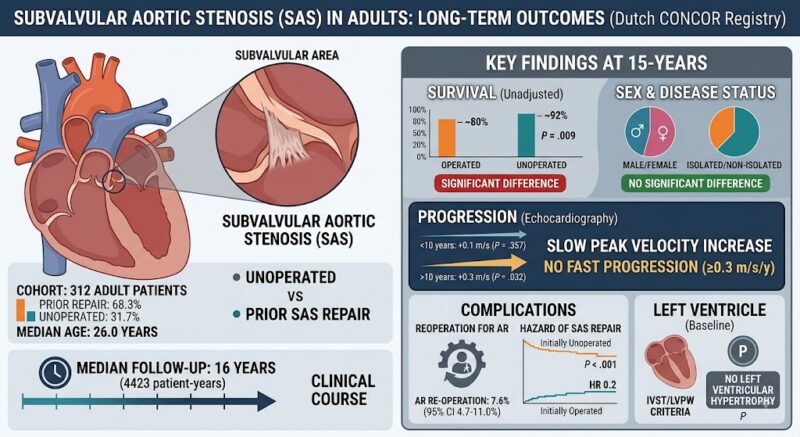
Recent large-scale prospective cohort data from the Dutch Congenital Cor Vitia (CONCOR) registry (de Keijzer et al., 2026) provide comprehensive insights into adult SAS clinical trajectory. Over a median follow-up of 16 years, 312 adult SAS patients with a median age of 26 years were evaluated, including both operated (68.3%) and unoperated individuals. This study offers longitudinal evidence on echocardiographic parameters, survival, reoperation incidence, and cardiovascular events including arrhythmias and heart failure.
Complementary pediatric data (McMurtry et al., 2015) have previously illuminated risk factors for reoperation and AR after discrete subaortic stenosis (DSS) resection, underscoring the role of preoperative gradient and anatomical proximity of the obstruction to the aortic valve. While survival remains favorable in pediatrics, these findings contextualize risk strata that inform adult follow-up and intervention timing.
Clinical Outcomes in Adults with SAS
Survival outcomes demonstrate that operated adult SAS patients have significantly lower 15-year survival compared to their unoperated counterparts (P = .009), potentially reflecting selection of more severe phenotypes for surgery. No significant survival difference was noted by sex or isolated versus non-isolated SAS status.
The cumulative incidence of (re-)operation for aortic regurgitation was notable at 7.6% within 15 years, suggesting AR remains a critical long-term complication necessitating vigilance. Hazard analysis highlights a substantially higher risk of undergoing SAS repair among initially unoperated patients during follow-up (HR 0.2, P < .001), affirming the progressive nature of the lesion in select cases.
Cardiovascular events including arrhythmias and heart failure contribute to the long-term morbidity burden. These comorbidities mandate integrated management strategies beyond hemodynamic obstruction alone.
Echocardiographic Progression and Remodeling
Longitudinal echocardiographic analysis reveals a mean peak velocity progression of 0.1 m/s in the first decade post-enrolment and 0.3 m/s during the subsequent period, with no instances of rapid progression defined as ≥0.3 m/s/year. This stability in peak velocity contrasts with more aggressive stenosis phenotypes and suggests a relatively indolent natural history in many adults.
Importantly, criteria for left ventricular hypertrophy based on interventricular septal thickness (IVST) and left ventricular posterior wall thickness (LVPW) showed no hypertrophic remodeling at baseline, signifying limited compensatory myocardial changes despite chronic outflow obstruction.
Risk Factors and Surgical Considerations
Pediatric studies emphasize younger age at resection, high preoperative gradients, and anatomical parameters such as membrane distance to the valve as predictors for reoperation and AR (McMurtry et al., 2015). These risk factors likely extrapolate to adult outcomes, highlighting the necessity for individualized risk stratification.
Surgical management aims to relieve obstruction and mitigate valve damage but carries risks of residual obstruction and progression of aortic regurgitation. The rate of reoperations in adult cohorts underscores the need for diligent postoperative surveillance.
Expert Commentary
The differential survival observed between operated and unoperated adult SAS patients likely reflects baseline disease severity bias, as surgery is typically reserved for patients with more significant obstruction or symptomatic disease. This selection bias should inform interpretation of outcomes and patient counseling.
The relatively slow progression of obstruction supports current European Society of Cardiology (ESC) guidelines recommending periodic echocardiographic follow-up, with consideration for extending surveillance intervals in patients with mild obstruction and absence of AR.
The emergence and progression of aortic regurgitation as a significant cause of morbidity highlights a need for enhanced valve-focused assessment, including multimodality imaging to detect early valvular dysfunction and subtle morphological changes.
Mechanistically, the fibromuscular subvalvular ridge, combined with altered flow dynamics, may contribute to aortic valve leaflet stress and subsequent regurgitation. Understanding the interaction of hemodynamic factors with myocardial remodeling remains an important translational research domain.
Controversies persist regarding optimal timing for surgical intervention to balance risks of progressive obstruction and valve damage against operative morbidity. The stability of obstruction in adults suggests watchful waiting may be appropriate in select mild cases; however, individualized risk assessment remains paramount.
Conclusion
Adult subvalvular aortic stenosis exhibits a relatively stable hemodynamic course with limited progression of peak velocity over two decades in most patients. Those with prior surgical repair constitute a higher-risk phenotype with reduced survival and elevated long-term morbidity, including AR requiring reoperation.
These findings advocate for a tailored surveillance approach, potentially reducing echocardiographic frequency in mild SAS without AR while maintaining vigilance for clinical sequelae such as arrhythmias and heart failure. Multidisciplinary management incorporating cardiology, imaging, and cardiac surgery teams is essential to optimize outcomes.
Future research should focus on refining risk stratification markers, delineating mechanistic pathways of valve degeneration in SAS, and evaluating novel medical and surgical interventions to improve long-term prognosis.
References
- de Keijzer AR, Meccanici F, Keuning ZA, et al. Subvalvular aortic stenosis in adults: clinical course and long-term outcomes. Eur Heart J. 2026;47(29):3920-3934. doi:10.1093/eurheartj/ehaf1078. PMID: 41635281
- McMurtry MS, Dave HB, McGowan FX Jr, et al. Long-term outcomes and risk factors for aortic regurgitation after discrete subvalvular aortic stenosis resection in children. Heart. 2015;101(19):1547-1553. doi:10.1136/heartjnl-2015-307460. PMID: 26238147
- European Society of Cardiology (ESC) Guidelines for the management of adult congenital heart disease. Eur Heart J. 2020;41(6):567-645.