Highlights
- Once-weekly semaglutide 2.4 mg induces robust and clinically meaningful bodyweight reduction in Chinese adults with overweight or obesity, including those with type 2 diabetes.
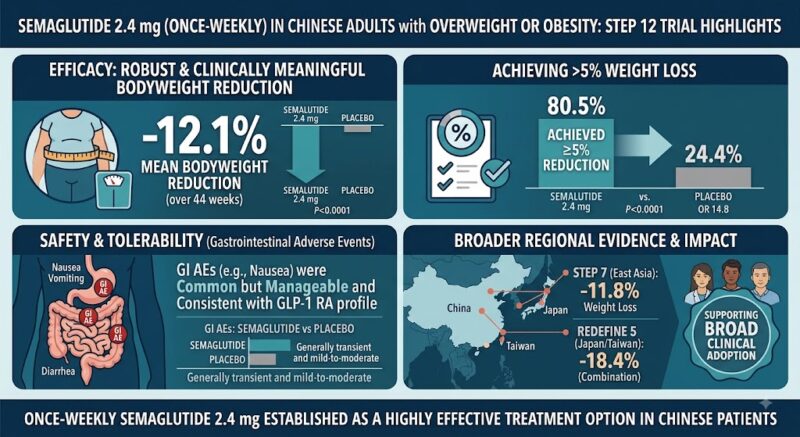
- The STEP 12 trial demonstrated a weight loss of approximately 12.1% over 44 weeks, significantly outperforming placebo with strong statistical confidence.
- Gastrointestinal adverse events are common but consistent with the known safety profile of semaglutide and are generally manageable.
- Additional studies including STEP 7 and REDEFINE 5 confirm the efficacy of semaglutide alone or in combination therapies in East Asian populations, supporting its broader clinical adoption.
Background
Obesity and overweight are major contributors to cardiometabolic diseases globally and within Chinese populations, posing significant public health challenges. The prevalence of overweight (BMI ≥ 24 kg/m2) and obesity (BMI ≥ 28 kg/m2) in China continues to rise, accompanied by increasing rates of type 2 diabetes mellitus (T2DM) and weight-associated comorbidities such as hypertension and dyslipidemia. Traditional lifestyle interventions often yield inadequate long-term weight management outcomes. Glucagon-like peptide-1 receptor agonists (GLP-1 RAs) have emerged as effective pharmacotherapies for obesity and T2DM due to their effects on satiety, gastric emptying, and glycemic control. Semaglutide, a once-weekly GLP-1 RA, was approved for weight management at a dose of 2.4 mg, based on global trials demonstrating substantial weight loss. However, data specific to Chinese populations, considering locally relevant BMI thresholds and cardiometabolic risk profiles, have been limited, necessitating focused clinical trials like STEP 12 to inform regional practice.
Key Content
STEP 12 Trial: Methodology and Outcomes
The STEP 12 trial (NCT06041217) was a randomized, double-blind, placebo-controlled, phase 3b study conducted across 19 sites in mainland China and Taiwan. It enrolled adults with overweight (BMI 24-<28 kg/m2 plus ≥1 weight-related comorbidity) or obesity (BMI 28-<30 kg/m2), with or without T2DM. Participants were randomized 2:1 to receive once-weekly subcutaneous semaglutide 2.4 mg or placebo plus lifestyle intervention over 44 weeks.
Primary endpoints were:
– Percentage change in bodyweight from baseline.
– Proportion of participants achieving at least 5% bodyweight reduction.
Findings revealed:
– Mean bodyweight change was -12.1% (SE 0.6) with semaglutide versus -2.2% (SE 0.8) with placebo.
– Estimated treatment difference was -9.9 percentage points (95% CI, -11.8 to -8.0, p<0.0001).
– 80.5% achieved ≥5% weight loss versus 24.4% in placebo (OR 14.8; 95% CI, 7.4 to 29.6; p<0.0001).
– Adverse events were more frequent with semaglutide (87.6%) than placebo (75.3%), predominantly gastrointestinal (nausea, vomiting, diarrhea).
Other East Asian Trials Supporting Semaglutide Efficacy
The efficacy and safety of semaglutide in East Asian populations are further supported by the STEP 7 trial (NCT04251156) and the REDEFINE 5 trial. In STEP 7, involving predominantly East Asian adults including Chinese participants, semaglutide achieved an average weight reduction of 11.8% compared with 3.5% in placebo at 44 weeks, with 85.4% reaching at least 5% weight loss. Adverse events were consistent with the known GLP-1 RA profile.
REDEFINE 5 compared co-administration of cagrilintide and semaglutide against semaglutide alone in Japanese and Taiwanese adults, showing enhanced efficacy (18.4% vs 11.9% weight loss at week 68) while maintaining comparable safety.
Semaglutide in Special Populations and Concomitant Therapies
A randomized trial evaluating semaglutide plus metformin in overweight/obese women with polycystic ovary syndrome (PCOS) demonstrated superior weight loss and improved metabolic and reproductive outcomes compared to metformin alone, underscoring semaglutide’s broader applications within metabolic disorders prevalent in Chinese populations.
Emerging Therapeutics: Novel agents such as mazdutide, a glucagon and GLP-1 receptor co-agonist, are under investigation for enhanced efficacy against semaglutide in people with obesity and T2DM in China, reflecting ongoing innovation in the pharmacologic landscape.
Expert Commentary
The STEP 12 trial robustly confirms semaglutide 2.4 mg’s efficacy in Chinese adults with overweight or obesity using tailored BMI thresholds per regional standards. Weight loss magnitudes and proportion achieving clinically meaningful weight reduction match or exceed results in global populations, supporting cross-ethnic applicability.
The gastrointestinal side-effect profile, while frequent, is consistent with previous trials and generally transient. These manageable adverse effects, alongside semaglutide’s once-weekly dosing, favor treatment adherence.
Notably, the exclusion of individuals with BMI ≥30 kg/m2 but the inclusion of those with lower BMI yet with comorbidities reflects regional epidemiological and guideline distinctions, emphasizing the importance of local evidence generation.
The demonstrated cardiometabolic benefits of semaglutide, including potential improvements in glycemic control especially in participants with T2DM, are relevant given the high burden of diabetes in China. Combination therapies and emerging co-agonists like cagrilintide and mazdutide may further optimize outcomes.
Clinicians should consider semaglutide as part of a comprehensive weight management strategy, integrated with lifestyle modification. Continued real-world studies and long-term safety data are warranted to consolidate these pivotal phase 3 findings.
Conclusion
Evidence from STEP 12 and corroborating East Asian trials establishes once-weekly semaglutide 2.4 mg as a highly effective and generally well-tolerated option for weight management in Chinese adults with overweight or obesity. Its ability to achieve substantial weight loss, coupled with cardiometabolic improvements, addresses an unmet need within this population characterized by distinctive obesity phenotypes and comorbidity profiles.
Future research should explore semaglutide’s impact on long-term cardiovascular outcomes, comparative effectiveness against novel dual agonists, and its role across broader indications such as metabolic syndrome and PCOS.
References
- Guo L, Bao X, Huang KC, et al. Efficacy and safety of once-weekly semaglutide 2·4 mg in Chinese adults with overweight or obesity (STEP 12): a randomised, double-blind, placebo-controlled, multicentre, phase 3b trial. Lancet Diabetes Endocrinol. 2026 Aug 10. doi:10.1016/S2213-8587(26)00133-6. PMID:42575111.
- Yoshino M, Hashimoto Y, Ueno T, et al. Efficacy and safety of co-administered cagrilintide and semaglutide vs semaglutide alone in adults with overweight or obesity in Japan and Taiwan (REDEFINE 5): a phase 3a trial. Lancet Diabetes Endocrinol. 2026 Jun;14(6):450-462. doi:10.1016/S2213-8587(25)00402-4. PMID:42009015.
- Gu W, Bao Y, Lu Y, et al. Efficacy and safety of once-weekly semaglutide 2.4 mg for weight management in participants from China: prespecified analysis of STEP 7 trial. Diabetes Obes Metab. 2025 May;27(5):2540-2551. doi:10.1111/dom.16253. PMID:40069849.
- Wang S, Lin Y, Zhang C, et al. Effects of combined metformin and semaglutide therapy on body weight, metabolic parameters, and reproductive outcomes in overweight/obese women with PCOS: a randomized controlled trial. Reprod Biol Endocrinol. 2025 Jul 26;23(1):108. doi:10.1186/s12958-025-01447-3. PMID:40713699.
- Zhang Z, Chen W, Pang S, et al. Mazdutide versus Semaglutide for T2D and Obesity: rationale and design of DREAMS-3 phase 3 trial. Contemp Clin Trials. 2026 Jan;160:108150. doi:10.1016/j.cct.2025.108150. PMID:41260459.