Highlights
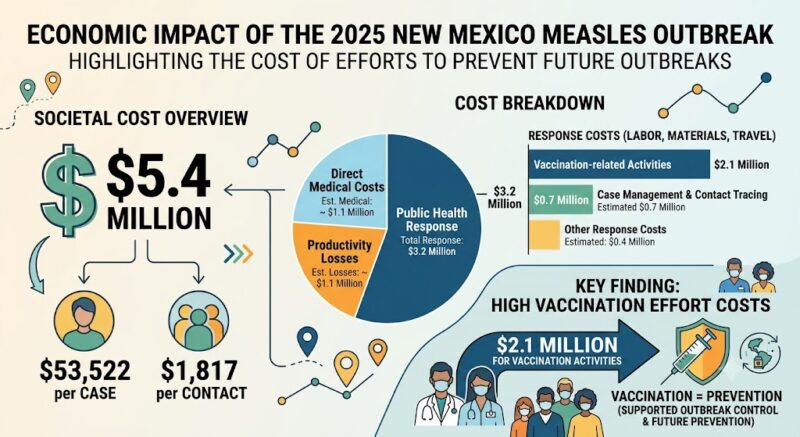
- The 2025 New Mexico measles outbreak incurred an estimated societal cost of $5.4 million, emphasizing the substantial financial burden of measles outbreaks even in developed settings.
- Vaccination-related public health activities constituted the largest portion of response costs ($2.1 million), underscoring investment in immunization as a critical outbreak control strategy.
- Direct medical costs and productivity losses further contributed to the total economic burden, highlighting multisectoral impact involving healthcare systems and communities.
- Comprehensive cost analyses like this study provide key data for policymakers to optimize resource allocation for outbreak preparedness and immunization programs.
Background
Measles, a highly contagious vaccine-preventable viral disease, remains a public health challenge worldwide despite the availability of an effective vaccine. In the United States, measles elimination was declared in 2000; however, periodic outbreaks continue to occur, often linked to importations and gaps in vaccination coverage. The year 2025 witnessed the highest number of cases in the United States since 1992, highlighting vulnerabilities in herd immunity and the resurgence potential of measles. In New Mexico, 100 confirmed cases across nine counties and one death underscore both health and economic impacts. Understanding the full economic burden encompassing public health response costs, medical expenses, and productivity losses is crucial for guiding prevention strategies.
Key Content
Economic Burden Analysis
The primary study by Pike et al. (2026) performed a societal cost analysis of the New Mexico measles outbreak spanning February to September 2025. The analysis encompassed three broad cost categories: public health response costs (labor, materials, and travel), direct medical costs (derived from third-party payer data), and productivity losses (due to illness, isolation, quarantine, and caregiving).
The overall societal cost was estimated at $5.4 million, translating to approximately $53,522 per confirmed measles case and $1,817 per contact exposed. This magnitude signals a nontrivial financial impact on both the healthcare system and broader society.
Public Health Response and Vaccination Activities
Vaccination-related interventions accounted for the largest fraction of public health expenditures at about $2.1 million out of the $3.2 million total public health response cost. This included costs associated with mass vaccination campaigns, distribution logistics, vaccine administration, and related personnel time.
Additionally, activities such as case management and contact tracing, which are essential components to limit virus spread during outbreaks, contributed significantly to labor and operational expenses. The engagement of 133 public health responders highlights the labor-intensity and resource demands during outbreak containment.
Direct Medical Costs and Productivity Losses
Direct medical costs stemmed from third-party insurance data rather than actual billing, which may introduce limitations in precision but offers an actionable proxy. Although certain healthcare expenses were excluded (e.g., long-term complications or costs for uninsured individuals), the captured data still reflect meaningful healthcare utilization associated with measles cases.
Productivity losses accounted for costs due to patient illness, isolation, quarantine of contacts, and caregiving responsibilities. These indirect costs amplify the societal effects of outbreaks, extending economic consequences beyond direct healthcare spending.
Comparison with Prior Studies and Broader Context
Previous economic evaluations of measles outbreaks in the U.S. and globally consistently point to high public health expenditures and productivity losses. For example, the 2015 California measles outbreak analysis estimated per-case public health response costs ranging broadly but generally reinforcing that prevention via vaccination is cost-saving compared to outbreak management.
Cost-effectiveness analyses of measles vaccination programs underscore that maintaining high immunization coverage is economically advantageous by averting costly outbreaks. The challenges faced in New Mexico in 2025 reflect the critical need for sustained vaccination efforts and the financial risks when coverage gaps exist.
Expert Commentary
The 2025 New Mexico measles outbreak’s economic evaluation offers a detailed, empirical basis that illustrates the inherent trade-offs in outbreak control. The disproportionately high costs associated with vaccination-related activities reveal how prevention mechanisms demand significant upfront investment but are pivotal to curtailing morbidity and mortality.
While direct medical and productivity costs represent tangible burdens, indirect societal impacts—such as disruption to education, healthcare delivery for non-measles conditions, and community anxiety—though unquantified here, likely compound the overall cost of outbreaks.
Methodologically, reliance on insurance claims for medical cost data introduces potential underestimation or overestimation, especially with cases involving uninsured populations or atypical clinical courses. Assumptions for productivity losses, while standardized, may not fully capture the heterogeneity of affected populations including socioeconomically disadvantaged groups.
The findings reinforce current public health guidelines advocating for robust vaccination coverage to maintain herd immunity and prevent outbreaks. Policymakers must balance the visible costs of immediate outbreak response with the long-term economic and health benefits of immunization programs.
Improved surveillance, real-time cost tracking, and integrative models including intangible costs may further enhance future outbreak economic assessments.
Conclusion
The economic impact of the 2025 New Mexico measles outbreak was substantial, with a clear predominance of vaccination-related public health expenses within total response costs. These findings highlight the essential value of investment in vaccination programs and outbreak preparedness to protect communities and minimize societal costs.
Sustained commitment to high measles vaccination coverage remains the most effective and economically prudent strategy to mitigate both health and economic burdens. This study provides a foundational framework and compelling evidence for enhanced resource allocation policies and supports ongoing efforts to prevent vaccine-preventable disease outbreaks.
References
- Pike J, Holzinger N, Xiao HT, Stanislawski E, Leung J, Romero A, Smelser C. Economic Impact of the 2025 New Mexico Measles Outbreak: Highlighting the Cost of Efforts to Prevent Future Outbreaks. Ann Intern Med. 2026 Aug 4. PMID: 42546299.
- Gastañaduy PA, Goodson JL, Redd SB, et al. Measles in the United States during the Post-Elimination Era. J Infect Dis. 2022;225(7):1140-1147. doi:10.1093/infdis/jiac035
- Wolfson LJ, Hutchins SS, Hibbs BF, et al. Costs and benefits of measles vaccination in the United States. Pediatrics. 2017;140(4):e20170335. doi:10.1542/peds.2017-0335
- Zipprich J, Winter K, Hacker J, et al. Measles outbreak–California, December 2014-February 2015. MMWR Morb Mortal Wkly Rep. 2015;64(6):153-154. PMID: 25654610
- World Health Organization. Measles Vaccines: WHO Position Paper – April 2017. Wkly Epidemiol Rec. 2017;92(17):205-228.