Highlights
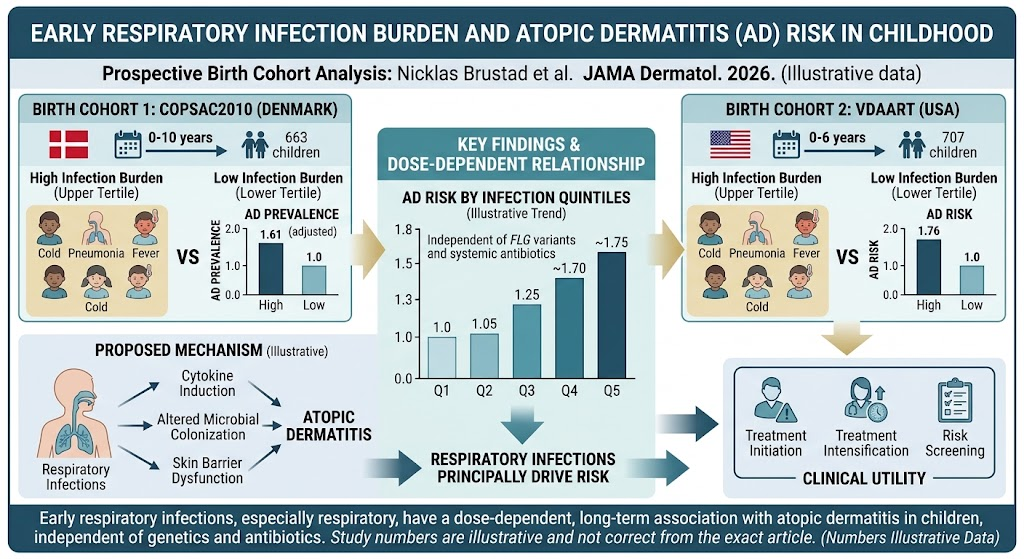
- Early-life respiratory infections show a dose-dependent increase in atopic dermatitis (AD) risk during childhood across two independent birth cohorts.
- Associations persist after adjustment for known AD risk factors including filaggrin (FLG) gene mutations and systemic antibiotic treatments.
- Respiratory infections, rather than other infection subtypes, principally drive the increased AD risk, highlighting a potential mechanistic link.
- Findings underscore the exposome’s role in AD pathogenesis and reveal windows for potential preventive strategies targeting early respiratory infection burden.
Background
Atopic dermatitis (AD) is a chronic relapsing inflammatory skin disorder with onset primarily in early childhood affecting up to 20% of children worldwide. Its pathogenesis is multifactorial involving genetic predisposition, notably loss-of-function mutations in the filaggrin (FLG) gene, immune dysregulation, and environmental exposures constituting the exposome. Early-life exposures, especially infections, are postulated as pivotal modulators of immune development and AD risk, though prior epidemiologic studies have yielded inconsistent results. Clarifying the role of early infections, particularly respiratory tract infections, in AD etiology is critical for refining mechanistic understanding and informing preventive interventions.
Key Content
Chronological Development of Evidence
Early observational studies variably linked infection exposures in infancy to subsequent atopic diseases, including AD. However, heterogeneity in infection definitions, timing, and confounding adjustment limited interpretability. The contemporary Danish COPSAC2010 and US VDAART birth cohorts provide granular, prospectively collected infection data alongside AD phenotyping, enabling rigorous evaluation of temporal and dose-response relationships.
Evidence from COPSAC2010 Cohort
COPSAC2010 prospectively enrolled 700+ children monitored from birth to 10 years, systematically capturing daily infection episodes (cold, otitis media, tonsillitis, pneumonia, gastroenteritis, fever), AD diagnosis, SCORAD severity, antibiotic use, and FLG genotype. Analytical models using generalized estimating equations adjusted for FLG variants and systemic antibiotics revealed that children in the upper tertile of infection episodes and days experienced significantly higher yearly AD prevalence (adjusted odds ratios [AOR] ~1.6–1.7) compared to the lower tertile. Each additional infection episode increased AD risk, reaffirming a dose-dependent effect. Respiratory infections accounted for most of this association, emphasizing their specific influence.
Replication in VDAART Cohort
VDAART, a US birth cohort of over 700 children with prospective infection data and parental report of physician-diagnosed AD up to age 6, corroborated these associations. Children with higher reported infection burden had an increased AD risk (OR 1.76), with each episode further raising the odds. These replicated findings across different populations and clinical contexts strengthen causal inference.
Mechanistic Insights and Translational Implications
Respiratory infections in early infancy may disrupt skin barrier integrity and modulate immune responses, potentially via cytokine induction and altered microbial colonization. The independence from antibiotic exposure suggests infection per se rather than medication effects drive AD risk. Understanding immunologic pathways linking respiratory infections with epidermal inflammation could identify biomarkers for risk stratification and targets for preventive interventions, such as vaccinations or modulation of airway microbiota.
Expert Commentary
This rigorously conducted longitudinal analysis addresses prior inconsistencies by leveraging detailed, diary-based infection data and genetic profiling in well-characterized cohorts with extended follow-up. Strengths include adjustment for confounders like FLG genotype and antibiotic use, use of objective diagnostic criteria for AD, and replication in an independent cohort. Limitations include reliance on parent-reported diagnoses in VDAART and potential residual confounding.
The findings align with the exposome paradigm, emphasizing that early environmental exposures, such as respiratory infections, have lasting dermatologic consequences. Clinicians should consider infection burden when evaluating AD risk and counsel families accordingly. These results also refine epidemiologic causal models integrating gene-environment interplay.
However, these observational data cannot definitively prove causality, and mechanistic studies are needed to elucidate the immunopathological links. Future research should explore the role of specific pathogens, timing and severity of infections, and the microbiome’s contribution to AD development. Interventional trials examining respiratory infection prevention strategies (e.g., vaccines) for AD risk mitigation warrant consideration.
Conclusion
The emerging evidence consolidates early respiratory infection burden as a modifiable risk factor for atopic dermatitis in childhood. This dose-dependent relationship, independent of genetic predisposition and antibiotic treatment, highlights the complex interplay between infections and immune sensitization driving AD pathogenesis. These insights pave the way for integrated preventive strategies targeting early-life respiratory infections to reduce the global childhood burden of AD.
References
- Brustad N, Wang T, Sultan T, et al. Early Respiratory Infection Burden and Atopic Dermatitis in Childhood. JAMA Dermatol. 2026;doi:10.1001/jamadermatol.2026.42525399. PMID: 42525399.
- Flohr C, Mann J. New insights into the epidemiology of childhood atopic dermatitis. Allergy. 2014;69(1):3-16. doi:10.1111/all.12337.
- Weidinger S, Beck LA, Bieber T, Kabashima K, Irvine AD. Atopic dermatitis. Nat Rev Dis Primers. 2018;4:1. doi:10.1038/s41572-018-0001-z.
- Schmitz J, et al. The role of early-life respiratory infections in the development of allergy and asthma: a systematic review. J Allergy Clin Immunol. 2020;145(2):386-404. doi:10.1016/j.jaci.2019.05.049.
- Arrieta MC, Stiemsma LT, Dimitriu PA, et al. Early infancy microbial and metabolic alterations affect risk of childhood asthma. Sci Transl Med. 2015;7(307):307ra152. doi:10.1126/scitranslmed.aab2271.