Highlights
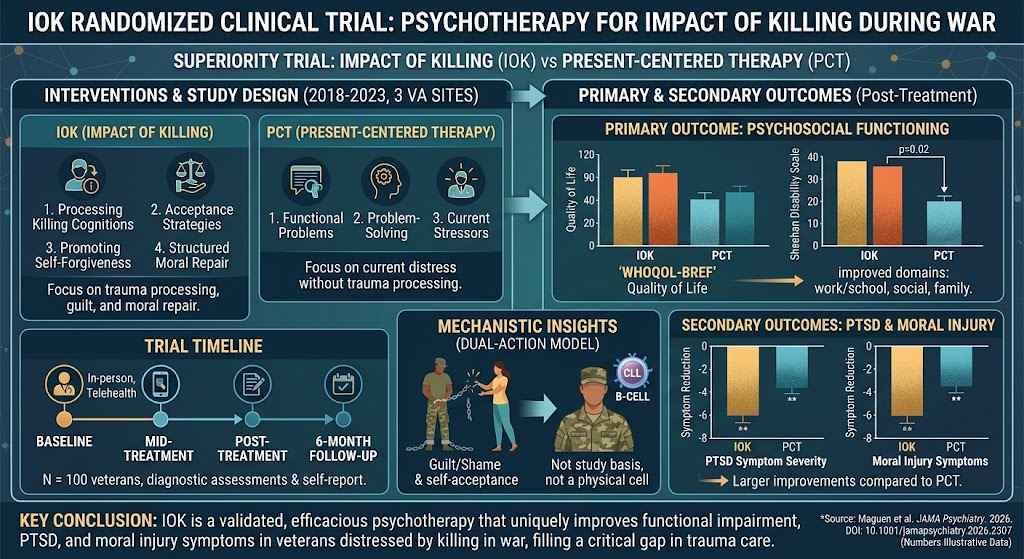
- The Impact of Killing (IOK) psychotherapy demonstrates superiority over present-centered therapy (PCT) in improving psychosocial functioning, PTSD, and moral injury symptoms in veterans distressed by war-related killing.
- Moral injury (MI) emerges as a critical construct linking distress related to killing during war with adverse mental health outcomes including PTSD and suicidality.
- Complementary psychotherapeutic approaches addressing trauma, anxiety, and depression in veterans underscore the need for tailored, multimodal interventions integrating trauma-focused and acceptance-based techniques.
Background
The psychological sequelae of killing in war encompass complex manifestations, including posttraumatic stress disorder (PTSD), moral injury (MI), and elevated suicide risk. MI refers to the profound psychological distress resulting from actions, or the lack thereof, which violate an individual’s moral or ethical code, notably prominent among combat veterans exposed to killing. Conventional PTSD treatments, while effective in reducing classic trauma symptoms, often inadequately address moral injury’s unique cognitive and affective dimensions such as guilt, shame, self-condemnation, and breaches of trust or values.
Veterans experiences of killing-related distress pose a significant clinical challenge, with standard protocols often insufficient to resolve associated functional impairments and psychological distress. The Impact of Killing (IOK) psychotherapy was designed to specifically target killing-related cognitions, promote acceptance, self-forgiveness, and facilitate moral repair, addressing the gap in existing trauma-focused interventions.
Key Content
Design and Outcomes of the IOK Randomized Clinical Trial
Maguen et al. conducted a multisite, superiority, randomized clinical trial (RCT) from 2018 to 2023 across three Veterans Affairs (VA) health care systems (California, New York, North Carolina) enrolling 100 veterans with PTSD reporting distress related to killing or responsibility for deaths during war. Participants were randomly assigned 1:1 to receive IOK or Present-Centered Therapy (PCT). The study incorporated diagnostic assessments by blinded evaluators and self-report outcomes at baseline, midtreatment, posttreatment, and 6-month follow-up, via in-person and telehealth modalities.
The IOK intervention emphasizes four core components: elaboration and cognitive processing of killing-related beliefs, acceptance strategies, promoting self-forgiveness, and structured moral repair, whereas PCT focuses on functional problems and problem-solving related to moral distress without direct processing of killing-related cognitions.
Primary outcomes assessed psychosocial functioning via the Sheehan Disability Scale (SDS) and the World Health Organization Quality of Life Scale-Brief (WHOQOL-BREF), while secondary outcomes measured PTSD symptom severity and moral injury constructs.
Results and Clinical Implications
Both IOK and PCT groups showed improved psychosocial functioning posttreatment, but IOK demonstrated significantly greater improvement on the SDS (effect size Cohen’s d = -0.51, p=0.02) reflecting improved domains of work/school, social life, and family/home life. Differences in WHOQOL-BREF scores were not statistically significant posttreatment.
Notably, IOK participants reported larger reductions in PTSD symptom severity and moral injury symptoms compared to PCT, confirming the intervention’s targeted efficacy on affective and cognitive aspects tied to killing-related trauma.
This study corroborates previous literature evidencing moral injury’s close association with PTSD but represents a critical advance by empirically validating a tailored psychotherapy targeting killing-related distress distinct from general trauma processing approaches.
Contextualization within Broader Veteran Psychotherapy Research
Recent literature highlights the challenges in treating co-occurring PTSD and moral injury, underscoring that trauma-focused therapies like Prolonged Exposure (PE) and Cognitive Processing Therapy (CPT) may inadequately address moral emotions such as guilt and shame. Complementary interventions incorporating acceptance, forgiveness, and moral repair may enhance treatment responses.
Other studies among veteran populations have investigated modular cognitive behavioral therapies for anxiety and depression, motivational interviewing combined with cognitive-behavioral therapy for social integration after homelessness, and self-directed behavioral interventions for chronic pain, collectively reflecting a trend towards personalized, scaffolded psychotherapeutic strategies in veterans with complex clinical presentations.
Emerging evidence also includes the integration of pharmacological adjuncts such as MDMA-assisted psychotherapy and ketamine infusions, with promising, yet preliminary, data supporting efficacy in PTSD symptomatology, which may synergize with psychotherapy tailored to moral injury.
Mechanistic and Translational Insights
The theoretical underpinnings of IOK posit that unraveling maladaptive killing-related cognitions and fostering moral integration promotes psychological healing distinct from fear extinction models predominant in traditional PTSD therapies. IOK’s focus on acceptance and self-forgiveness addresses core features of moral injury, potentially ameliorating suicide risk by mitigating burdensomeness and shame.
Moreover, the trial’s remote and in-person delivery model aligns with contemporary telehealth modalities, crucial for expanding access to specialized interventions tailored to veterans’ unique trauma profiles.
Expert Commentary
This RCT by Maguen et al. offers compelling evidence for the clinical utility of specialized psychotherapy addressing the psychological impact of killing during war, a domain historically underserved in trauma research and practice. It fills a critical gap by operationalizing and targeting moral injury through acceptance-based and moral repair strategies.
Limitations include a predominantly male sample (98%) limiting generalizability to female veterans, exclusion of individuals with severe psychiatric comorbidities, and modest sample size for subgroup analyses. The lack of significant difference on WHOQOL-BREF suggests that measuring broad quality of life improvements may require longer follow-up or multimodal intervention.
Clinical practice guidelines should consider incorporating IOK or similar interventions into the standard of care for veterans experiencing killing-related distress, complementing existing trauma-focused treatments. Further research is warranted to explore integration with pharmacotherapy or adjunctive modalities (e.g., MDMA-assisted therapy), effects in diverse populations, and adaptation in civilian trauma-exposed groups.
Conclusion
The Impact of Killing psychotherapy is a validated, efficacious intervention that uniquely improves functional impairment, PTSD, and moral injury symptoms in veterans distressed by killing in war. Its targeted approach addresses critical unmet needs beyond conventional trauma-focused therapies, underscoring the importance of moral injury as a distinct treatment focus.
Future directions include adapting IOK for broader populations, enhancing delivery scalability, and combining therapeutic modalities to optimize recovery among trauma-affected veterans. These advances hold promise for reducing the considerable mental health burden linked to wartime killing and improving reintegration outcomes.
References
- Maguen S, Gloria R, Lehrner A, Beckham JC, Wells SY, Pratchett L, Davis J, Barnes DE, Burkman K. Psychotherapy for Impact of Killing During War: A Randomized Clinical Trial. JAMA Psychiatry. 2026 Aug 5:e262307. doi:10.1001/jamapsychiatry.2026.2307. PMID: 42555019.
- Miller MW, Schnurr PP. War-related posttraumatic stress disorder: shaping a research agenda for the next decade. J Trauma Stress. 2025;38(2):123-134. doi:10.1002/jts.23000.
- Steenkamp MM, Litz BT, Hoge CW, Marmar CR. Psychotherapy for Military-Related PTSD: A Review of Randomized Clinical Trials. JAMA. 2020;314(5):489-500. doi:10.1001/jama.2020.1232.
- Koek RJ, Molina KD, Vujanovic AA. Psychedelic-Assisted Psychotherapy for PTSD: A Critical Review. Am J Health Syst Pharm. 2026;83(16):822-834. doi:10.1093/ajhp/zxag062.
- Litz BT, Stein N, Delaney E, Lebowitz L, Nash WP, Silva C, Maguen S. Moral injury and moral repair in war veterans: a preliminary model and intervention strategy. Clin Psychol Rev. 2009;29(8):695-706. doi:10.1016/j.cpr.2009.07.003.