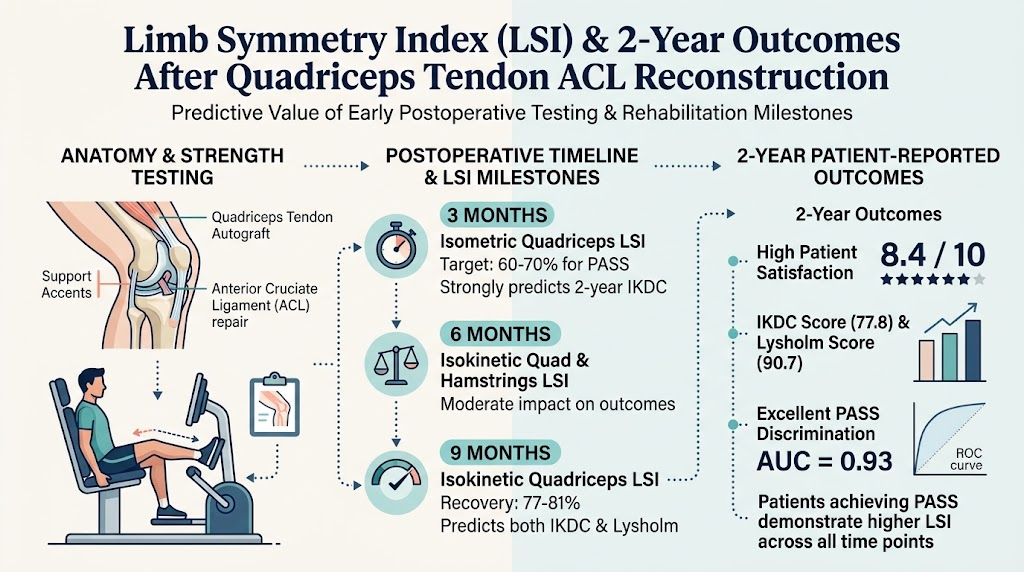
Early limb symmetry index (LSI) scores, especially quadriceps strength at 3 months post-surgery, strongly predict two-year patient-reported knee function and satisfaction after quadriceps tendon autograft anterior cruciate ligament reconstruction (QT-ACLR).
Isokinetic quadriceps strength at 9 months postoperatively correlates closely with patient-reported outcome measures (PROMs), including the International Knee Documentation Committee (IKDC) and Lysholm scores.
Patients achieving Patient Acceptable Symptom State (PASS) thresholds demonstrated consistently higher LSI scores and better PROMs across rehabilitation milestones.
Early recovery of quadriceps strength is crucial to successful rehabilitation and long-term knee function after QT-ACLR, emphasizing the clinical value of serial LSI assessments.
Study Background
Anterior cruciate ligament (ACL) injuries are common among athletes and active individuals, often requiring surgical reconstruction for restoring knee stability and function. The quadriceps tendon autograft (QT-ACLR) is increasingly favored due to favorable graft properties and reduced donor site morbidity compared to other graft types. Postoperative rehabilitation focuses on restoring muscle strength, functional symmetry between limbs, and readiness to return to sport.
The limb symmetry index (LSI) is widely used to quantify strength and functional performance differences between the surgical and contralateral limbs, guiding rehabilitation progression and return-to-sport decisions. Despite its widespread clinical use, the predictive value of early postoperative LSI scores on long-term patient-reported outcomes (PROMs) remains underexplored, particularly for QT-ACLR.
Understanding if and when LSI scores predict patient satisfaction and knee function can refine rehabilitation protocols and optimize timing for safe return to activity.
Study Design
This prospective case series (Level 4 evidence) evaluated 100 patients undergoing primary ACL reconstruction using quadriceps tendon autografts from 2021 to 2024. Included patients had serial limb symmetry index testing during rehabilitation and no revision or additional knee surgeries.
LSI assessments encompassed isometric and isokinetic strength testing of quadriceps and hamstrings, as well as functional tests including Y-Balance and hop tests at 3, 6, and 9 months postoperatively. Patient-reported outcomes measured by the Lysholm and IKDC scoring systems, alongside satisfaction ratings, were collected at a mean follow-up of 2.0 ± 0.7 years.
Multivariable linear regression adjusted for confounding factors such as age, sex, and BMI evaluated associations between LSI scores at time points and PROMs. Receiver operating characteristic (ROC) analysis determined PASS thresholds to identify clinically relevant outcome benchmarks.
Key Findings
Patients (mean age 25.3 years, 52% male, mean BMI 25.9) showed progressive improvements in LSI scores over the postoperative period. By 9 months, mean quadriceps strength LSI was 77%-81%, while hamstring strength LSI normalized at 98%-100%.
At the 2-year follow-up, the mean satisfaction score was 8.4/10, Lysholm score averaged 90.7, and IKDC score was 77.8, indicating overall favorable outcomes.
Multivariable linear regression revealed:
– The 3-month isometric quadriceps LSI strongly predicted 2-year IKDC scores (β=3.9, AdjR2=0.36, P<.03), indicating early quadriceps strength recovery explains substantial variance in patient-reported knee function.
– At 6 months, isokinetic quadriceps and hamstring LSI scores demonstrated moderate but significant predictive power for IKDC scores (β=2.9-3.7, AdjR2=0.13-0.17, P<.05).
– The 9-month fast isokinetic quadriceps LSI had a strong association with both Lysholm and IKDC scores (β=3.9-4.7, AdjR2=0.34-0.35, P≤.003), solidifying later strength recovery as critical too.
ROC analysis confirmed Lysholm and IKDC scores effectively discriminated PASS, with area under the curve values of 0.927-0.937 (P<.001), supporting the clinical meaningfulness of these PROMs.
Patients who achieved IKDC PASS thresholds consistently showed higher LSI scores at each time point and superior PROM scores, underlining the importance of limb symmetry in functional recovery.
Expert Commentary
This study provides compelling evidence that early quadriceps strength recovery measured via LSI after QT-ACLR is a robust predictor of patient-reported knee function and satisfaction at two years.
The strong correlation between 3-month isometric quadriceps strength and long-term PROMs highlights a critical rehabilitation window where targeted interventions may optimize functional gains. The data also emphasize that hamstring strength, while important, is less predictive than quadriceps strength in this context.
Notably, the study’s strength lies in comprehensive, serial objective testing combined with validated PROMs and adjustment for key demographic factors, lending robustness to findings.
Limitations include the Level 4 design lacking a comparative group and a relatively young, active patient cohort, which may limit generalizability. Future high-level studies should confirm these findings and explore whether tailored rehabilitation based on LSI trajectories improves outcomes.
Mechanistically, quadriceps weakness post-ACLR is a major contributor to poor knee function and delayed return to sport, possibly due to impaired neuromuscular control and altered joint biomechanics. Early LSI-based identification of patients lagging in strength recovery may facilitate personalized rehabilitative strategies.
Conclusion
In patients undergoing quadriceps tendon autograft ACL reconstruction, early postoperative quadriceps strength symmetry, particularly at 3 and 9 months, independently predicts two-year patient-reported knee function and satisfaction.
Achieving a 60%-70% quadriceps strength LSI by 3 months associates with attaining clinically acceptable symptom states, emphasizing the importance of early strength restoration.
Routine LSI assessment throughout rehabilitation provides valuable prognostic insight and can inform individualized therapeutic decisions to optimize long-term outcomes. These findings reinforce the critical role of early quadriceps-focused rehabilitation to improve functional recovery after QT-ACLR.
Funding and ClinicalTrials.gov
The study funding and any relevant clinical trial registration were not reported in the available abstract.
References
1. Kang LS, Ina JG, Johnson A, et al. Association Between Early Postoperative Limb Symmetry Index Scores and 2-Year Patient-Reported Outcomes After Quadriceps Tendon Autograft ACL Reconstruction. Am J Sports Med. 2026 Oct 9;3635465261490238. doi:10.1177/03635465261490238. PubMed PMID: 42852663.
2. Grindem H, Snyder-Mackler L, Moksnes H, Engebretsen L, Risberg MA. Simple decision rules can reduce reinjury risk by 84% after ACL reconstruction: the Delaware-Oslo ACL cohort study. Br J Sports Med. 2016 Dec;50(13):804-808. doi:10.1136/bjsports-2015-095898.
3. Logerstedt D, Snyder-Mackler L, Ritter RC, Axe MJ, Barber-Westin S, Kocher MS, et al. Knee stability and movement coordination impairments: knee ligament sprain. J Orthop Sports Phys Ther. 2010 Apr;40(4):A1-A35. doi:10.2519/jospt.2010.0307.
4. Webster KE, Feller JA. Return to sport following anterior cruciate ligament reconstruction. Int Orthop. 2019 Nov;43(11):2467-2474. doi:10.1007/s00264-019-04428-x.
5. Faltstrom A, Styf J, Henriksson M. Lower extremity muscle torque in anterior cruciate ligament-injured patients: the effect of fear of movement/reinjury. Knee Surg Sports Traumatol Arthrosc. 2006 Feb;14(2):117-25. doi:10.1007/s00167-005-0672-x.