Highlight
The Modified Liacyr-Ribeiro Technique for breast reduction and mastopexy ensures sustainable breast shape maintenance with high patient satisfaction over a follow-up exceeding 10 years. The technique’s autologous prosthesis approach using an inferior lipo-glandular flap effectively prevents late complications such as inferior pole descent and pseudoptosis. Furthermore, major physiological factors like aging, pregnancy, menopausal status, and significant weight changes do not adversely affect long-term outcomes.
Study Background
Reduction mammaplasty and mastopexy are among the most frequently performed aesthetic and reconstructive breast surgeries worldwide. However, a persistent challenge remains in achieving durable long-term aesthetic results, particularly maintaining breast shape, upper pole fullness, and nipple position. Over time, anatomic changes such as inferior pole descent and pseudoptosis (the appearance of breast sagging despite nipple elevation) frequently occur postoperatively, potentially compromising patient satisfaction and requiring revision surgery.
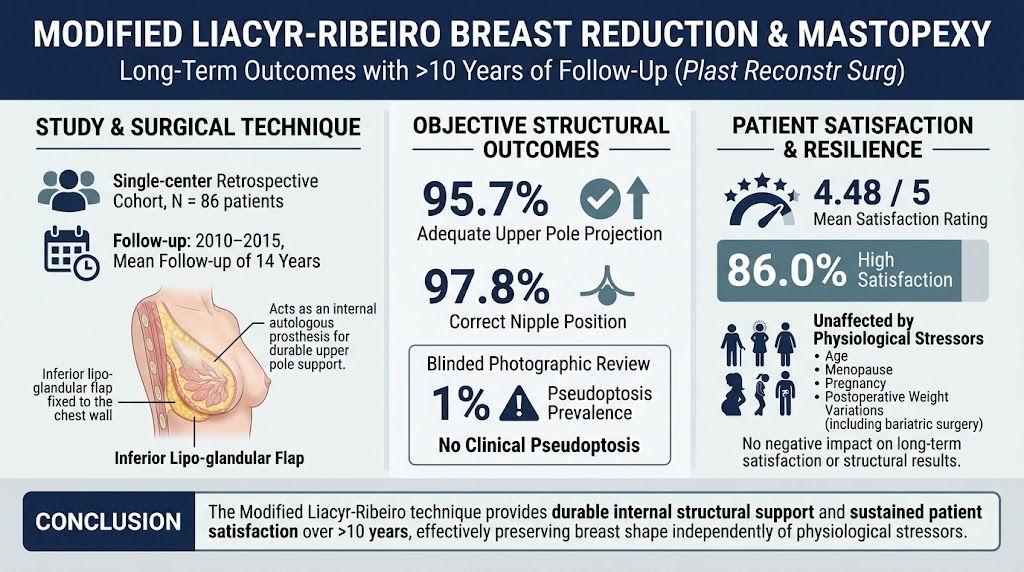
The Modified Liacyr-Ribeiro Technique innovatively addresses these challenges by incorporating an inferior lipo-glandular flap, fixed securely to the chest wall. This structure acts as an autologous internal prosthesis, providing mechanical support to counter gravitational forces and tissue laxity over time. Yet, while short-term efficacy has been described, objective data evaluating outcomes beyond a decade remain scarce.
Study Design
This investigation was a single-center, retrospective cohort study with prospective follow-up assessment. Eighty-six patients underwent bilateral reduction mammaplasty using the Modified Liacyr-Ribeiro Technique between 2010 and 2015, with a mean follow-up of 14 years (range not specified). The study included patients of varying age groups, menopausal statuses, and with diverse physiological events postoperatively such as pregnancies and weight fluctuations, including some who underwent bariatric surgery.
Outcome measures comprised multiple dimensions: patient-reported satisfaction and symptom relief, objective anthropometric measurements (breast shape, upper pole projection, nipple position), surgeon clinical assessment, and blinded photographic panel evaluation. Multivariable regression analyses examined predictors of long-term patient satisfaction.
Key Findings
Long-term patient-reported satisfaction was notably high, with a mean satisfaction score of 4.48 out of 5 and 86.0% of patients expressing high satisfaction at more than 10 years post-surgery. Patients uniformly reported improvements or resolution of preoperative symptoms related to macromastia, including pain and discomfort.
On objective clinical evaluation, results demonstrated stable breast shape with maintenance of upper pole projection in 95.7% of cases. Correct nipple positioning was achieved and maintained in 97.8% of patients, indicating effective prevention of common long-term morbidities such as nipple malposition or ptosis.
Crucially, no clinically documented cases of pseudoptosis were observed among the cohort. Blinded photographic assessment, intended to minimize observer bias, corroborated these findings with a very low pseudoptosis prevalence of only 1%. This confirms the technique’s capacity to provide lasting structural integrity.
Physiological stressors traditionally implicated in structural breast changes—including advancing age, menopausal transition, subsequent pregnancies, and significant postoperative weight variations—had no statistically significant negative impact on satisfaction scores or on objective anatomical outcomes. Even extreme weight loss cases requiring bariatric surgery maintained durable surgical benefits.
Expert Commentary
The Modified Liacyr-Ribeiro Technique’s conceptual advance lies in its use of autologous tissue to create an internal support scaffold, differing from techniques reliant on skin tension alone or synthetic materials. The inferior lipo-glandular flap fixated to the chest wall provides mechanical resistance to gravitational descent, which biomechanically explains the stable long-term results.
From a surgical perspective, this method allows preservation of vascular supply to the flap, minimizing ischemic complications and enhancing healing.
Study limitations include its retrospective nature and single-center design, which may limit generalizability. Additionally, the absence of a direct comparator group precludes head-to-head evaluation with other common reduction or mastopexy techniques regarding durability and complication rates. However, the comprehensive multi-modal outcome assessment and lengthy follow-up provide robust evidence of efficacy.
Further multicenter, prospective randomized studies would strengthen the evidence base, while biomechanical studies quantifying flap support could elucidate the mechanistic underpinnings.
Conclusion
The Modified Liacyr-Ribeiro breast reduction and mastopexy technique confers durable structural support and sustained high patient satisfaction over a minimum decade-long follow-up. By effectively preventing inferior pole descent and pseudoptosis, it addresses a major challenge in aesthetic breast surgery. Notably, these benefits remain resilient despite major physiological changes, underscoring the technique’s robustness.
Surgeons seeking long-term aesthetic stability with minimal need for reoperation should consider integrating this technique into practice. Ongoing research should focus on comparative effectiveness, refinement of patient selection criteria, and integration with enhanced recovery protocols.
Funding and ClinicalTrials.gov
The article does not report specific funding sources or disclose clinical trial registration.
References
Matias M, Igreja R, Insua I, Teixeira S, Carvalho F, Marques M, Barros AS, Costa-Ferreira A. Modified Liacyr-Ribeiro Breast Reduction and Mastopexy: Long-Term Outcomes with More Than 10 Years of Follow-up. Plastic and Reconstructive Surgery. 2026 Oct 15. PMID: 42879138.
Additional literature supporting concepts of autologous internal support in breast surgery:
– Cárdenas-Camarena L, Bayter JE, Mazier WP. Aesthetic and functional aspects of breast reduction with internal dermoglandular suspension. Plast Reconstr Surg. 2006 Mar;117(3):763-72.
– Nahabedian MY. Breast reduction and mastopexy: Principles of successful outcome. Plast Reconstr Surg. 2007 May;119(6):1805-15.
– Spear SL, Pelletiere CV, Menon N. One-stage augmentation combined with mastopexy: A review of 286 cases. Plast Reconstr Surg. 2004 Apr;113(4): 1107-14.