Limitations include retrospective design, single-center data, and potential confounding from unrecorded inflammatory states.
Study Background
Cutaneous squamous cell carcinoma (cSCC) ranks as the second most prevalent skin cancer worldwide, with generally favorable prognosis following definitive treatment. However, a subset of tumors exhibits aggressive behavior, manifesting as local recurrence, regional spread, and disease-specific mortality. Current prognostic factors—such as tumor size, depth, differentiation, perineural invasion, and anatomical location—are predominantly determined post-excision, limiting the ability to preoperatively stratify patients’ risk and plan appropriate interventions.
Systemic inflammation has emerged as a key contributor to oncogenesis and tumor progression. The neutrophil-to-lymphocyte ratio (NLR), derived from routine complete blood counts, reflects the balance between pro-tumor inflammatory neutrophils and anti-tumor lymphocytes. Elevated NLR has been identified as a prognostic marker in diverse malignancies, including various skin cancers, yet its specific utility in cSCC remains underexplored with inconsistent findings.
Study Design
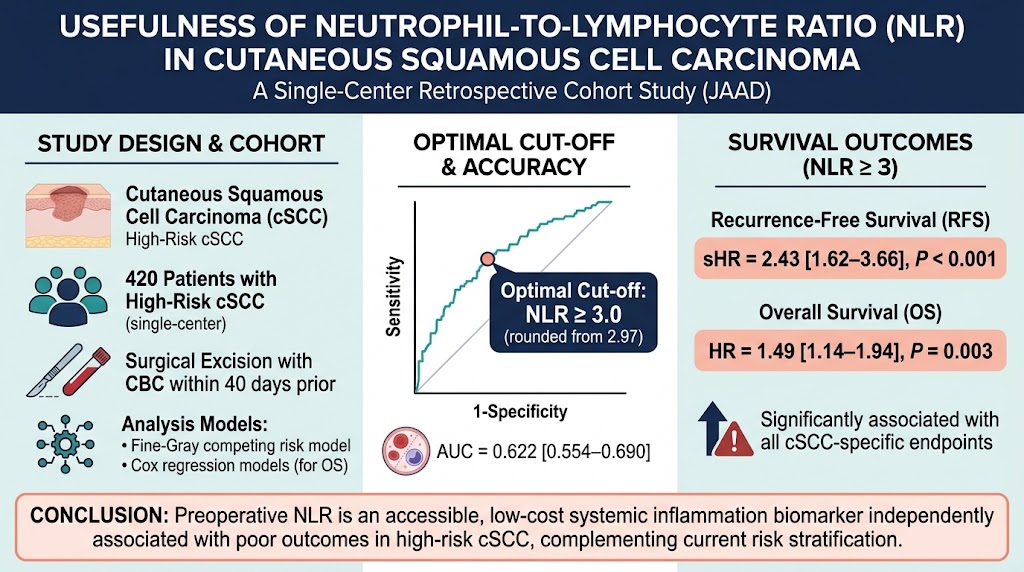
This study was a retrospective cohort analysis conducted at a single center, involving 420 patients with high-risk cSCC who underwent surgical excision. Inclusion criteria required availability of a complete blood count performed within 40 days before surgery to calculate preoperative NLR. The high-risk classification followed established clinical and histopathological criteria reflective of aggressive tumor biology.
The primary endpoint was recurrence-free survival (RFS), with secondary endpoints including overall survival (OS) and other cSCC-specific outcomes. NLR was analyzed both as a continuous variable and dichotomized using a receiver operating characteristic (ROC)-derived cutoff value. Predictive performance metrics including area under the curve (AUC) were calculated. Fine-Gray competing risk models addressed cSCC-specific outcomes while Cox proportional hazards models estimated effects on OS.
Key Findings
The optimal NLR cutoff for predicting RFS was identified as 2.97, with the threshold rounded to ≥3 for clinical applicability. The ROC analysis reported an AUC of 0.622 (95% CI 0.554–0.690), signifying modest discriminatory power.
Patients with preoperative NLR≥3 demonstrated significantly worse outcomes. Adjusted Fine-Gray analyses revealed a subdistribution hazard ratio (sHR) of 2.43 (95% CI 1.62–3.66; P <0.001) for recurrence-free survival, indicating more than double the risk of tumor recurrence or disease-specific events compared to those with NLR <3. Likewise, Cox regression indicated inferior overall survival (HR 1.49; 95% CI 1.14–1.94; P =0.003) associated with elevated NLR.
All evaluated cSCC-specific endpoints showed similar independent associations with NLR≥3 after controlling for confounders. These findings support NLR as an independent prognostic biomarker reflecting systemic inflammatory status that correlates with aggressive tumor behavior.
Expert Commentary
The study builds on prior literature linking systemic inflammation markers like NLR to oncologic outcomes, applying it to the dermatologic oncology context where preoperative prognostication remains a challenge. The biological plausibility rests on the dual role of neutrophils in promoting tumor growth, angiogenesis, and immune evasion, contrasted with lymphocytes’ antitumor cytotoxic functions. Elevated NLR suggests a shift towards a pro-tumor inflammatory milieu.
Nevertheless, the modest AUC underlines that NLR alone has limited accuracy as a stand-alone predictor and should be integrated with established clinicopathologic factors. Residual confounding, such as active infections, autoimmune or inflammatory diseases, may influence NLR values, especially in retrospective analyses lacking comprehensive clinical data.
Prospective multicenter studies are warranted to validate these findings and establish standardized NLR thresholds. Moreover, mechanistic investigations could elucidate the molecular pathways linking systemic inflammation to cSCC aggressiveness, potentially identifying therapeutic targets or refining patient selection for adjuvant therapies.
Conclusion
Preoperative neutrophil-to-lymphocyte ratio is a promising, inexpensive, and readily obtainable biomarker independently associated with poorer outcomes in patients with high-risk cutaneous squamous cell carcinoma. Although the discriminatory ability is modest, NLR can complement traditional risk stratification approaches, supporting more informed surgical planning and postoperative surveillance strategies. Further validation is needed before clinical implementation, but integrating systemic inflammation markers reflects an important step towards personalized prognostication in cSCC management.
Funding and ClinicalTrials.gov
The study was supported by institutional resources from the conducting center. No clinical trial registration number is reported due to the retrospective study design.
References
1. Cardona-Machado C, Felices B, Rodríguez-Conde S, et al. Usefulness of neutrophil-to-lymphocyte ratio in the prognosis of cutaneous squamous cell carcinoma: a single-center retrospective cohort study. J Am Acad Dermatol. 2026 Oct 1; PMID: 42822768.
2. Templeton AJ, McNamara MG, Šeruga B, et al. Prognostic role of neutrophil-to-lymphocyte ratio in solid tumors: a systematic review and meta-analysis. J Natl Cancer Inst. 2014;106(6):dju124.
3. Guthrie GJ, Charles KA, Roxburgh CS, et al. The systemic inflammation-based neutrophil-lymphocyte ratio: experience in patients with cancer. Crit Rev Oncol Hematol. 2013 Apr;88(1):218-30.
4. Stratigos AJ, Garbe C, Lebbé C, et al. European interdisciplinary guideline on invasive squamous cell carcinoma of the skin: part 1. Epidemiology, diagnostics and prevention. Eur J Cancer. 2020;128:60-82.