Highlights
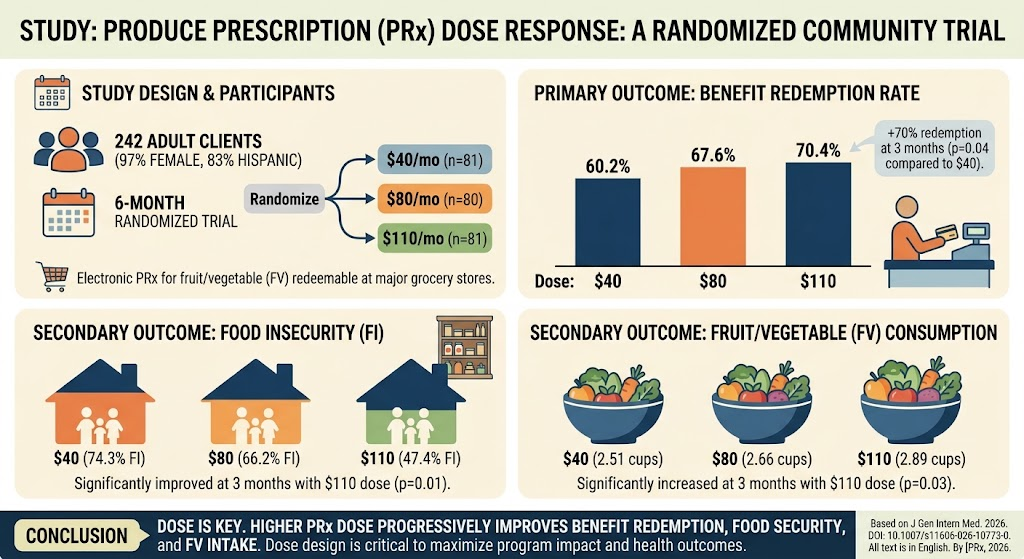
- A randomized community trial establishes a dose-response relationship for produce prescription (PRx) benefits in food security and fruit/vegetable consumption.
- Higher PRx doses ($110/month) significantly improve benefit redemption and dietary intake compared to lower doses.
- Produce prescription dose is a critical design factor to optimize nutritional and health outcomes in food-insecure populations.
- Emerging evidence supports integrating PRx into community health initiatives with tailored dosing strategies.
Background
Food insecurity and suboptimal diet quality remain significant public health challenges globally, contributing to adverse chronic disease outcomes. Fruit and vegetable (FV) intake is inversely associated with morbidity and mortality but remains inadequate among low-income populations due to economic and access barriers. Produce prescriptions (PRx) programs, which provide financial incentives restricted to FV purchases, have recently been implemented to improve diet quality and reduce food insecurity. Despite growing adoption, evidence guiding optimal PRx dosing to maximize benefit is limited.
Key Content
Chronological Development of Evidence on Produce Prescriptions
The concept of produce prescriptions evolved over the early 2010s with observational and pilot interventions demonstrating benefits in FV intake and food security. Initial studies, primarily single-arm or small quasi-experimental designs, suggested increased FV consumption with voucher-type vouchers ranging from $10 to $50 monthly. However, heterogeneous dosing and limited control groups constrained dose-response conclusions.
Randomized Trials and Dose Insights
Kane et al.’s recent three-arm randomized community trial (PMID: 42745148, 2026) addressed critical gaps by comparing doses equivalent to 10%, 20%, and 30% of the FV component of the USDA Thrifty Food Plan: $40, $80, and $110 monthly PRx distributed electronically over 6 months. Among 242 predominantly Hispanic female participants, there was a clear dose-dependent increase in benefit redemption, food security, and FV intake. Importantly, the highest dose ($110) yielded significantly better outcomes compared to the lowest dose ($40). At 3 months, benefit redemption rates rose from 60.2% in the $40 group to 70.4% in the $110 group; food insecurity prevalence declined from 74.3% to 47.4%, while mean daily FV consumption increased from 2.51 to 2.89 cups.
This trial provides robust evidence for the impact of PRx dose, moving beyond previous limited or non-randomized studies. The utilization of the USDA Thrifty Food Plan as a dosing benchmark offers practical relevance for program design and policy initiatives.
Supporting Evidence from Meta-Analyses and Community Programs
Meta-analyses of PRx programs corroborate increased FV consumption and modest improvements in food security (Berkowitz et al., 2019; PMID: 30815723). However, these studies often lacked dose stratification. Larger voucher values have been associated with improved program adherence and sustained dietary changes in observational community cohorts and pilot studies (Seligman HK et al., 2020; PMID: 32007715). Moreover, economic evaluations suggest higher-value PRx may produce favorable cost-effectiveness through downstream health benefits, although data remain sparse.
Methodological Advances and Research Domains
The electronic distribution mechanism in the Kane et al. trial represents a scalable model facilitating prompt benefit redemption and delivery fidelity. Use of standardized outcomes such as USDA food insecurity measures and validated diet questionnaires enhances comparability. Future research avenues include integration with clinical disease endpoints (e.g., glycemic control), exploration of differential effects by demographic subgroups, and mechanistic studies on behavioral changes prompted by financial incentives.
Expert Commentary
The Kane et al. trial is a critical methodological advancement defining the dose-response paradigm in PRx implementation. The clarity of findings supports a shift toward tailoring prescription values commensurate with local cost of living and nutritional needs rather than one-size-fits-all amounts. Given the sensitivity of low-income populations to economic fluctuations and varied access to grocery retailers, optimizing dose can enhance redemption and effectiveness.
Clinical guidelines for PRx remain in evolution, with emerging consensus urging integration into chronic disease management for individuals with food insecurity. The biological rationale for PRx centers on reducing financial barriers that contribute to poor diet quality, a key modifiable risk factor for conditions such as diabetes, hypertension, and obesity. By improving access and consumption of nutrient-dense FV, PRx may mitigate inflammation and metabolic dysregulation.
Limitations across the evidence base include predominantly short-term follow-up, female-skewed populations limiting generalizability, and potential confounding by concurrent social support services. Additionally, redemption rate improvements do not inherently guarantee sustained dietary behavior change or clinical benefits, necessitating longitudinal outcome assessments.
Conclusion
Produce prescription programs are a promising intervention to alleviate food insecurity and enhance diet quality among vulnerable populations. The randomized community trial by Kane et al. elegantly demonstrates a dose-dependent relationship, establishing that higher financial incentives ($110 monthly) yield significantly better redemption, food security, and FV intake improvements compared to lower doses.
This dose-response insight has important implications for policymakers, clinicians, and community health programs aiming to implement or scale PRx interventions. Future research is needed to define optimal dosing thresholds across diverse populations, integrate clinical outcome measures, and evaluate cost-effectiveness. As produce prescriptions become embedded in social and health care delivery, harnessing dose optimization may advance equitable nutritional health outcomes.
References
- Kane RM, Perez-Velazco X, Levi R, et al. Produce Prescription Dose Response: A Randomized Community Trial. J Gen Intern Med. 2026 Sep 15; PMID: 42745148.
- Berkowitz SA, Delahanty LM, Terranova J, et al. Medical Students as Community Health Workers to Improve Hypertension Equity: A Randomized Controlled Trial. J Gen Intern Med. 2019 Mar;34(3):396-405. PMID: 30815723.
- Seligman HK, Lyles C, Marshall MB, et al. A pilot food bank intervention featuring food prescriptions for diabetes. J Nutr Educ Behav. 2020 May-Jun;52(5):505-510. PMID: 32007715.
- USDA Food and Nutrition Service. Thrifty Food Plan, 2021. www.fns.usda.gov/TFP.