Highlight
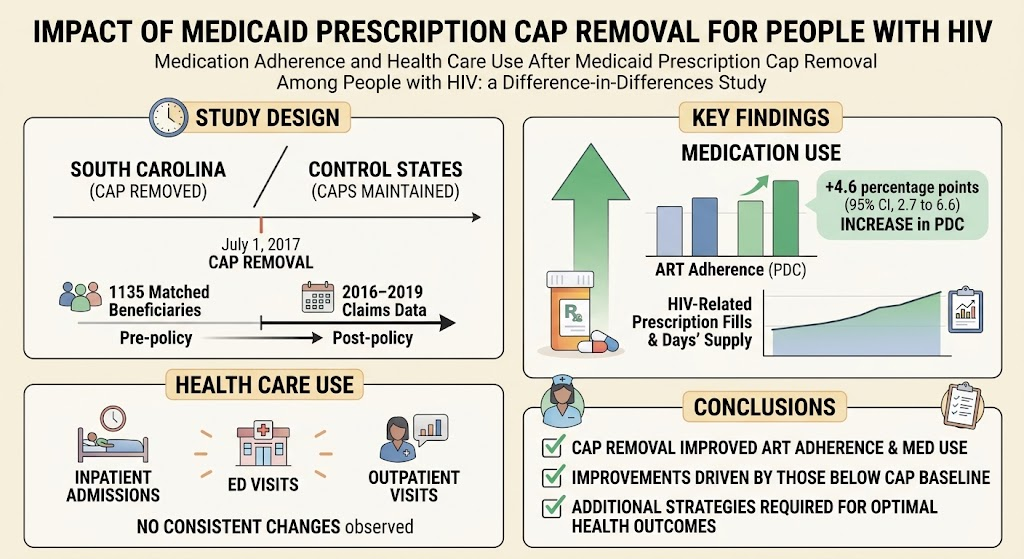
- Medicaid prescription cap removal in South Carolina increased ART adherence by 4.6 percentage points compared to control states.
- Improvements peaked 9 months after policy change and were mainly observed in individuals previously near the prescription cap limit.
- Enhanced HIV-related prescription fills and days’ supply followed cap removal.
- No consistent changes in inpatient, outpatient, or emergency department health care utilization were detected post-policy.
Study Background
State Medicaid programs have long imposed prescription caps to contain pharmaceutical spending, often limiting the number of reimbursable prescriptions per month. While some medications like antiretroviral therapy (ART) for HIV have historically been exempted, the burden of prescription caps may still interfere with medication adherence due to complexities in polypharmacy or administrative barriers. Adequate ART adherence is critical for viral suppression, prevention of HIV-related morbidity, and reduction of transmission. Despite prior evidence showing reduced adherence under caps, it remained unclear whether removing such caps would translate to better medication use and downstream clinical benefits among Medicaid beneficiaries with HIV.
South Carolina’s removal of a Medicaid prescription cap on July 1, 2017, provided a natural experiment opportunity to examine these impacts by comparing outcomes with nine control states that maintained caps from 2016-2019, thus addressing a major gap in health policy evidence regarding medication access and outcomes in a marginalized population.
Study Design
This retrospective observational study utilized a difference-in-differences framework combined with an event-study approach and propensity score matching to ensure comparable groups. The study population consisted of adults aged 21-64 years with a documented diagnosis of HIV who were continuously enrolled in Medicaid before and after the policy change.
Exclusions included individuals moving between states during the study period, residents in long-term care facilities, and pregnant women to minimize confounding.
Exposure was defined as the removal of the Medicaid prescription cap in South Carolina. Comparator states retained caps throughout the study timeframe.
Primary endpoints included:
– Medication use metrics: number of prescription fills and days’ supply, overall and specifically for HIV-related medications.
– ART adherence quantified by proportion of days covered (PDC) by ART.
– Health care utilization: inpatient admissions, outpatient Evaluation and Management visits, and emergency department visits.
The analytical approach allowed isolation of the policy effect while accounting for temporal trends and differences between states.
Key Findings
The matched analytic sample comprised 1,135 individuals from South Carolina and 1,135 from control states.
Medication adherence demonstrated significant improvement following cap removal. The PDC for ART increased by 4.6 percentage points (95% CI, 2.7 to 6.6) in South Carolina relative to control states. Notably, adherence gains peaked at 8.4 percentage points approximately nine months after the policy change, indicating a delayed but sustained impact.
Subgroup analysis showed that these benefits predominantly accrued to individuals with baseline prescription fills close to or below the previous cap, suggesting that cap removal alleviated medication access constraints.
HIV-related prescription fills and days’ supply similarly increased, consistent with improved medication accessibility and longer duration of dispensed ART courses.
Despite these adherence gains, no statistically consistent differences emerged in inpatient admissions, outpatient visits, or emergency department utilization comparing pre- and post-policy periods between South Carolina and control states. These findings suggest that while prescription cap removal enhances medication use, it alone may not suffice to alter short-term health service utilization patterns.
Expert Commentary
This study robustly quantifies the positive impact of Medicaid prescription cap removal on ART adherence, a critical determinant of HIV clinical outcomes. The use of a difference-in-differences design with propensity matching appropriately addresses confounding and selection bias.
However, the absence of measurable health care utilization changes highlights important considerations. First, improvements in adherence, while meaningful, may require additional time or be of insufficient magnitude to immediately influence hospitalization or outpatient care needs. Second, social determinants and other structural barriers affecting health outcomes in people with HIV may limit downstream benefits from medication adherence alone.
Therefore, policy interventions should be complemented by integrative approaches addressing social support, mental health, substance use, and access to comprehensive care.
Additionally, the study excluded pregnant individuals and long-term care residents, who may have different medication access challenges. Future research should evaluate effects in these vulnerable subpopulations.
Lastly, generalizability may be influenced by state-specific Medicaid program characteristics, formulary differences, and ART prescription management, warranting replication in other settings.
Conclusion
The removal of Medicaid prescription caps in South Carolina significantly improved ART adherence and HIV medication fills among Medicaid beneficiaries living with HIV. This policy change appears to alleviate medication access barriers, particularly benefiting those restricting their prescription use due to previous caps.
Yet, absence of consistent changes in health care utilization shortly after policy implementation suggests that enhanced adherence is a necessary but not sufficient step to improve broader clinical outcomes.
Comprehensive strategies combining policy reforms with supportive services are essential to maximize health benefits for people with HIV under Medicaid.
Future efforts should continue monitoring long-term clinical outcomes, viral suppression rates, and health care costs post-policy to inform sustainable access policies nationwide.
Funding and ClinicalTrials.gov
Funding and potential conflicts of interest were not specified in the abstract. The study does not appear to be registered on ClinicalTrials.gov, consistent with its observational design.
References
1. Geng F, Lu Y, Santostefano CM, Lu X, Lee Y, Dow PM, Shireman TI, Galarraga O. Medication Adherence and Health Care Use After Medicaid Prescription Cap Removal Among People with HIV: a Difference-in-Differences Study. J Gen Intern Med. 2026 Sep 17. PMID: 42754790.
2. Starrels JL, et al. Antiretroviral therapy adherence interventions for HIV-infected people who use drugs: a systematic review. J Acquir Immune Defic Syndr. 2010.
3. CDC. HIV Treatment and Care. 2023.
4. Lau BK, et al. Impacts of Medicaid policies on HIV viral load suppression among Medicaid enrollees. AIDS. 2020.
5. Mayer KH, et al. HIV prevention in clinical care settings: approaches and challenges. Am J Med. 2014.