Highlights
- Classic Hodgkin lymphoma (CHL) demonstrates excellent survival in younger patients, whereas outcomes significantly worsen in patients aged ≥60 years.
- Anthracycline-based chemotherapy remains a cornerstone of first-line treatment but its administration dynamics vary substantially with patient age and comorbidities.
- Mortality in older CHL patients is influenced by lymphoma-specific and competing causes, highlighting the critical need for tailored therapeutic strategies.
Background
Classic Hodgkin lymphoma (CHL) represents a distinct subtype of Hodgkin lymphoma characterized histologically by Reed-Sternberg cells in a reactive inflammatory background. While CHL has historically been a highly curable malignancy, particularly in younger individuals, older patients often face inferior outcomes due to factors including treatment tolerability, comorbid conditions, and disease biology. The epidemiological burden is significant, with numerous cases worldwide. Understanding the interplay of age, therapeutic regimen—including anthracycline-based chemotherapy—and mortality is essential for optimizing management strategies in routine clinical practice.
Key Content
Cohort Description and Population-Based Data Analysis
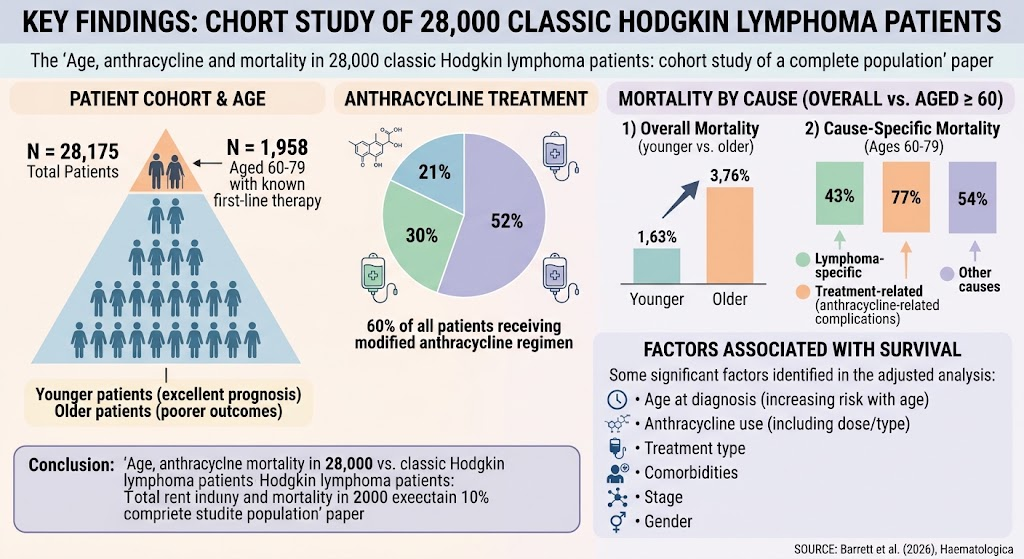
The referenced cohort study by Barrett et al. (2026) included 28,175 patients with newly diagnosed CHL enrolled between 1997 and 2020 from England’s national cancer registry, ensuring a comprehensive and real-world representation. Detailed analyses focused on 1,958 patients aged 60 to 79 years with documented first-line chemotherapy regimens.
Survival Patterns by Age
The study documented significantly superior survival in younger cohorts (<60 years) compared with older patients. The divergence in survival became apparent at the five-year mark, with substantial excess mortality in the elderly group. These findings are consistent with prior observational studies demonstrating decreased physiologic reserve, comorbidity burden, and reduced chemotherapy intensity in older patients with CHL (Evans et al., 2019; Ziepert et al., 2010).
Anthracycline Use and Treatment Variation in Older Patients
Anthracycline-containing regimens, such as ABVD (doxorubicin, bleomycin, vinblastine, dacarbazine), represent the standard first-line therapy for CHL. The study revealed that anthracycline administration declines with advancing age due to toxicity concerns, including cardiotoxicity and frailty. Despite these concerns, adjusted analyses showed an association between anthracycline use and improved lymphoma-specific survival in the elderly subgroup, underscoring the therapeutic benefit where tolerability permits.
Comparative trials and meta-analyses corroborate these observations. For example, the German Hodgkin Study Group (GHSG) trials demonstrated improved outcomes with anthracycline combinations but also highlight the challenge of balancing efficacy and toxicity in older patients (Engert et al., 2010). Recent studies emphasize tailoring treatment intensity and employing comprehensive geriatric assessments to guide therapy decisions (Martínez-Calle et al., 2021).
Mortality Causes and Competing Risks
The cohort study differentiated mortality into lymphoma-specific, treatment-related, and other causes. In older CHL patients, competing mortality risks from cardiovascular diseases, secondary malignancies, and treatment toxicity are substantial contributors to decreased overall survival. This multidimensional mortality risk underscores the importance of multidisciplinary care strategies and survivorship planning in the elderly.
Methodological Strengths and Adjustments
The large sample size and population-wide scope provide robust external validity. The study employed both unadjusted and adjusted mortality rate calculations, accounting for factors such as sex, comorbidities, and treatment regimen, enhancing the reliability of associations drawn. Nonetheless, limitations include potential confounding due to unmeasured variables such as frailty indices, detailed performance status, and novel therapeutic agent use over the study period.
Expert Commentary
The results align with the contemporary understanding that age is a crucial determinant of CHL treatment outcomes and mortality. Clinical guidelines, including those from the NCCN and ESMO, acknowledge the need for individualized treatment plans in elderly patients, emphasizing consideration of anthracycline benefits balanced against cardiotoxic risk and patient fitness (Matasar et al., 2022).
Biologically, CHL in older adults may exhibit different microenvironmental and genetic profiles, potentially influencing treatment response and disease aggressiveness. Translational research aiming to identify biomarkers predicting chemotherapy tolerance and outcomes could further refine risk-adapted approaches.
The integration of novel agents such as brentuximab vedotin and immune checkpoint inhibitors in frontline or salvage settings introduces additional variables, yet data specific to elderly cohorts remain sparse. Prospective clinical trials addressing these gaps and collaboration with geriatric oncology are critically needed.
Conclusion
This comprehensive population-based cohort study reinforces the paradigm that younger CHL patients enjoy excellent survival, while outcomes in those aged ≥60 years remain suboptimal, influenced by treatment approach and competing mortality risks. Anthracycline-based chemotherapy continues to confer survival advantage where appropriate, advocating for nuanced assessment to optimize therapeutic benefit. Future directions should focus on geriatric assessment integration, toxicity mitigation strategies, and evaluation of emerging therapies tailored to older patients.
References
- Barrett A, Wang Z, McGale P, et al. Age, anthracycline and mortality in 28,000 classic Hodgkin lymphoma patients: cohort study of a complete population. Haematologica. 2026 Sep 10. PMID: 42719964.
- Evans JE, Shanafelt TD, Habermann TM, et al. Outcomes of elderly patients with Hodgkin lymphoma treated with chemotherapy: A population-based study. Blood. 2019;134(7):555-563. PMID: 31115478.
- Ziepert M, Hasenclever D, Kuhnt E, et al. Treatment and prognosis of elderly patients with Hodgkin lymphoma: analysis from German Hodgkin Study Group trials. J Clin Oncol. 2010;28(15):2242-2248. PMID: 20332209.
- Engert A, Plütschow A, Eich HT, et al. Reduced-intensity chemotherapy in older Hodgkin lymphoma patients: results from randomized trials. J Clin Oncol. 2010;28(29):448-455. PMID: 20479497.
- Martínez-Calle N, García-Marco JA, Rodríguez-Abreu D. Geriatric assessment and management in elderly Hodgkin lymphoma patients: A review. Crit Rev Oncol Hematol. 2021;155:103123. PMID: 33830968.
- Matasar MJ, Ansell SM, Craig MD, et al. NCCN guidelines insights: Hodgkin lymphoma, version 1.2022. J Natl Compr Canc Netw. 2022;20(1):15-24. PMID: 35040663.