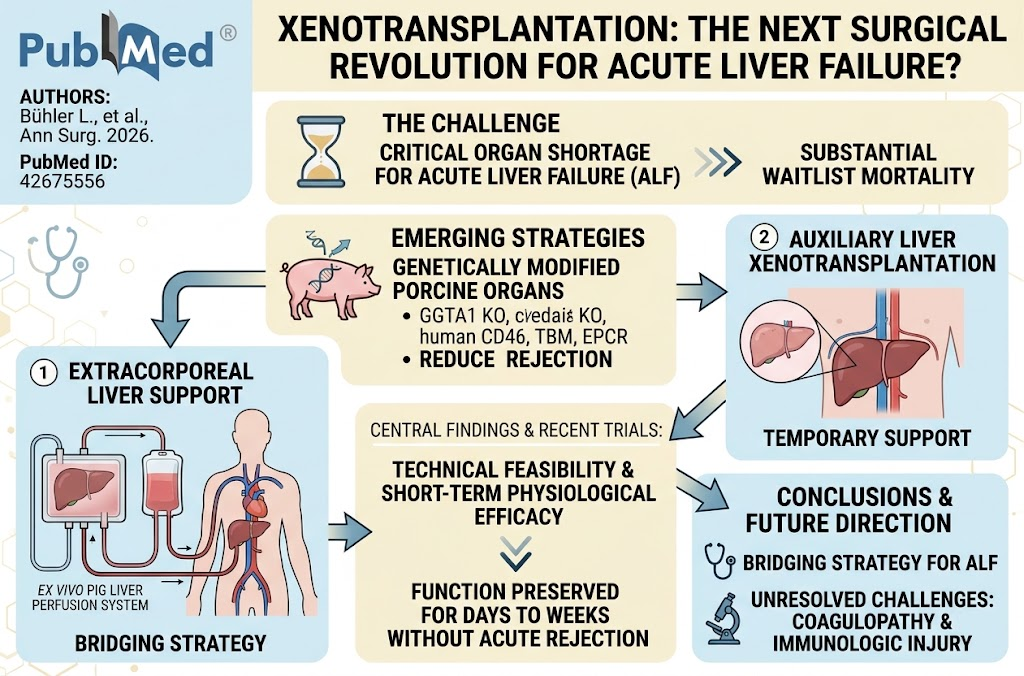
Highlight
- Xenotransplantation with genetically modified porcine livers offers a promising bridge therapy for patients with acute liver failure, addressing the critical organ shortage.
- Recent early clinical cases demonstrate technical feasibility and short-term viability of porcine liver grafts in extracorporeal support and auxiliary transplantation.
- Challenges remain, notably coagulopathy and immune-mediated injury, necessitating further genetic and immunologic refinements.
- Advances in gene editing, organ preservation, and machine perfusion technology underpin these translational breakthroughs.
Study Background
The persistent shortage of human donor livers is a critical limiting factor in the care of patients with acute liver failure (ALF), a clinical syndrome characterized by rapid loss of liver function often leading to multi-organ dysfunction and high mortality if transplantation is not timely. Traditional liver transplantation remains the definitive treatment, but the scarcity of available grafts leads to substantial waitlist mortality. Bridging therapies such as extracorporeal liver support systems have been explored with limited success. Xenotransplantation—the transplantation of organs from one species to another—has emerged as a potential solution, leveraging recent advances in genetic engineering of donor animals, particularly pigs. Pig organs share physiological similarities with human organs, and genetic modifications can mitigate hyperacute rejection and coagulation incompatibilities.
While xenotransplantation has had early successes in kidney and heart transplants, liver xenotransplantation poses unique challenges due to complex metabolic, synthetic, and hemodynamic functions of the liver. This has slowed clinical translation despite substantial research progress. Given the urgent need for effective bridge therapies in ALF and the promise shown by genetically modified porcine organs, a critical review of the current state of liver xenotransplantation is timely.
Study Design and Methods
This article reviews existing literature and early clinical applications focusing on genetically engineered porcine liver xenotransplantation. It summarizes two predominant clinical strategies:
1. Extracorporeal liver support using ex vivo perfusion of whole porcine livers connected to recipient circulation temporarily to provide metabolic support.
2. Transplantation of genetically modified porcine livers as auxiliary transplants to support native liver recovery or as bridging to allotransplantation.
The review highlights advances in gene editing technologies used to mitigate immunologic barriers, discusses organ preservation and logistics including long-term machine perfusion techniques, and evaluates outcomes from recent pioneering clinical trials and case reports.
Key Findings
Initial clinical applications since 2021 have demonstrated feasibility of using genetically modified porcine livers in both extracorporeal and in vivo auxiliary transplant settings. Notably:
– Porcine livers with multiple gene modifications (including knockout of galactose-alpha-1,3-galactose epitopes and additions of human complement regulatory and anticoagulant proteins) have functioned in human recipients for several days to weeks, providing essential metabolic and synthetic liver functions.
– Extracorporeal perfusion circuits incorporating porcine livers have temporarily supported recipients with ALF without immediate acute rejection.
– Auxiliary transplantation strategies where porcine livers are implanted alongside native livers have shown preserved graft function and hemodynamic stability for weeks, serving as an effective bridge to human transplantation.
Nonetheless, significant challenges endure. Recipient coagulopathy remains a major issue due to porcine liver interactions with the human coagulation system, leading to clotting abnormalities that have complicated post-transplant management. Immunologic injury, although mitigated by gene edits and immunosuppression, still leads to delayed rejection and organ dysfunction.
Technological advances in organ preservation via normothermic machine perfusion have enhanced graft viability and delivery to recipients, and ongoing improvements in genetic engineering strategies aim to improve immunologic compatibility further. These progressive steps establish a foundation for broader clinical trials and eventual routine use.
Expert Commentary
The re-emergence of liver xenotransplantation as a clinically viable modality represents a significant paradigm shift in managing acute liver failure. Experts underscore that overcoming complex immunologic and coagulation barriers is key to success. Prominent transplant surgeons and immunologists highlight that multi-gene editing approaches combined with tailored immunosuppressive regimens will be crucial to extending graft survival. Furthermore, better understanding of recipient-porcine liver interactions at the cellular and molecular level is necessary to circumvent ongoing rejection and coagulopathy.
Current early human experience is encouraging but limited to small case series; thus, randomized controlled trials and expanded registries are needed to evaluate efficacy and safety definitively. Guidelines on patient selection, timing, and post-implantation management will evolve as more data accrue.
Conclusion
Liver xenotransplantation using genetically modified porcine organs has transitioned from experimental proof-of-concept to early clinical application with promising results. It holds transformative potential as a bridge therapy for patients with acute liver failure who lack timely access to human donor grafts. Challenges including immune rejection, coagulopathy, and logistical hurdles remain but are actively being addressed through advances in gene editing and organ preservation technologies. Future research focused on optimizing graft genetics, immunomodulatory protocols, and multicenter clinical trials will be essential to realize widespread clinical adoption. In conclusion, xenotransplantation may herald a new surgical revolution for acute liver failure, improving survival and reducing waitlist mortality substantially.
Funding and Clinical Trials
The reviewed studies and trials have been supported by academic medical centers and innovation grants in transplantation research. No specific clinical trials were registered at the time of this review, but ongoing Phase I/II trials for porcine organ xenotransplantation are registered in transplant centers globally.
References
1. Bühler L, Hu X, Dou K, Deng S, Pinna A, Clavien PA. Xenotransplantation: The Next Surgical Revolution for Acute Liver Failure?. Ann Surg. 2026 Sep 1. PMID: 42675556.
2. Mohiuddin MM, Singh AK, Corcoran PC, et al. Genetically engineered pig heart transplantation in baboons. Nat Med. 2016;22(8):935-937.
3. Ekser B, Ezzelarab M, Hara H, et al. Clinical xenotransplantation: The next medical revolution? Lancet. 2012;379(9816):672-683.
4. Kawai T, Sachs DH, Sykes M, Cosimi AB. Xenotransplantation. Lancet. 2014;383(9915):1016-1028.
5. Cooper DKC, Ekser B, Tector AJ. Progress in pig-to-non-human primate transplantation models (1998-2013): a comprehensive review of the literature. Xenotransplantation. 2015;22(3):131-146.