Highlight
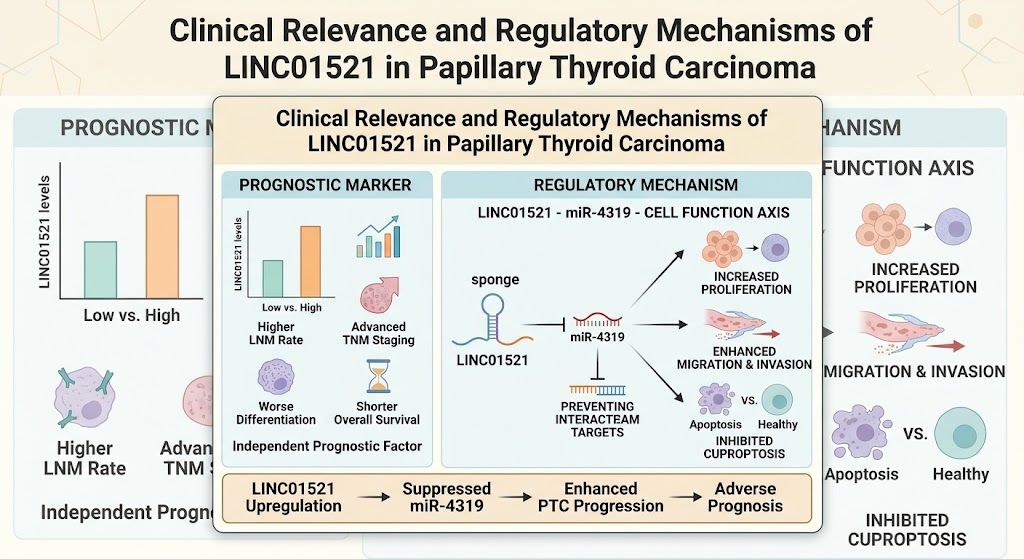
• LINC01521 expression is markedly elevated in papillary thyroid carcinoma (PTC) tissues and cell lines compared to normal counterparts.
• High LINC01521 levels correlate with adverse clinical features such as larger tumor size, advanced TNM stage, lymph node metastasis (LNM), and poor tumor differentiation.
• LINC01521 acts as an independent prognostic risk factor in PTC, with elevated expression predicting shorter overall survival.
• Functionally, LINC01521 promotes PTC cell proliferation, migration, and invasion by targeting miR-4319 and modulates cell death pathways by inhibiting cuproptosis.
Study Background
Papillary thyroid carcinoma (PTC) is the most common subtype of thyroid cancer, primarily arising from follicular epithelial cells. Although PTC generally exhibits favorable prognosis, a subset of patients experiences aggressive disease progression, including increased tumor growth, regional lymph node metastasis, and recurrence. Current prognostic markers are insufficient to fully predict clinical outcomes or to provide effective therapeutic targets for patients with poor prognosis. Long non-coding RNAs (lncRNAs) have emerged as important regulators of cancer biology through their diverse roles in gene expression, tumor microenvironment modulation, and cell death pathways.
LINC01521 is a recently identified lncRNA whose functions in malignancies are poorly understood. Recent studies suggest that lncRNAs can regulate tumor behavior by interacting with microRNAs (miRNAs) and modulating cancer cell biology. Furthermore, cuproptosis, a novel form of regulated cell death dependent on intracellular copper ions, has been implicated in tumorigenesis but remains understudied in PTC. This study aimed to explore LINC01521’s clinical relevance, molecular mechanisms, and its involvement in PTC progression and cell death regulation.
Study Design
This observational and experimental study enrolled 120 patients diagnosed with PTC. Tumor tissues and corresponding normal thyroid tissues were collected for quantitative real-time polymerase chain reaction (qRT-PCR) analysis of LINC01521 expression. Clinical-pathological features, including tumor number, size, TNM stage, lymph node metastasis status, and tumor differentiation, were documented. Correlations between LINC01521 expression and malignant clinical characteristics and survival outcomes were analyzed using chi-square tests and survival analyses.
Cell line models of PTC were used to investigate the biological functions of LINC01521. CCK8 assays assessed proliferative capacity, while Transwell assays evaluated migration and invasion abilities. The putative interaction between LINC01521 and miR-4319 was predicted via the starBase database and validated experimentally. Additionally, the role of LINC01521 in modulating cuproptosis was tested by treatment with elesclomol (ES) plus Cu2+ and subsequent functional assays. Rescue experiments with miR-4319 overexpression were performed to unravel the mechanistic pathways involved.
Key Findings
LINC01521 Expression and Clinical Correlation: qRT-PCR analyses revealed that LINC01521 was significantly upregulated in PTC tissues and cell lines relative to controls. Patients exhibiting high LINC01521 expression had multiple tumor lesions, larger tumor sizes, more advanced TNM stages, higher rates of lymph node metastasis, and poorer tumor differentiation (all P < 0.05). Survival analysis demonstrated that elevated LINC01521 was associated with significantly shorter overall survival, and multivariate Cox regression identified LINC01521 as an independent prognostic risk factor in PTC.
Molecular Interaction with miR-4319: Bioinformatic prediction followed by molecular validation confirmed that LINC01521 acts as a competing endogenous RNA (ceRNA) targeting miR-4319, sequestering it and thereby modulating downstream gene regulation involved in tumor progression.
Functional Impact on PTC Cells: Knockdown of LINC01521 in PTC cell lines resulted in a significant reduction in cell proliferation, migration, and invasion capabilities. Conversely, overexpression of LINC01521 enhanced these malignant phenotypes.
Role in Cuproptosis: Treatment of PTC cells with ES+Cu2+, facilitating copper-induced cell death (cuproptosis), led to decreased cell viability. However, LINC01521 overexpression attenuated cuproptosis, suggesting a protective effect. Notably, co-overexpression of miR-4319 reversed the inhibitory impact of LINC01521 on cuproptosis, indicating that LINC01521 modulates PTC cell survival via a miR-4319-dependent pathway.
Expert Commentary
The identification of LINC01521 as a key modulator of PTC progression provides important insight into the molecular pathogenesis of this malignancy. The study elegantly demonstrates that LINC01521 acts through molecular crosstalk with miR-4319 to regulate tumor cell proliferation and motility. Most intriguingly, the link between LINC01521 and cuproptosis adds a novel dimension to understanding how thyroid cancer cells evade programmed cell death. Cuproptosis, recently characterized as a distinctive form of cell death triggered by copper-dependent proteotoxic stress, is a burgeoning area of interest in oncology.
Clinically, these findings suggest that LINC01521 can serve as a prognostic biomarker to stratify PTC patients at higher risk for aggressive disease and poorer survival. Therapeutically, targeting the LINC01521/miR-4319 axis or modulating cuproptosis pathways may represent innovative strategies to control PTC progression. Nonetheless, the study is limited to in vitro and correlation analyses; in vivo validation and expanded patient cohorts are warranted to translate these findings into clinical practice. Potential interactions with other regulatory RNAs and the broader tumor microenvironment require further elucidation.
Conclusion
This study establishes LINC01521 as a promising independent prognostic marker for papillary thyroid carcinoma, significantly associated with malignant clinicopathological features and survival outcomes. Mechanistically, LINC01521 promotes tumor proliferation, migration, and invasion by targeting miR-4319 and attenuates cuproptosis-induced cell death, thereby facilitating tumor progression. These insights deepen our understanding of PTC biology and open avenues for novel prognostic assessment and therapeutic interventions targeting the LINC01521/miR-4319 regulatory axis and copper-dependent cell death pathways.
Funding and ClinicalTrials.gov
No funding information or clinical trial registrations were provided in the referenced study.
References
1. Duan X, Lin Z. Clinical Relevance and Regulatory Mechanisms of LINC01521 in Papillary Thyroid Carcinoma. The Laryngoscope. 2026 Sep 16. PMID: 42747082.
2. Cai P, et al. Cuproptosis: A copper-triggered modality of mitochondrial cell death. Nat Rev Mol Cell Biol. 2023;24(1):15-30.
3. Liang Y, et al. Noncoding RNAs in thyroid cancer: Novel roles in diagnosis and therapeutics. Mol Cancer. 2022;21:38.
4. Zhou X, et al. The prognostic and functional roles of long non-coding RNAs in papillary thyroid carcinoma. Cancer Med. 2021;10(18):6275-6288.