Highlight
– Real-world international cohort study comparing hypothermic oxygenated perfusion (HOPE) and normothermic machine perfusion (NMP) in liver transplantation.
– Despite significant donor risk differences, death-censored graft survival was similar and excellent for both modalities up to 3 years.
– The study highlights the necessity for high-quality evidence and longer preservation time analysis to substantiate NMP’s advantages in high-risk grafts.
Study Background
Liver transplantation (LT) is a life-saving treatment for patients with end-stage liver disease and acute liver failure. However, organ shortage remains a critical barrier, forcing transplant programs to increasingly use marginal or high-risk grafts such as extended-criteria donation after brain death (DBD) and donation after circulatory death (DCD) livers. These grafts are more susceptible to preservation injury, contributing to graft dysfunction and inferior outcomes. Machine perfusion technologies, notably hypothermic oxygenated perfusion (HOPE) and normothermic machine perfusion (NMP), have emerged as innovative methods to enhance graft preservation by optimizing organ quality and potentially improving transplant outcomes.
Comparative real-world data on HOPE and NMP remain scarce and methodologically challenging due to variability in donor and recipient risk profiles across regions and transplant centers. Thus, an international, multicenter cohort comparison is valuable for understanding the clinical effectiveness of these perfusion modalities in diverse practice environments.
Study Design
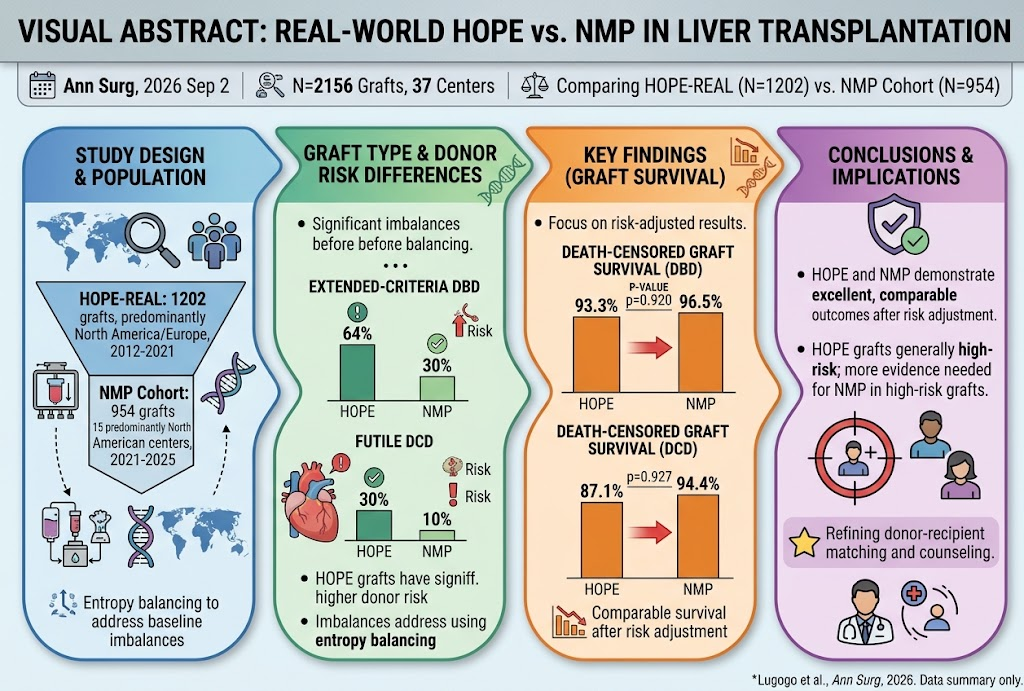
This study analyzed consecutive liver transplants preserved using NMP at 15 predominantly North American centers from 2021 to 2025. The comparator cohort comprised HOPE-treated transplants from the European HOPE-REAL study, including 22 centers and transplants performed between 2012 and 2021.
The primary endpoint was death-censored graft survival at 1, 2, and 3 years post-transplantation. Secondary analyses stratified outcomes by graft type—DBD and DCD—and graft risk category. To address baseline heterogeneity and confounding, entropy balancing was employed to adjust for differences in donor and recipient characteristics, ensuring a fair comparison of perfusion modalities. This approach compensates for imbalances, such as differing proportions of extended-criteria donors and futile grafts, thus improving the validity of comparative inferences.
Key Findings
A total of 954 grafts preserved via NMP and 1202 grafts treated with HOPE were included in the analysis. Substantial differences between the cohorts were evident: the HOPE cohort had a significantly higher percentage of extended-criteria DBD grafts (64% vs 30%) and futile DCD grafts (30% vs 10%) compared to the NMP cohort, signaling greater donor risk burden in the HOPE group.
Survival outcomes were excellent in both groups. In the NMP cohort, death-censored graft survival exceeded 96% in DBD and 94% in DCD grafts at 1, 2, and 3 years. The HOPE cohort demonstrated slightly lower but comparable survival rates, with 93% for DBD grafts and 87% for DCD grafts up to 3 years, despite the higher donor risk.
After rigorous risk adjustment, death-censored graft survival was statistically similar between HOPE and NMP across all graft types and risk categories, indicating that both machine perfusion methods effectively support graft viability.
These results underline the robustness of both HOPE and NMP in clinical practice, highlighting their capacity to enable successful transplantation of high-risk grafts while maintaining favorable long-term graft survival.
Expert Commentary
This large-scale, real-world cohort study constitutes a pivotal step in comparative evaluation of liver machine perfusion technologies. It confirms the clinical feasibility and safety of both HOPE and NMP, particularly in managing extended-criteria and DCD grafts.
However, the baseline donor risk disparities and regional practice variations underscore the complexity of direct comparisons. The study’s use of entropy balancing is commendable but cannot fully eliminate residual confounding from unmeasured variables such as recipient comorbidities, intraoperative practices, and post-transplant management.
NMP offers theoretical advantages by preserving graft metabolism at physiological temperature, enabling functional assessment and therapeutic interventions during perfusion. Yet, current real-world evidence does not definitively demonstrate superior clinical effectiveness over HOPE, which is simpler and has established efficacy in improving outcomes especially in DCD grafts.
Notably, the relatively shorter clinical experience and shorter preservation times with NMP compared to HOPE may limit the demonstration of long-term benefits. Future randomized controlled trials with standardized protocols and extended preservation durations are warranted to clarify NMP’s incremental value.
Conclusion
Both hypothermic oxygenated perfusion and normothermic machine perfusion achieve excellent graft survival in real-world liver transplantation, including for high-risk graft categories such as extended-criteria donors and DCD livers. After adjustment for donor risk differences, outcomes appear comparable, substantiating both modalities as valid approaches to improve organ preservation.
Further high-quality evidence, including prospective randomized studies and longer preservation time assessments, is essential to substantiate any additional benefits of NMP, particularly for marginal grafts. Clinicians and transplant centers should consider local expertise, resource availability, and donor characteristics when selecting machine perfusion strategies.
Funding and ClinicalTrials.gov
This study was conducted by the Real-World Liver Perfusion Consortium and was supported by multicenter research funding. Detailed funding sources were not specified in the publication. ClinicalTrials.gov registration details were not provided.
References
Pfister M, Eden J, Rasel H, et al. Real-World Analysis of Hypothermic Oxygenated Perfusion and Normothermic Machine Perfusion in Liver Transplantation: An International Cohort Study. Ann Surg. 2026 Sep 2. PMID: 42684111.
Additional relevant literature:
– Dutkowski P, Polak WG, Muiesan P, et al. HOPE for Human Liver Grafts Retrieved from Donors After Cardiac Death. J Hepatol. 2014 Feb;60(2): 335-343.
– Nasralla D, Coussios CC, Mergental H, et al. A randomized trial of normothermic preservation in liver transplantation. Nature. 2018 Jan 4;557(7703):50-56.
– Schlegel A, Graf R, Clavien PA. Hypothermic machine preservation of organs: State of the art. Curr Opin Organ Transplant. 2017 Jun;22(3):274-280.