Highlights
- Age and body mass index (BMI) significantly influence serum dexamethasone concentrations during the 1-mg overnight dexamethasone suppression test (DST).
- Renal function and concomitant medications, including proton pump inhibitors (PPIs) and statins, have limited impact on dexamethasone exposure after statistical adjustment.
- Suboptimal dexamethasone exposure, defined as serum dexamethasone <4.5 nmol/L, occurs in approximately 3.3% of patients and often correlates with inadequate cortisol suppression.
- Measuring serum dexamethasone levels can enhance the interpretation of DST results by identifying insufficient dexamethasone exposure rather than attributing cortisol levels to pathologic hypercortisolism.
Study Background
The overnight 1-mg dexamethasone suppression test (DST) is a cornerstone biochemical screening tool used to identify endogenous hypercortisolism, including Cushing’s syndrome. Its principle relies on the suppression of the hypothalamic-pituitary-adrenal (HPA) axis by dexamethasone, a potent synthetic glucocorticoid, thereby reducing serum cortisol levels in healthy individuals. However, clinical interpretation of the DST may be confounded by variability in dexamethasone exposure due to interindividual differences in absorption, metabolism, and clearance, as well as by concurrent medications or comorbid conditions. This variability can lead to false-positive or false-negative results, challenging the diagnostic accuracy of the test.
Understanding the determinants of serum dexamethasone concentration during DST is key to refining test interpretation and improving diagnostic reliability. Previous studies have suggested that age, body mass index (BMI), renal function, and the use of certain medications might affect dexamethasone pharmacokinetics, but evidence is limited, and the clinical impact remains unclear.
Study Design
This was an observational cohort study involving 546 adult patients undergoing the 1-mg overnight DST as part of clinical evaluation for suspected hypercortisolism. Serum cortisol and dexamethasone levels were measured the morning following administration of 1 mg oral dexamethasone at 11 PM. Clinical variables including age, BMI, and estimated glomerular filtration rate (eGFR) were recorded. Concomitant medications known or suspected to affect dexamethasone metabolism, such as proton pump inhibitors (PPIs), statins, and calcium channel blockers, were documented.
The study primarily used multivariable linear regression to assess independent associations of clinical and pharmacological factors with serum dexamethasone concentrations. Logistic regression was employed to identify determinants of suboptimal dexamethasone exposure, defined as serum dexamethasone <4.5 nmol/L, a threshold linked to inadequate cortisol suppression.
Key Findings
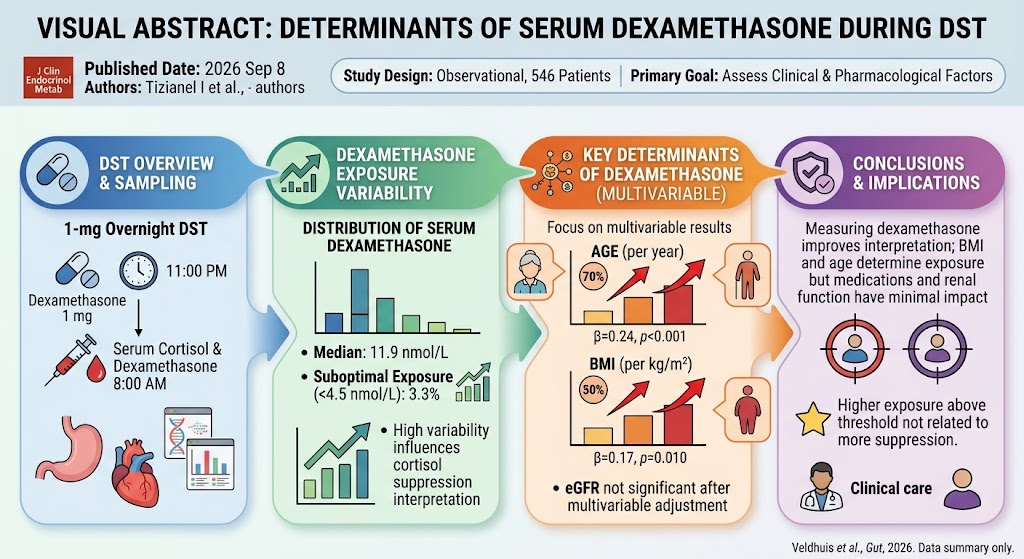
The median serum dexamethasone concentration was 11.9 nmol/L (interquartile range not specified). Multivariable analysis revealed that older age and higher BMI were independently associated with increased dexamethasone levels. Specifically, age had a standardized beta coefficient (β) of 0.24 (p<0.001) and BMI had β = 0.17 (p=0.010). In contrast, renal function (eGFR) did not significantly impact dexamethasone levels when adjusting for other variables.
Univariable analyses suggested that concomitant use of PPIs, statins, and calcium channel blockers correlated with higher dexamethasone concentrations. However, these associations lost significance after sensitivity analyses and adjustment for confounders. Age-stratified analyses revealed nuanced patterns: among patients younger than 65 years, BMI and PPI use remained associated with dexamethasone levels, whereas in those aged 65 years or older, statin and PPI use were more relevant determinants.
Importantly, suboptimal dexamethasone exposure occurred in 3.3% of the cohort and was frequently linked to insufficient cortisol suppression on DST, suggesting a potential cause of false-positive DST results due to inadequate dexamethasone bioavailability rather than true hypercortisolism. Even after excluding patients with mild autonomous cortisol secretion, BMI and eGFR remained significant factors influencing dexamethasone concentrations.
Crucially, once adequate dexamethasone exposure was achieved, higher serum dexamethasone levels did not correspond to further cortisol suppression, indicating a ceiling effect and underscoring the importance of ensuring minimal effective dexamethasone concentration rather than striving for supraphysiological levels.
Expert Commentary
This study addresses a critical but often underappreciated aspect of the dexamethasone suppression test: variability in dexamethasone exposure that can confound test results. The findings emphasize that demographic parameters, particularly age and BMI, significantly affect dexamethasone pharmacokinetics and thus DST performance. The initial associations of concomitant medications such as PPIs and statins likely reflect complex pharmacological interactions and patient characteristics, but these effects appear modest after controlling for confounders.
Renal function did not emerge as a robust independent determinant of dexamethasone levels, which may reassure clinicians that mild-to-moderate reductions in eGFR have limited impact on dexamethasone clearance in DST settings.
Measurement of serum dexamethasone levels is not routinely performed during DST but can provide valuable information to differentiate false-positive DST results caused by suboptimal dexamethasone exposure versus true hypercortisolism. Clinical protocols may incorporate dexamethasone assays to enhance diagnostic precision, especially in atypical presentations or when clinical suspicion remains despite DST findings.
Limitations of the study include its observational design, potential selection bias, and lack of detailed characterization of mild autonomous cortisol secretion, which may affect generalizability. Additionally, pharmacogenetic factors influencing dexamethasone metabolism were not explored, representing an area for future research.
Conclusion
This comprehensive analysis highlights age and BMI as significant clinical determinants of serum dexamethasone concentrations during the 1-mg overnight DST. While renal function and common medications exert minor influences after adjustment, the identification of suboptimal dexamethasone exposure in a minority of patients underscores the need for nimble interpretation of DST results.
Routine or targeted measurement of serum dexamethasone may improve the clinical utility of DST by distinguishing inadequate dexamethasone exposure from pathological cortisol dysregulation. This approach can reduce false positives, enhance diagnostic accuracy, and guide patient management more effectively.
Future studies should explore genetic and molecular determinants of dexamethasone pharmacokinetics, optimal dexamethasone dosing strategies across patient subgroups, and prospective validation of dexamethasone measurement-guided DST interpretation algorithms.
Funding and Registration
The study was conducted without specific external funding. Clinical trial registration details were not provided.
References
1. Tizianel I, Antonelli G, Mondin A, et al. Clinical and pharmacological determinants of serum dexamethasone concentrations during dexamethasone suppression test. J Clin Endocrinol Metab. 2026 Sep 8; PMID: 42708510.
2. Nieman LK, Biller BMK, Findling JW, et al. The diagnosis of Cushing’s syndrome: an Endocrine Society clinical practice guideline. J Clin Endocrinol Metab. 2008;93(5):1526-1540.
3. Oelkers W. Adverse effects of glucocorticoids on the cardiovascular system. Ann N Y Acad Sci. 2002;966: 896-900.
4. Stewart PM, Bouloux PMG, Cunningham MJ. Dexamethasone in the diagnosis of disorders of the hypothalamic–pituitary–adrenal axis. Rev Endocr Metab Disord. 2014;3(2):215-220.
5. Newell-Price J, Grossman AB, Nieman LK, et al. Cushing’s syndrome. Lancet. 2006;367(9522):1605-1617.