Highlight
This retrospective cohort study analyzed corticosteroid tapering practices for immune-related adverse events (irAEs) in gynecologic malignancy patients undergoing immune checkpoint inhibitor (ICI) therapy. The key findings include: 1) Substantial variability in steroid taper length and adherence to National Comprehensive Cancer Network (NCCN) guidelines; 2) Guideline-discordant and shorter (< 28 days) steroid tapers correlated with higher rates of additional supportive medication requirements and steroid reinitiation; 3) Longer tapers were associated with increased rates of permanent ICI discontinuation due to toxicity; 4) No differences were observed in hospitalization, ICU admission, or irAE resolution between groups.
Background
Immune checkpoint inhibitors have transformed the treatment landscape for various gynecologic cancers, including endometrial, cervical, and ovarian cancers, by enhancing antitumor immune responses. However, irAEs—ranging from mild to severe—pose significant management challenges. High-grade (grade 3 or 4) irAEs often require systemic corticosteroids for immunosuppression. While guidelines such as those from the NCCN recommend clinical management strategies including steroid tapering schedules, real-world practices vary considerably. There is limited evidence guiding the optimal corticosteroid taper duration to balance irAE control with minimizing steroid-related toxicity and preserving the efficacy of immunotherapy. Understanding steroid tapering impact on treatment outcomes in gynecologic oncology is crucial for optimizing irAE management.
Study Design
This is a single-center retrospective cohort study conducted at an academic institution analyzing patients with gynecologic malignancies treated with ICIs between August 2016 and September 2025. Inclusion criteria were the development of grade 3 or 4 irAEs necessitating systemic corticosteroids. Clinical data including cancer type, ICI regimen, severity and type of irAE, corticosteroid dosing, taper duration, and management outcomes were abstracted from medical records. Corticosteroid tapers were categorized based on conformity to NCCN guidelines and taper length (<28 days vs. ≥28 days). Endpoints included additional medication requirements for irAE management (secondary steroids or supportive drugs), time to ICI therapy restart, rates of ICI discontinuation due to toxicity, hospitalization or ICU admission related to irAEs, and irAE resolution.
Key Findings
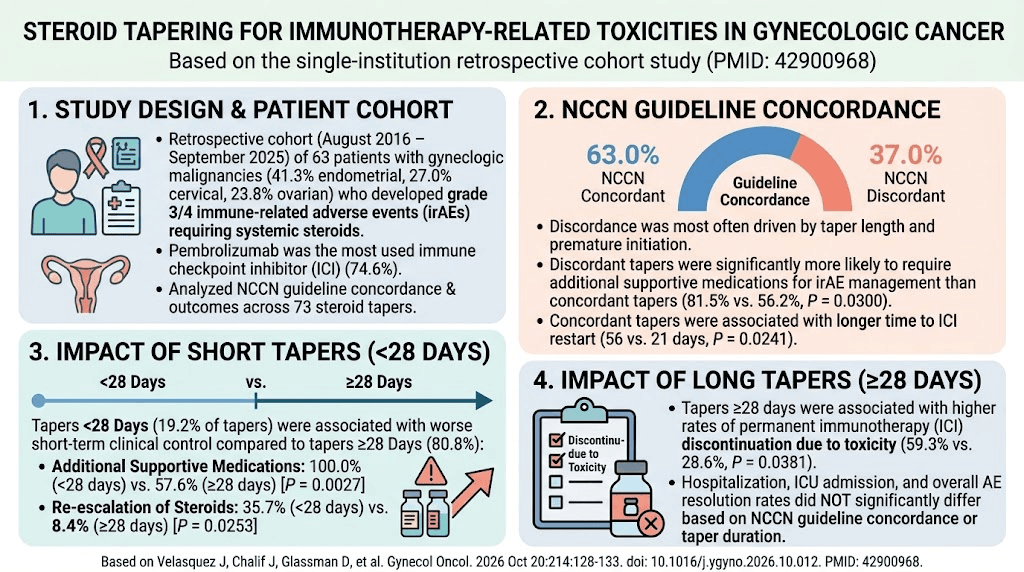
The study included 63 patients with 73 separate steroid taper courses. Endometrial cancer was most common (41.3%), followed by cervical (27.0%) and ovarian cancer (23.8%). Pembrolizumab was the predominant ICI used (74.6%).
NCCN Guideline Concordance: About 63.0% of tapers conformed to NCCN guidelines, whilst 37.0% were discordant. Nonconformity mainly stemmed from inappropriate taper lengths and early taper initiation before recommended criteria.
Taper Duration: Fourteen tapers (19.2%) lasted less than 28 days, whereas 59 (80.8%) had longer taper durations of 28 days or more.
Impact on Treatment Escalation: Guideline-discordant tapers showed significantly higher need for additional supportive medications for irAE management (81.5% vs. 56.2%; p=0.0300). Similarly, tapers less than 28 days universally required adjunctive therapies (100% vs 57.6%; p=0.0027) and were more likely to necessitate steroid reinitiation (35.7% vs 8.4%; p=0.0253).
ICI Treatment Considerations: Patients with NCCN guideline-concordant tapers had a longer interval before restarting ICIs (median 56 vs 21 days; p=0.0241), potentially reflecting more cautious management. Conversely, longer tapers (≥28 days) correlated with more frequent ICI treatment discontinuation due to toxicity (59.3% vs 28.6%; p=0.0381), possibly indicating more severe or persistent irAEs.
Safety and Resolution: Hospitalization rates, intensive care admissions, and ultimate resolution of irAEs did not significantly differ according to taper guideline adherence or duration, underscoring that both short and long tapers could achieve irAE resolution given appropriate clinical monitoring.
Expert Commentary
This study highlights the real-world heterogeneity in corticosteroid tapering practices for severe irAEs in gynecologic oncology patients receiving ICIs. The association of guideline-discordance and shorter tapers with increased need for subsequent immunosuppressive treatment supports current recommendations for careful prolonged tapering schedules to prevent relapse of irAEs. However, longer taper durations might reflect more severe toxicities, as suggested by higher ICI discontinuation rates, emphasizing the clinical complexity in balancing irAE resolution and continuation of immunotherapy.
Notably, the lack of difference in hospitalization or ICU admissions suggests that, despite variations in practice, irAE management outcomes can be satisfactory if closely monitored. The findings are consistent with prior evidence from other cancer types that gradual corticosteroid tapering reduces irAE recurrence risk but may also prolong immunosuppression, raising infection and metabolic risks. Clinicians should individualize tapers based on irAE severity, patient tolerance, and cancer status.
Limitations include the retrospective design, single-center setting, and potential residual confounding by irAE severity and patient comorbidities. Prospective studies are warranted to refine corticosteroid tapering protocols further and integrate biomarkers predictive of irAE recurrence or steroid responsiveness.
Conclusion
Among gynecologic cancer patients experiencing severe irAEs on immune checkpoint inhibitors, corticosteroid tapering strategies vary considerably, impacting subsequent treatment escalation and immunotherapy management. Adherence to NCCN guideline taper recommendations and longer taper durations are associated with reduced need for additional immunosuppression but may result in longer delays before ICI reinitiation and higher ICI discontinuation rates. Balancing effective irAE control with minimizing steroid-related adverse effects and maintaining cancer treatment remains a clinical challenge. This study informs the need for standardized tapering protocols and prospective research to optimize immunotherapy safety and efficacy in gynecologic oncology.
References
1. Velasquez J, Chalif J, Glassman D, Gonzalez A, O’Connor R, Abdeen C, et al. How slow should we go? Variation and outcomes of steroid tapering for immunotherapy-related toxicities in gynecologic cancer. Gynecol Oncol. 2026 Oct 20;214:128-133. doi:10.1016/j.ygyno.2026.10.008. PubMed PMID: 42900968.
2. Brahmer JR, Abu-Sbeih H, Ascierto PA, et al. Management of Immune-Related Adverse Events in Patients Treated With Immune Checkpoint Inhibitor Therapy: American Society of Clinical Oncology Clinical Practice Guideline. J Clin Oncol. 2018 Jun 10;36(17):1714-1768. doi:10.1200/JCO.2017.77.6385.
3. National Comprehensive Cancer Network. NCCN Clinical Practice Guidelines in Oncology – Management of Immunotherapy-Related Toxicities. Version 1.2024.