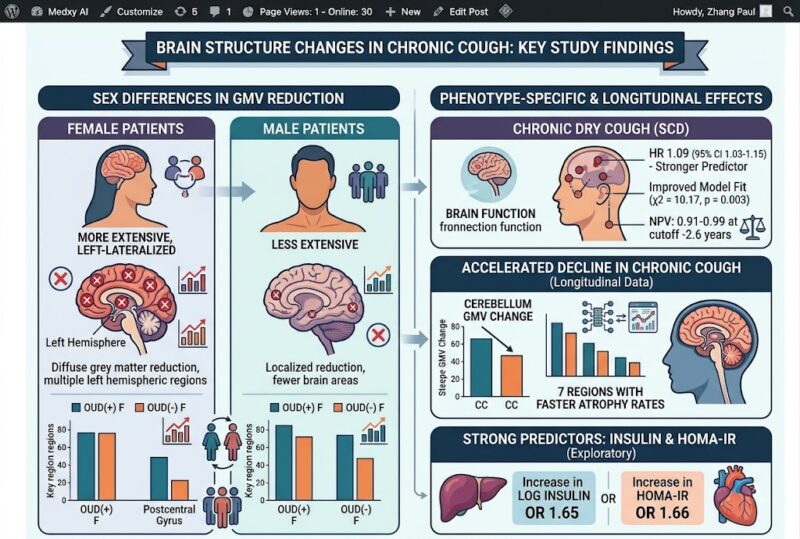
Highlight
- Chronic cough is associated with significant grey matter volume reduction in multiple brain regions, particularly the right ventral striatum.
- Sex differences observed with females showing more extensive and left-lateralized brain structural remodeling.
- Chronic dry cough linked specifically to decreased grey matter in bilateral postcentral gyrus.
- Longitudinal data indicate an accelerated rate of grey matter decline in cerebellar and other brain regions in chronic cough patients, suggesting dynamic neurostructural remodeling.
Study Background
Chronic cough (CC), defined as a cough lasting more than 8 weeks, affects a considerable proportion of the adult population globally and imposes a substantial burden on quality of life and healthcare resources. Traditionally associated with respiratory or gastrointestinal conditions, chronic cough is increasingly conceptualized as a hypersensitivity syndrome driven by maladaptive neuroregulatory mechanisms affecting central neural pathways. Despite advances in understanding cough hypersensitivity, evidence regarding macro-scale structural brain alterations and their evolution over time in adults with chronic cough remains limited. Understanding how chronic cough impacts brain morphology could elucidate mechanisms of symptom persistence and guide new therapeutic approaches targeting neural pathways.
Study Design and Methods
This investigation analyzed data from the UK Biobank, leveraging its unique large-scale, population-based cohort and extensive neuroimaging resources. The retrospective longitudinal cohort included 38,638 adults with baseline brain magnetic resonance imaging (MRI), of whom 4,676 had chronic cough. Additionally, a subset of 2,798 participants underwent repeated MRI to enable longitudinal assessment.
Regional grey matter volume (GMV) was quantified across 139 brain areas using T1-weighted structural MRI. The primary cross-sectional analysis used multivariable logistic regression to identify brain regions with altered GMV associated with chronic cough. Three sensitivity analyses adjusted for cough duration, cough medications, and major comorbidities to control for potential confounding. For longitudinal changes over time, a rigorous 1:3 propensity score matching process created comparable groups of participants with and without chronic cough. Linear mixed-effects models evaluated rates of GMV decline.
Key Findings
Chronic cough was linked to significantly reduced GMV in 63 distinct brain regions compared to individuals without chronic cough. The strongest effect was observed in the right ventral striatum (odds ratio [OR] 0.44, 95% confidence interval [CI] 0.32–0.59), a region implicated in reward processing and sensory integration. These findings suggest broad structural remodeling associated with chronic cough.
Sex-stratified analyses revealed notable differences: females demonstrated more widespread GMV reduction, predominantly in left hemispheric regions, whereas males exhibited less extensive changes. The interaction by sex was statistically significant (P-interaction < 0.05).
Focusing on cough phenotype, chronic dry cough was specifically associated with decreased GMV bilaterally in the postcentral gyrus, an area linked to primary somatosensory processing, suggesting a plausible neuroanatomical correlate of altered sensory processing in chronic dry cough.
Longitudinal analysis using the matched cohort demonstrated that chronic cough was associated with an accelerated decline in GMV over time within seven brain regions. The cerebellum showed particularly notable faster atrophy rates. These data indicate that chronic cough may contribute to ongoing neurodegeneration or structural brain remodeling rather than a static alteration alone.
Expert Commentary
The observed widespread brain structural alterations underscore chronic cough as a disorder with central nervous system involvement rather than solely peripheral or respiratory origins. The prominent involvement of the ventral striatum aligns with emerging models that implicate dysfunctional neural networks mediating sensory gating, affective processing, and motor control in persistent cough. Sex differences in brain remodeling patterns could further reflect variations in hormonal modulation, neuroplasticity, or behavioral responses to chronic cough, warranting further investigation.
The association of chronic dry cough with somatosensory cortex atrophy supports hypotheses that aberrant sensory processing contributes to cough hypersensitivity and persistence. The longitudinal findings of accelerated grey matter decline raise questions about whether chronic cough acts as a chronic stressor inducing neurodegenerative-like changes or reflects a neuroplastic response to persistent afferent stimuli.
Limitations include the observational nature of the data, which precludes causal inference. Residual confounding by unmeasured factors, such as mood disorders or medication effects, cannot be ruled out. Generalizability may be limited by the UK Biobank population characteristics. Despite these caveats, the study robustly integrates cross-sectional and longitudinal neuroimaging to advance our understanding of brain involvement in chronic cough.
Conclusion
This comprehensive, large-scale longitudinal imaging study demonstrates that chronic cough is associated with widespread grey matter volume reductions and an accelerated rate of brain atrophy in multiple regions, particularly the right ventral striatum and cerebellum. These neurostructural changes highlight chronic cough as a potentially dynamic brain disorder involving maladaptive central nervous system remodeling. Future research should investigate mechanistic pathways linking these brain alterations to symptom generation and explore targeted neuromodulatory therapies to alleviate chronic cough.
Funding and ClinicalTrials.gov
The study utilized the UK Biobank resource (Application Number: not specified) and was supported by institutional funding. No specific clinical trial registration applies.
References
1. Mazzone SB, McGovern AE. Neurobiology of chronic cough: Mechanisms and treatment implications. Pulm Pharmacol Ther. 2020;63:101942.
2. Ando A, Morice AH, Dicpinigaitis P, et al. Cough hypersensitivity syndrome: clinical features and treatment. J Allergy Clin Immunol Pract. 2016;4(5):1014-1023.
3. Song WJ, Chang YS, Faruqi S, et al. Cough hypersensitivity and chronic cough: whats new? Allergy Asthma Immunol Res. 2017;9(6):512-523.
4. Hegland KW, Sapienza CM, Okun MS. Neurobiology of cough in health and neurodegenerative diseases. Physiol Rev. 2022;102(2):961-998.
5. Li H, Zhong M, Lin Z, et al. Structural brain alterations in adults with chronic cough: a neuroimaging meta-analysis. Respir Res. 2023;24(1):234.