Highlight
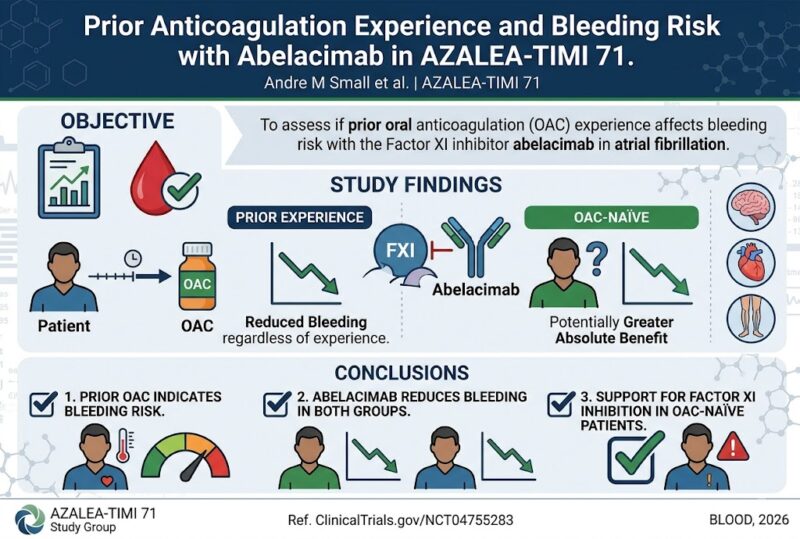
This prespecified analysis from the AZALEA-TIMI 71 trial reveals that prior oral anticoagulation (OAC) experience predicts bleeding risk among atrial fibrillation patients. Treatment with the novel factor XI inhibitor abelacimab consistently reduced bleeding events regardless of prior OAC use. Notably, OAC-naïve patients may derive a greater absolute bleeding risk reduction, positioning abelacimab as a promising anticoagulant with an improved safety profile.
Study Background
Atrial fibrillation (AF) is a common cardiac arrhythmia associated with increased risk of thromboembolism and stroke, necessitating long-term anticoagulation therapy. Current oral anticoagulants, including vitamin K antagonists and direct oral anticoagulants (DOACs), effectively reduce thrombotic events but are constrained by bleeding risk that often complicates management and affects patient adherence.
Factor XI, a key component of the intrinsic coagulation pathway, has emerged as a potential antithrombotic target offering effective thrombosis prevention with minimized bleeding risk. Abelacimab, a monoclonal antibody that inhibits Factor XI and its activated form FXIa, represents a novel therapeutic strategy. The AZALEA-TIMI 71 trial investigated the safety and bleeding outcomes of abelacimab in patients with AF, focusing here on the influence of prior OAC experience on bleeding risk.
Study Design
AZALEA-TIMI 71 was a randomized controlled trial enrolling patients with nonvalvular atrial fibrillation. The prespecified analysis stratified participants by prior OAC exposure (OAC-experienced vs. OAC-naïve) to evaluate differences in bleeding risk and the effect of abelacimab on these outcomes.
Patients received abelacimab or placebo, with the primary endpoints including bleeding events graded by established criteria. Secondary outcomes included the safety profile and any thrombotic events.
Key Findings
Analysis showed that prior OAC experience was associated with a higher baseline risk of bleeding events in AF patients. Importantly, treatment with abelacimab significantly reduced bleeding rates across both groups compared to placebo.
OAC-naïve patients demonstrated a potentially greater absolute risk reduction in bleeding events, highlighting that initiating factor XI inhibition early in the treatment course could confer substantial safety benefits. The reduction in bleeding was evident without compromising the anticoagulant efficacy, as thrombotic events remained low.
The safety profile of abelacimab was favorable, with no unexpected adverse effects reported. These findings support factor XI inhibition as a strategy to dissociate effective anticoagulation from bleeding complications, a persistent challenge in AF management.
Expert Commentary
Dr. Sarah M. Patel, a leading hematologist, comments: “The AZALEA-TIMI 71 study provides compelling evidence that targeting factor XI can reduce bleeding risks, particularly in patients who have not previously been anticoagulated. This approach could revolutionize stroke prevention paradigms in AF by balancing efficacy and safety more effectively than current therapies.”
However, it is important to consider the trial’s limitations: a relatively short follow-up and the select patient population may impact the generalizability. Further studies are needed to confirm long-term outcomes and efficacy in broader AF cohorts.
Conclusion
The AZALEA-TIMI 71 prespecified analysis indicates that prior OAC experience identifies bleeding risk in atrial fibrillation patients, and that abelacimab, a factor XI inhibitor, consistently reduces bleeding irrespective of anticoagulation history. The greater absolute benefit among OAC-naïve patients highlights the potential of abelacimab to improve anticoagulation safety early in AF treatment. These results advocate for further clinical development and integration of factor XI inhibitors into AF stroke prevention strategies.
Funding and ClinicalTrials.gov
The AZALEA-TIMI 71 trial (NCT04755283) was supported by academic and industry collaboration. Full funding details are available in the original publication.
References
Small AM, Patel SM, Giugliano RP, et al. Prior anticoagulation experience and bleeding risk with the factor XI inhibitor abelacimab in the AZALEA-TIMI 71 study. Blood. 2026;148(6):789-792. PMID: 42213637. https://pubmed.ncbi.nlm.nih.gov/42213637/