Highlight
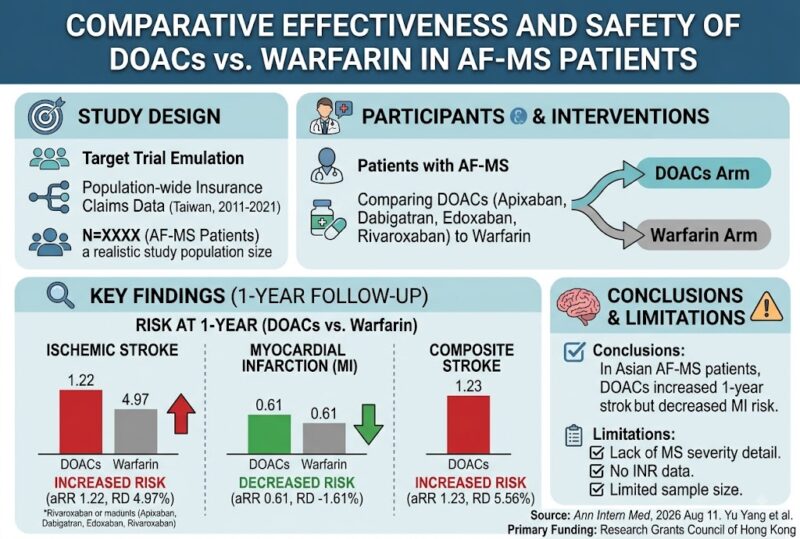
– Direct oral anticoagulants (DOACs) showed a higher 1-year risk of ischemic and composite stroke compared to warfarin in patients with atrial fibrillation and mitral stenosis (AF-MS).
– DOACs were associated with a lower risk of myocardial infarction at 1 year.
– No significant difference was found between DOACs and warfarin regarding bleeding complications or all-cause mortality.
– Rivaroxaban, a specific DOAC, was linked to increased ischemic stroke risk in both short- and long-term follow-up.
Study Background
Atrial fibrillation (AF) concurrent with mitral stenosis (MS) represents a particularly high-risk subset for thromboembolic events. Traditionally, vitamin K antagonists such as warfarin have been the mainstay of anticoagulation in this population due to concerns about the safety and efficacy of direct oral anticoagulants (DOACs) in valvular AF. However, warfarin use is complicated by narrow therapeutic windows, dietary interactions, and frequent monitoring requirements. The expanding usage of DOACs in other AF populations necessitates robust data addressing their role in patients with AF and MS. This is clinically critical given the significant morbidity associated with ischemic stroke, systemic embolism, and bleeding events in this high-risk group and the evolving landscape of anticoagulation therapy.
Study Design
This investigation was an observational cohort study applying a target trial emulation approach, leveraging population-wide insurance claims data from Taiwan between January 2011 and December 2021. The study included patients diagnosed with atrial fibrillation and mitral stenosis who initiated either DOACs or warfarin therapy. The interventions compared were DOAC regimens versus warfarin treatment. The primary outcomes were ischemic stroke, systemic embolism, composite stroke, myocardial infarction (MI), intracranial hemorrhage, gastrointestinal bleeding, bleeding at other critical sites, and all-cause death assessed at 1 and 5 years of follow-up. Absolute risk differences (RDs) and risk ratios (RRs) with 95% confidence intervals were calculated to quantify comparative effectiveness and safety.
Key Findings
The study included an Asian cohort with AF-MS, reflecting real-world prescribing patterns. At 1 year, DOACs were associated with significantly higher risks of ischemic stroke (RD 4.97 percentage points, 95% CI 1.27 to 8.57; RR 1.22, 95% CI 1.05 to 1.41) and composite stroke (RD 5.56 percentage points, 95% CI 1.77 to 8.97; RR 1.23, 95% CI 1.07 to 1.42) compared with warfarin. Notably, DOAC use corresponded with a reduced risk of myocardial infarction (RD -1.61 percentage points, 95% CI -3.17 to -0.03; RR 0.61, 95% CI 0.37 to 0.99). These contrasting outcomes highlight a complex risk-benefit profile in this population.
Regarding safety, the incidence of bleeding events, including intracranial hemorrhage, gastrointestinal bleeding, and bleeding at other critical sites, did not differ significantly between DOAC and warfarin groups. Similarly, all-cause mortality was comparable, underscoring that increased stroke risk with DOACs was not offset by survival differences within 1 year.
Subgroup analysis revealed that rivaroxaban, a common DOAC, was specifically associated with an elevated ischemic stroke risk in both short- and long-term follow-up periods. This finding suggests divergent efficacy among specific DOAC agents within this clinical context.
Expert Commentary
This study addresses an important clinical uncertainty: the appropriateness of DOACs in atrial fibrillation patients with mitral stenosis. While DOACs offer practical advantages over warfarin, including fixed dosing and no routine anticoagulation monitoring, the increased stroke risk observed calls for caution. The biological plausibility may relate to altered hemodynamics and thrombogenic milieu in rheumatic mitral stenosis, which potentially attenuates DOAC efficacy. Conversely, the reduction in myocardial infarction risk may reflect differential vascular effects or patient selection biases.
Limitations include the observational design susceptible to confounding despite target trial emulation methodology, limited sample size, and a lack of granular data on mitral stenosis severity and INR control in the warfarin group. These factors limit the precision of effect estimates and generalizability, particularly outside the Asian patient population studied.
Current guidelines cautiously recommend warfarin for valvular AF, especially with moderate to severe MS. This study reinforces that position and highlights the need for randomized controlled trials specifically evaluating DOACs in AF-MS.
Conclusion
In Asian patients with atrial fibrillation and mitral stenosis, DOACs were associated with an increased 1-year risk of ischemic and composite stroke yet a decreased myocardial infarction risk compared to warfarin. There were no significant differences in bleeding outcomes or overall mortality. Rivaroxaban may pose higher stroke risk among specific DOACs. These findings support warfarin as the preferred anticoagulant in AF-MS until further evidence from robust randomized trials clarifies DOAC safety and efficacy. Clinicians should carefully weigh stroke and cardiac risks when considering anticoagulant choice in this complex patient population.
Funding
This study was funded by the Research Grants Council of Hong Kong.
References
Yang Y et al. Real-World Effectiveness and Safety of Direct Oral Anticoagulants Versus Warfarin in Patients With Atrial Fibrillation and Mitral Stenosis: A Target Trial Emulation. Ann Intern Med. 2026 Aug 11. PMID: 42574730.
Connolly SJ, et al. Dabigatran versus Warfarin in Patients with Atrial Fibrillation. N Engl J Med. 2009.
Vahanian A, et al. 2021 ESC/EACTS Guidelines for the management of valvular heart disease. Eur Heart J. 2022.