Highlights
- Financial incentives tied to hypertension quality metrics modestly increase blood pressure remeasurement but have limited impact on overall blood pressure control rates.
- Among patients with marginally elevated blood pressure, incentives can lead to selective remeasurement and documentation of control without corresponding medication intensification.
- Reduced antihypertensive dose adjustments in marginally hypertensive patients correlate with increased risk of stroke and acute coronary syndrome hospitalizations over 1 year.
- These findings raise critical considerations about unintended consequences of pay-for-performance models in chronic disease management.
Background
Hypertension affects over one billion adults worldwide and remains a leading modifiable risk factor for cardiovascular morbidity and mortality. Effective management in primary care can substantially reduce risks of stroke, myocardial infarction, and heart failure. To improve care quality, health systems have increasingly implemented financial incentives tied to quality metrics emphasizing blood pressure (BP) control, commonly defined as BP <140/90 mm Hg. Despite widespread adoption, isolating the net clinical impact of such incentive programs remains challenging due to multiple confounding factors and variable clinical behaviors.
The clinical landscape has evolved with guidelines periodically adjusting BP targets and with growing recognition of the nuances between population-level control metrics and individualized patient care decisions. Understanding the effects of these incentives on both clinical processes, such as medication adjustments and BP monitoring, and on downstream patient outcomes is essential to optimize hypertension management policies.
Key Content
Methodological Overview of the Evaluated Study
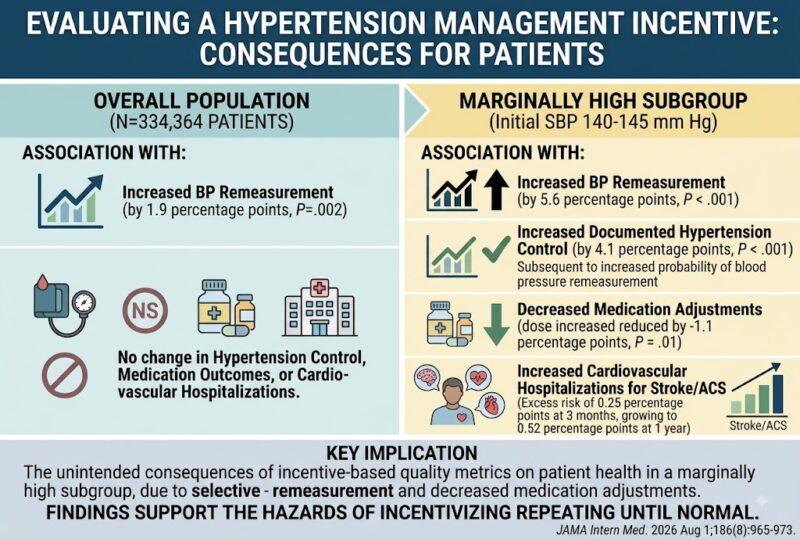
Boone et al. conducted a quasi-experimental difference-in-differences study in a large US health system encompassing 334,364 patients aged 18 to 85 years with diagnosed hypertension across 103 primary care practices. Starting January 2022, a financial incentive directed at physicians was incorporated into contracts for 63 practices, targeting BP control (<140/90 mm Hg). Outcomes before (2021) and after (2022–2023) the intervention were compared between incentivized and non-incentivized practices.
Primary metrics included the frequency of BP remeasurement during visits, medication prescriptions and dose changes, and hospitalization rates for stroke or acute coronary syndrome (ACS). The study notably analyzed both the overall hypertensive population and a focused subgroup with marginally high systolic BP (140-145 mm Hg), a group at the clinical threshold of control status.
Impact on Clinical Measurement and Documentation
After incentive introduction, there was a statistically significant increase in the probability of BP remeasurement during a primary care encounter across the overall hypertensive cohort (increase of 1.9 percentage points). In the marginally hypertensive subgroup, this effect was even more pronounced, with a 5.6 percentage point increase in remeasurement probability.
Correspondingly, documenting BP as controlled rose by 4.1 percentage points in this borderline group. These findings suggest that financial incentives encourage more meticulous BP monitoring and possibly influence documentation practices, potentially enhancing reported quality metric performance without substantive change in true BP control.
Medication Management and Dose Adjustments
Despite enhanced BP measurement, the probability of increasing antihypertensive medication doses in patients with marginally elevated BP decreased by 1.1 percentage points following incentive implementation. This reduction in pharmacologic intensification implies that physicians may be more inclined to remeasure BP and declare control to meet quality metrics rather than undertake medication changes that could better manage elevated BP but impact performance metrics adversely.
In the broader hypertensive population, medication prescription and dose adjustments showed no significant change post-incentive, indicating that practice alterations were specifically concentrated in those near the BP control threshold.
Cardiovascular Outcomes and Safety Implications
Critically, the subgroup with marginally high BP experienced an increased risk of hospitalization for stroke or ACS, rising by 0.25 percentage points at 3 months and 0.52 percentage points at 1 year after the incentive was introduced. This excess risk temporally coincides with reduced medication intensification and suggests that selective remeasurement and documentation strategies led to undertreatment of patients genuinely requiring tighter BP control, resulting in adverse cardiovascular outcomes.
No significant change in cardiovascular hospitalizations was observed in the overall hypertensive cohort.
Contextualizing Findings Within Broader Evidence
Previous randomized controlled trials and meta-analyses evaluating pay-for-performance (P4P) programs in chronic disease have yielded mixed results regarding BP control improvement. A Cochrane review (Kondo et al., 2020) indicated that P4P interventions have variable effects on process measures and less consistent effects on clinical outcomes like BP control or cardiovascular events.
Some observational studies documented improved measurement fidelity but also raised concerns about ‘gaming’ behaviors, such as selective patient inclusion or data manipulation to meet targets. This study by Boone et al. substantiates these concerns with its robust quasi-experimental design and long-term outcome data.
Guideline bodies such as the American College of Cardiology/American Heart Association (ACC/AHA) advocate for individualized BP targets and clinical judgment rather than strict adherence to rigid thresholds alone. This nuanced approach recognizes the risks of overtreatment and undertreatment in different patient contexts, insights reinforced by the current findings.
Expert Commentary
These findings critically highlight potential unintended consequences of incorporating financial incentives into hypertension quality metrics. While incentives can improve clinical documentation and monitoring diligence, they may inadvertently foster behavior that prioritizes performance metrics over optimal patient-centered care.
The observed decrease in antihypertensive dose escalation among patients with marginally elevated BP suggests a misplaced emphasis on measured control rates rather than true BP improvement. This divergence may stem from physicians’ efforts to avoid penalization or to secure incentives by documenting controlled BP status, using remeasurement strategically rather than effecting therapeutic change.
Mechanistically, insufficient BP control in this at-risk subgroup plausibly leads to progression of target-organ damage and heightened incident cardiovascular events, as supported by the increased stroke and ACS hospitalizations.
This study underscores the importance of designing quality metrics that align incentives with genuine clinical improvements and avoid perverse incentives. Health systems might consider composite measures integrating outcomes and process metrics, with safeguards against selective data presentation.
Clinical guidelines and policymakers should interpret quality metric data within the context of potential measurement and management biases. Enhanced physician education about balancing metric goals and patient-specific care remains essential.
Limitations include the quasi-experimental design, potential unmeasured confounders, and generalizability confined to one health system. However, the large sample size, difference-in-differences methodology, and outcome linkage strengthen causal inference.
Conclusion
The introduction of physician-facing financial incentives for hypertension control increased BP remeasurement frequency but did not improve overall BP control or medication management in a large US health system. In patients with marginally elevated BP, incentives resulted in higher documentation of controlled BP without corresponding therapeutic intensification, accompanied by increased cardiovascular hospitalization risk.
These findings highlight the complexity of using financial incentives in chronic disease management and urge caution in metric design to prevent unintended harms. Future research should focus on refining incentive structures, incorporating patient outcomes, and supporting individualized care to optimize hypertension management safely.
References
- Boone C, Robicsek A. Evaluating the Consequences of a Hypertension Management Incentive. JAMA Intern Med. 2026;186(8):965-973. PMID: 42223964.
- Kondo K, Damberg C, Maggard-Gibbons M. Pay-for-Performance Programs in Chronic Disease Management: A Systematic Review and Meta-Analysis. Cochrane Database Syst Rev. 2020;2(2):CD012397. PMID: 32052740.
- Whelton PK, Carey RM, Aronow WS, et al. 2017 ACC/AHA Guideline for the Prevention, Detection, Evaluation, and Management of High Blood Pressure in Adults. Hypertension. 2018;71(6):e13-e115. PMID: 29133354.
- Campbell SM, Reeves D, Kontopantelis E, et al. Effects of Pay for Performance on the Quality of Primary Care in England. N Engl J Med. 2009;361(4):368-378. PMID: 19571260.
- Scott IA, Sarpong D, Elshaug AG. What are the unintended consequences of pay-for-performance for healthcare? A systematic review of the literature. BMC Health Serv Res. 2011;11:213. PMID: 21781354.