Introduction
Haploidentical hematopoietic stem cell transplantation (haplo-HCT) with post-transplant cyclophosphamide (PTCy) has emerged as a curative option for acute leukemia patients lacking matched donors. Although it broadens donor availability, early inflammatory complications (EICs) such as cytokine release syndrome (CRS) and engraftment syndrome (ES) represent significant post-transplant challenges. These complications can profoundly affect graft-versus-host disease (GvHD) outcomes and overall transplant success. While extensively studied in adults, data on the incidence, risk factors, and clinical impact of EICs in pediatric cohorts remain limited. This multicenter retrospective analysis addresses this gap by evaluating early inflammatory complications in pediatric haplo-HCT with PTCy for acute leukemia.
Background and Clinical Context
Acute leukemia in children often requires allogeneic hematopoietic stem cell transplantation (HSCT) for cure. Haploidentical transplantation, using partially matched family donors, has increased transplant access but introduces immune complications. Post-transplant cyclophosphamide is effective in preventing severe GvHD; however, the occurrence of early inflammatory reactions following engraftment—manifesting as CRS and ES—may predispose to treatment resistance and chronic GvHD. Understanding their epidemiology and clinical implications is crucial to improving pediatric transplant outcomes.
Study Design and Methods
This retrospective study analyzed 102 consecutive pediatric patients undergoing haplo-HCT with PTCy for acute leukemia across multiple centers. Patients were monitored for early inflammatory complications, including CRS and ES, defined according to established clinical criteria. Key variables recorded included stem cell source (peripheral blood stem cells [PBSC] versus bone marrow), timing of calcineurin inhibitor (CNI) initiation, incidence and severity of acute and chronic GvHD, response to first-line GvHD treatment, relapse, and survival outcomes. Statistical analyses identified risk factors for EICs and assessed their impact on transplantation results.
Key Findings
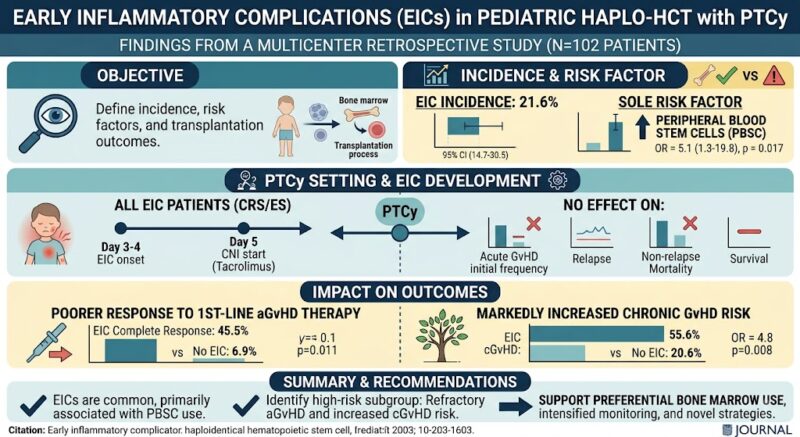
The incidence of early inflammatory complications was 21.6% (95% CI: 14.7–30.5). Peripheral blood stem cell use was the sole independent risk factor for EICs, significantly increasing risk by over fivefold (OR 5.1, 95% CI: 1.3–19.8, p=0.017). Notably, all patients who developed CRS initiated tacrolimus-based CNI therapy starting on day 5 post-transplant.
Importantly, EICs did not increase the incidence of initial acute GvHD; however, they were associated with significantly poorer responses to first-line steroid therapy for aGvHD (complete response 45.5% without EICs versus 6.9% with EICs, p=0.011). Furthermore, these complications predicted a markedly higher risk of chronic GvHD development (55.6% versus 20.6%; OR 4.8, p=0.008).
No significant differences were observed in relapse rates, non-relapse mortality, or overall survival between patients with and without EICs. These data delineate EICs as important negative prognostic indicators for GvHD outcomes rather than overall survival.
Expert Commentary and Mechanistic Insights
These findings underscore the immunologic complexity of haplo-HCT with PTCy in children. The data suggest that the use of PBSC grafts, which contain higher numbers of mature immune effector cells and cytokine-primed cells, may predispose recipients to heightened early inflammatory responses. Initiation of CNI therapy at day 5, though standard, may coincide with inflammatory priming, contributing to CRS occurrence.
The association between EICs and refractory acute GvHD alongside chronic GvHD risks indicates that early immune dysregulation could impair control of alloreactivity. This may warrant reconsideration of stem cell sources in pediatric haplo-HCT, favoring bone marrow to reduce EIC-associated morbidity.
Limitations of the study include the retrospective design and inherent variability across centers regarding supportive care and graft manipulation. Further research is needed to validate these findings prospectively and explore tailored immunosuppressive protocols and novel GvHD preventive strategies targeting this high-risk group.
Conclusion
Early inflammatory complications occur frequently in pediatric haplo-HCT with PTCy, predominantly linked to peripheral blood stem cell grafts. These complications identify patients at high risk for steroid-refractory acute GvHD and subsequent chronic GvHD, though without impacting relapse or survival rates. These insights support preferential use of bone marrow grafts and heightened clinical vigilance post-transplant, prompting the development of innovative prophylactic and therapeutic interventions tailored to mitigate inflammatory sequelae and improve long-term transplant outcomes in children with acute leukemia.
Funding and ClinicalTrials.gov
Details on study funding were not provided. As a retrospective analysis, no prospective clinical trial registration is applicable.
References
Pierri F, Bagnasco F, Saglio F, Fagioli F, Giardino S, Pestarino S, Leardini D, Gottardi F, Masetti R, Faraci M. Early inflammatory complications after haploidentical hematopoietic stem cell transplantation with post transplant cyclophosphamide for acute leukemia: a pediatric multicenter experience. Bone marrow transplantation. 2026 Jul 18. PMID: 42471474. https://pubmed.ncbi.nlm.nih.gov/42471474/