Highlight
– Two-thirds of hospitals caring for children screen for social risks during inpatient stays, with nurses most commonly conducting screenings.
– Screening approaches, including tools and domains assessed, vary widely; food insecurity is the most screened domain, while legal needs are not screened.
– Referral mechanisms primarily rely on social work consultations and printed materials, with minimal partnerships with community-based organizations.
– Data tracking of referrals and linkage to healthcare use outcomes are limited, and staffing constraints pose major barriers to systematic screening.
Study Background
Social determinants of health (SDOH) significantly influence child health outcomes. Hospitalization presents a critical opportunity to identify and address social risks such as food insecurity, housing instability, and caregiver stress that contribute to health disparities. Recently, professional organizations have recommended routine inpatient screening for social risks to facilitate timely interventions. However, existing literature primarily focuses on children’s hospitals, often excluding community hospitals where many children receive care, and lacks comprehensive data on actual screening and referral processes. Understanding current practices nationally is essential to guide policy and resource allocation to optimize social care for pediatric inpatients.
Study Design
This cross-sectional study surveyed hospital clinical leaders between August 2023 and November 2023 through the Pediatric Research in Inpatient Settings Network. The survey assessed social risk screening and referral practices at hospitals caring for children across the United States. One respondent per institution reported on multiple domains including screening implementation, populations screened, screening tools used, referral processes, data tracking mechanisms, and identified barriers and facilitators to social care integration in inpatient pediatrics. Descriptive statistics summarized survey responses.
Key Findings
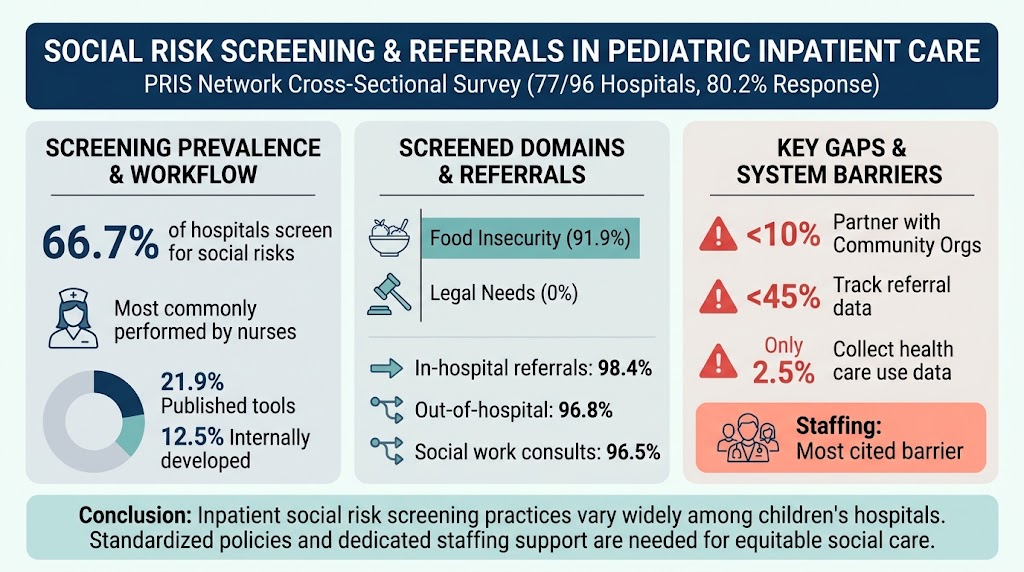
A total of 80.2% (77/96) hospitals completed the survey. Notably, 66.7% of hospitals reported performing some form of inpatient social risk screening. Nurses most frequently conducted screening activities, highlighting their central role in social risk assessment during hospitalization.
Screening approaches varied significantly. Only 21.9% of hospitals used validated published screening tools, whereas 12.5% relied on internally developed questions, reflecting a non-standardized measurement landscape. The domains screened were unevenly prioritized: food insecurity was screened in 91.9% of hospitals, reflecting strong recognition of this critical need. In contrast, legal needs screening was absent, suggesting gaps in addressing broader social risks that may affect child health.
Regarding referral pathways, nearly all hospitals had systems to connect patients to both in-hospital (98.4%) and out-of-hospital (96.8%) resources. The predominant referral mechanism was social work consultation (96.5%), supplemented by printed educational materials (54.4%). Nonetheless, fewer than 10% had formal partnerships with community-based organizations, indicating limited integration of hospital-based care with community resources.
Data tracking practices were suboptimal. Less than 45% of screening hospitals maintained systems to track referral outcomes, and a mere 2.5% collected data linking social care interventions with healthcare utilization metrics. This gap hampers quality improvement efforts and evaluation of program effectiveness.
Staffing constraints emerged as the most frequently cited barrier to implementing consistent social risk screening, underscoring resource limitations confronting hospitals.
Expert Commentary
The considerable variability in screening methods and domains reflects the nascent stage of social risk integration into inpatient pediatric practice. While food insecurity screening has gained traction given robust evidence linking it to child health, the absence of legal needs screening suggests a need for more comprehensive approaches that capture the full spectrum of social determinants.
Social work involvement is critical in bridging identification and linkage to services; however, reliance on printed handouts without active community partnerships may limit the effectiveness of referrals. The paucity of data tracking systems represents a missed opportunity to monitor and improve social care impact systematically.
Given staffing barriers, policy efforts might focus on allocating dedicated resources and developing scalable, standardized screening protocols. Prior studies have demonstrated the feasibility and acceptability of caregiver- and nurse-led social risk screening in inpatient settings, but broader implementation will require institutional commitment and interprofessional collaboration.
Conclusion
This national survey highlights that while many pediatric inpatient settings screen for social risks, substantial heterogeneity exists in screening domains, tools, referral practices, and follow-up data collection. To advance equitable social care for hospitalized children, there is an urgent need for standardized screening policies, enhanced data systems to track outcomes, and strengthened partnerships with community-based organizations. Addressing staffing and resource barriers will be pivotal to implementing sustainable social risk screening and referral programs.
Funding and ClinicalTrials.gov
The original study did not report external funding sources or clinical trial registration.
References
Leary JC, Tran N, Brittan MS, et al. Social Risk Screening and Referrals in the Pediatric Inpatient Setting. Pediatrics. 2026 Oct 16;PMID: 42880757.
Garg A, et al. Screening for Social Determinants of Health in Pediatrics: A Review of Current Practices and Recommendations. Pediatrics. 2024;153(2):e20230412.
Gottlieb LM, et al. Integrating Social Care into the Delivery of Health Care: Moving Upstream to Improve the Nation’s Health. NAM Perspectives. 2020;
Hill CV, et al. Implementation of the Social Determinants of Health Screening and Referral Program in Pediatric Inpatient Units. J Hosp Med. 2023;18(1):12-18.