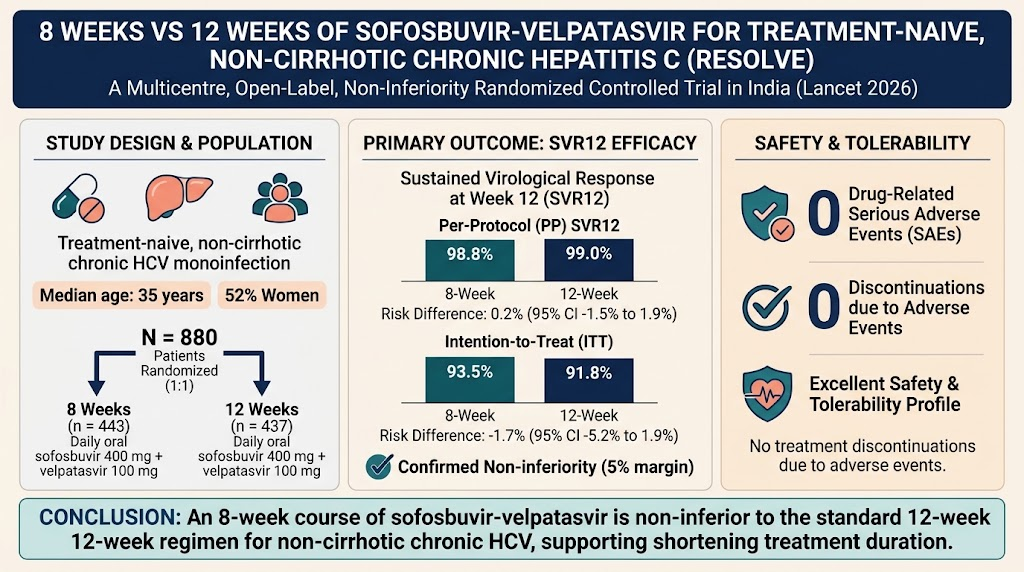
The RESOLVE trial compared 8-week versus 12-week regimens of sofosbuvir-velpatasvir in treatment-naive, non-cirrhotic chronic hepatitis C patients.
8-week therapy demonstrated non-inferior sustained virological response (SVR12) rates compared to 12-week therapy (98.8% vs. 99.0% per-protocol).
No drug-related serious adverse events or discontinuations were reported, confirming safety for the shorter regimen.
Findings support potential treatment shortening, which could improve adherence, reduce costs, and increase treatment access in resource-limited settings.
Study Background
Chronic hepatitis C virus (HCV) infection remains a significant global public health challenge. Despite the advent of highly effective direct-acting antivirals (DAAs), treatment duration and cost remain barriers to universal access, especially in low- and middle-income countries. Sofosbuvir-velpatasvir, a pan-genotypic DAA combination, is currently recommended for 12 weeks in treatment-naive patients without cirrhosis. However, reducing treatment duration without compromising efficacy could have important implications for healthcare resource optimization and patient adherence. The RESOLVE trial was designed to evaluate whether an 8-week regimen of sofosbuvir-velpatasvir is non-inferior to the conventional 12-week treatment in Indian patients with treatment-naive, non-cirrhotic chronic HCV infection.
Study Design
RESOLVE was a multicentre, open-label, non-inferiority randomized controlled trial conducted in five publicly funded hospitals across India. Eligibility criteria included adults aged 18 years or older who were HCV mono-infected, treatment-naive, and had no clinical or laboratory evidence of cirrhosis. A total of 880 participants were randomized 1:1 to receive either 8 weeks or 12 weeks of daily oral sofosbuvir (400 mg) and velpatasvir (100 mg). The primary endpoint was the proportion of participants achieving sustained virological response at 12 weeks post-treatment completion (SVR12), defined as undetectable HCV RNA. The trial was powered to detect non-inferiority with a 5% margin, assuming a 95% SVR12 rate in the 12-week arm.
Key Findings
Out of 1620 screened participants, 880 were enrolled and randomized evenly into the two treatment arms. The median age was 35 years, with a nearly equal gender distribution. Treatment completion rates were high (93%) and similar between groups.
Per-protocol analysis showed SVR12 rates of 98.8% (410/415) in the 8-week group and 99.0% (397/401) in the 12-week group, with a negligible risk difference of 0.2% (95% CI, -1.5% to 1.9%). Intention-to-treat analysis, which included all randomized participants, also confirmed non-inferiority with SVR12 of 93.5% in the 8-week group versus 91.8% in the 12-week group (risk difference -1.7%; 95% CI, -5.2% to 1.9%). These findings robustly support that shortening therapy to 8 weeks does not compromise virological cure in this population.
Safety was excellent, with no drug-related serious adverse events or treatment discontinuations. Both regimens were well tolerated, consistent with known safety profiles of sofosbuvir-velpatasvir.
Expert Commentary
The RESOLVE trial provides compelling evidence that 8 weeks of sofosbuvir-velpatasvir can effectively treat treatment-naive, non-cirrhotic chronic HCV in an Indian population, with efficacy comparable to the standard 12-week course. These results align with emerging data suggesting that shorter DAA regimens may suffice in specific patient subgroups without compromising SVR.
From a mechanistic perspective, direct-acting antivirals achieve rapid viral suppression, and in patients without cirrhosis—where hepatic fibrosis and viral reservoirs are minimal—shortened antiviral exposure may be adequate to clear infection. This has significant clinical and public health implications, especially in resource-limited settings where treatment costs and access remain barriers.
Limitations include the open-label design and the exclusion of patients with cirrhosis or prior treatment experience, which may limit generalizability. Further studies could explore applicability in diverse populations and assess long-term outcomes.
Conclusion
The RESOLVE trial conclusively demonstrates that an 8-week course of sofosbuvir-velpatasvir is non-inferior to the standard 12-week regimen for treating treatment-naive, non-cirrhotic chronic hepatitis C infection. This shorter treatment duration is associated with excellent efficacy and safety and could facilitate increased treatment uptake by reducing financial and logistical barriers. The study supports updated treatment guidelines considering shorter regimens in appropriate patients to advance global HCV elimination efforts.
Funding and Registration
This study was funded by the Indian Council of Medical Research and the Department of Health Research, Government of India. The trial was prospectively registered at the Clinical Trial Registry of India (CTRI/2022/03/041368).
References
1. Goel A, Rungta S, Kumar V, et al. 8 weeks versus 12 weeks of sofosbuvir-velpatasvir for treatment-naive, non-cirrhotic, chronic hepatitis C (RESOLVE): a multicentre, open-label, non-inferiority, randomized controlled trial in India. Lancet. 2026 Sep 30;408(10564):1593-1602. PMID: 42815507.
2. AASLD-IDSA HCV Guidance Panel. Hepatitis C Guidance 2020 Update: Recommendations for Testing, Managing, and Treating Hepatitis C Virus Infection. Clin Infect Dis. 2020;71(7): 944–963.
3. Feld JJ, Jacobson IM, Hézode C, et al. Safety and efficacy of 8-week treatment with ledipasvir/sofosbuvir in treatment-naive HCV genotype 1 patients without cirrhosis. J Hepatol. 2016;65(3):505-11.
[Further references and guideline documents may be added as needed.]