Highlights
- Antenatal magnesium sulfate (MgSO4) administration before very preterm birth consistently reduces cerebral palsy (CP) risk among survivors.
- Large binational cohort data demonstrate MgSO4 exposure is associated with decreased death or CP and reduced moderate-severe functional impairment at 2–3 years.
- MRI studies reveal enhanced neonatal brain functional connectivity after prenatal MgSO4, suggesting a biological neuroprotective mechanism.
- MgSO4 remains the only antenatal intervention with high-quality evidence for CP risk reduction among preterm infants; safety concerns are generally manageable.
Background
Preterm birth, defined as delivery before 37 weeks of gestation, remains a leading cause of neonatal morbidity and mortality worldwide. Very preterm infants, particularly those born before 30 weeks’ gestation or with very low birth weight (<1000 g), are at high risk for adverse neurodevelopmental outcomes including cerebral palsy (CP), a nonprogressive motor disability arising from early brain injury. Prevention of CP in this vulnerable population is a critical challenge in perinatal medicine. Over the past two decades, antenatal magnesium sulfate (MgSO4), initially established for eclampsia prevention, has emerged as a potential neuroprotective agent with variable international implementation.
Key Content
Chronological Evidence Supporting Antenatal MgSO4
Early observational studies provided conflicting data on the neuroprotective effects of antenatal MgSO4, with some suggesting increased risk and others indicating benefit. The pivotal randomized controlled trial (RCT) by Crowther et al. (2003) involving 1062 women at risk of birth before 30 weeks demonstrated a trend towards reduced combined death or CP (RR 0.83, 95% CI 0.66–1.03), with significant reductions in gross motor dysfunction and combined death or gross motor dysfunction at two years. The subsequent BEAM trial (2008) involving 2241 women confirmed that MgSO4 lowered the risk of moderate or severe CP among survivors (1.9% vs 3.5%; RR 0.55, 95% CI 0.32–0.95), although the composite primary outcome including death was not significantly changed.
Meta-analyses and systematic reviews, such as the Nutritional Reviews meta-analysis (2022), consolidate evidence of MgSO4’s effectiveness in decreasing CP risk in preterm infants with high-quality data, while other nutritional or amino acid interventions show no comparable benefit.
Real-World Effectiveness in Large Cohort Studies
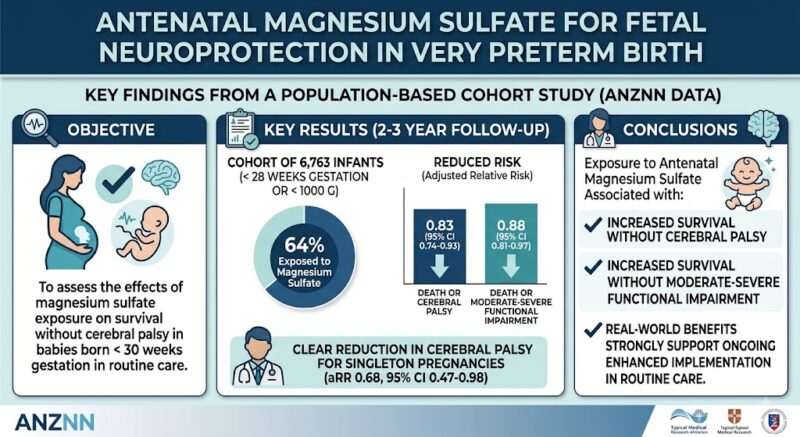
Building on trial data, the 2026 population-based retrospective cohort study from the Australian and New Zealand Neonatal Network (Shepherd et al.) analyzed 16,582 neonates born <30 weeks’ gestation from 2012 to 2020. Among 6,763 infants with 2-3 year follow-up (64% exposed to MgSO4), exposure was associated with reduced risk of death or CP (adjusted relative risk [aRR] 0.83, 95% CI 0.74–0.93) and death or moderate-severe functional impairment (aRR 0.88, 95% CI 0.81–0.97). Notably, in singletons, the risk of CP was reduced by 32% (aRR 0.68, 95% CI 0.47–0.98), reinforcing magnesium’s protective role in routine care settings.
This confirms beneficial effects seen in RCTs translate into regular clinical practice, supporting ongoing and expanded implementation of MgSO4 protocols.
Neurobiological Mechanisms and Functional Imaging Correlates
Recent studies have investigated the underlying mechanisms of MgSO4 neuroprotection. A 2024 nested cohort study within the MAGENTA RCT found antenatal MgSO4 administration between 30 and 34 weeks gestation enhanced neonatal brain functional connectivity at term-equivalent age on MRI, specifically in temporal, occipital lobes, and deep gray matter. Increased clustering coefficients, transitivity, local and global efficiencies were observed, indicating improved neural network segregation and integration, which may underlie reduced CP and death risks.
Safety and Special Considerations
While MgSO4 is generally safe, adverse maternal effects like flushing and hypotension are common. A 2021 meta-analysis showed no significant increase in postpartum uterine atony or hemorrhage risk. However, some racial/ethnic groups (e.g., Hispanics) may experience higher side effect rates and warrant closer monitoring. The balance of benefits outweighs risks given the severity of CP consequences.
Trials at later gestational ages (30–34 weeks) like MAGENTA (2023) found no statistically significant differences in survival free of CP, possibly reflecting diminished neuroprotective effects or sample size limitations at these gestations.
The neuroprotective benefit may be reduced in certain contexts such as chorioamnionitis-associated preterm births, highlighting the need for individualized care.
Expert Commentary
The integration of robust RCTs with extensive real-world data firmly establishes antenatal MgSO4 as a standard for neuroprotection in imminent very preterm delivery (<30 weeks gestation). The consistent reduction in CP risk with minimal safety concerns has led professional guidelines (e.g., ACOG, NICE) to recommend MgSO4 administration in appropriate candidates.
Nonetheless, residual uncertainty exists regarding optimal dosing, timing near birth, and efficacy at later preterm gestations. The heterogeneity in response among multiple gestations and inflammatory conditions remains a research focus.
The mechanistic insights from functional neuroimaging provide a scientific rationale for MgSO4’s neuroprotective action, proposing enhancement of neural network integrity and maturation. This may inform future adjunctive therapies.
Continued longitudinal follow-up is essential to confirm sustained cognitive and behavioral improvements beyond early childhood.
Conclusion
Antenatal magnesium sulfate administration prior to very preterm birth significantly improves survival without cerebral palsy or moderate to severe functional impairment, corroborated by randomized trials and large pragmatic cohorts. It remains the only evidence-based antenatal neuroprotective strategy proven to reduce CP risk. Mechanistic neuroimaging studies underpin its beneficial effects on brain connectivity. Systematic implementation and further research into optimizing timing, dose, and subgroup responsiveness will enhance the prevention of lifelong neurodisability in preterm infants.
References
- Shepherd E et al. Antenatal magnesium sulfate prior to very preterm birth in routine care is associated with increased survival without cerebral palsy. Am J Obstet Gynecol. 2026 Jul 30. PMID: 42532419.
- Crowther CA et al. Effect of magnesium sulfate given for neuroprotection before preterm birth: a randomized controlled trial. JAMA. 2003 Nov 26;290(20):2669-76. PMID: 14645308.
- Goldstein RF et al. A randomized, controlled trial of magnesium sulfate for the prevention of cerebral palsy. N Engl J Med. 2008 Aug 28;359(9):895-905. PMID: 18753646.
- Magnesium sulphate at 30 to 34 weeks’ gestational age (MAGENTA) Randomized Clinical Trial. JAMA. 2023 Aug 15;330(7):603-614. PMID: 37581672.
- Mathewson KE et al. Prenatal Magnesium Sulfate and Functional Connectivity in Offspring at Term-Equivalent Age. JAMA Netw Open. 2024 May 1;7(5):e2413508. PMID: 38805222.
- Auer RN. Effectiveness of nutritional interventions to prevent nonprogressive congenital and perinatal brain injuries: a systematic review. Nutr Rev. 2022 Oct;80(11):2136-2153. PMID: 35568996.
- McKinlay CJD et al. School-age outcomes following a randomized controlled trial of magnesium sulfate for neuroprotection of preterm infants. J Pediatr. 2014 Aug;165(2):398-400.e3. PMID: 24837863.