Highlight
1. The Pregnolia System (PS) provides an objective, reproducible measurement of cervical stiffness prior to induction of labour (IOL).
2. This study demonstrated excellent internal consistency of PS measurements in a cohort of nulliparous women undergoing IOL.
3. The PS assessment was associated with lower discomfort compared to the traditional Bishop Score cervical assessment.
4. Both PS and Bishop Score had limited predictive ability for vaginal delivery following induction in this cohort.
Study Background
Induction of labour (IOL) is a commonly performed obstetric intervention to initiate uterine contractions before spontaneous labour onset, usually to prevent maternal or fetal complications. However, the success of IOL largely depends on the readiness and favorability of the cervix, traditionally assessed with the Bishop Score (BS), a subjective clinical examination combining dilation, effacement, consistency, position, and fetal station. The predictive accuracy of the Bishop Score for vaginal delivery after IOL is limited, and its assessment can cause discomfort for patients.
Recently, there has been interest in objective, quantitative tools for cervical assessment to improve prediction of IOL outcomes and refine patient counseling. The Pregnolia System (PS) is a medical device designed to measure cervical stiffness (CS) mechanically, providing numeric data rather than subjective grading. By enhancing objectivity, PS could potentially improve decision making and patient experience.
Study Design
This was a single-centre, prospective, observational feasibility study conducted in the IOL suite at Liverpool Women’s Hospital (UK). The study enrolled 100 nulliparous pregnant women at term with intact membranes undergoing IOL as per local clinical protocols.
Prior to initiation of IOL, participants underwent cervical stiffness assessment using the Pregnolia System and routine Bishop Score measurement. Acceptability questionnaires evaluated patient tolerance and discomfort for both assessments. Clinical and delivery outcomes were collected from electronic records following delivery. The primary objective was to assess feasibility outcomes including recruitment rate, measurement reliability, patient acceptability, and fidelity of device performance in the IOL setting. Secondary exploratory analyses evaluated associations between PS cervical stiffness measurements and clinical IOL outcomes, particularly vaginal delivery success.
Key Findings
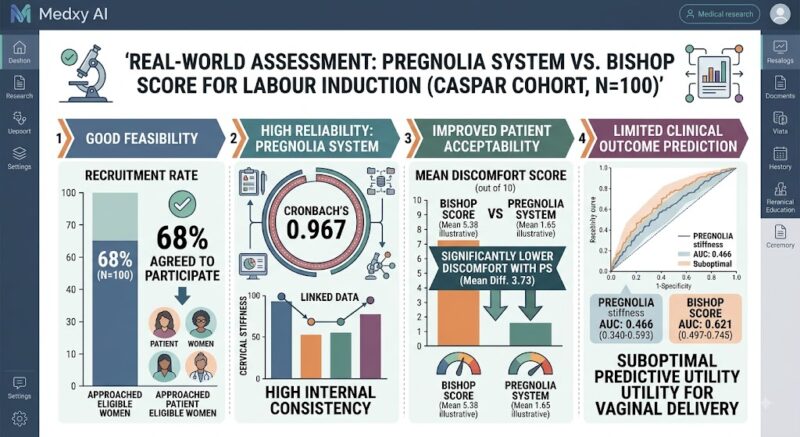
Feasibility and Acceptability: Recruitment was strong with 68% of approached eligible women agreeing to participate, signifying good feasibility for enrolment in this patient population.
The Pregnolia System demonstrated excellent internal consistency for cervical stiffness measurements, with Cronbach’s alpha of 0.967, indicating highly reliable data acquisition across repeated assessments.
Patient-reported discomfort was significantly lower with the Pregnolia System assessment compared to the Bishop Score examination (mean discomfort score difference 3.73; favoring PS), highlighting improved patient tolerance.
Clinical Outcome Analysis: Exploratory evaluation of predictive performance revealed suboptimal diagnostic utility for both cervical assessment methods regarding vaginal delivery success following induction.
The area under the receiver operating characteristic curve (AUC) for Pregnolia System stiffness values was 0.466 (95% CI 0.340–0.593), indicating no better-than-chance prediction. The Bishop Score had a slightly higher AUC at 0.621 (95% CI 0.497–0.745), but still representing limited clinical utility.
These findings suggest that while objective cervical stiffness measurement is feasible and well tolerated, neither tool robustly predicts induction success in this nulliparous cohort under current protocols.
Expert Commentary
The CASPAR feasibility study provides important early data on the use of the Pregnolia System in a real-world clinical setting. The strong reliability and improved patient comfort compared to traditional Bishop Score assessment underscore the potential utility of objective cervical stiffness measurement. However, the current clinical value, defined by prediction of vaginal delivery post-IOL, appears limited based on this cohort and study design.
This may reflect the complexity of labour induction physiology and multifactorial determinants of outcome beyond cervical stiffness alone. The subjective Bishop Score, despite variability, captures multiple components influencing readiness. It is plausible that integrating objective mechanical measurements with other clinical and biochemical markers might enhance predictive accuracy.
Limitations include single-centre design and relatively modest sample size primarily aimed at feasibility without powering for clinical endpoints. Further larger prospective studies, perhaps including multiparous women and differing induction protocols, are warranted to explore clinical utility and potentially refine the device measurements or thresholds.
Conclusion
The study confirms that the Pregnolia System is a feasible, reliable, and patient-acceptable method to objectively assess cervical stiffness prior to induction of labour in nulliparous women. Although it did not demonstrate superior predictive accuracy compared with the Bishop Score for vaginal delivery outcomes here, the technology represents a promising advancement toward objective cervical assessment.
Future research should focus on larger, multicentre cohorts with comprehensive evaluation of combined clinical parameters to fully determine the translational impact of cervical stiffness quantification on labour induction management and maternal-fetal outcomes.
Funding and Registration
Information on funding sources or clinical trial registration was not specified in the available abstract.
References
1. Medford E, Lane S, Care A, Sharp A. Objective Cervical Stiffness Assessment Using the Pregnolia System Prior to Induction of Labour: The CASPAR Feasibility Cohort Study. BJOG. 2026;133(9):1762–1770. PMID: 41882976.
2. American College of Obstetricians and Gynecologists (ACOG). Practice Bulletin No. 107: Induction of labor. Obstet Gynecol. 2009 Mar;114(3):386-97.
3. Cox JH, O’Donovan E, Fleming JP. The Bishop score for induction of labour: A literature review. J Obstet Gynaecol. 2015;35(6):500–503.