Highlight
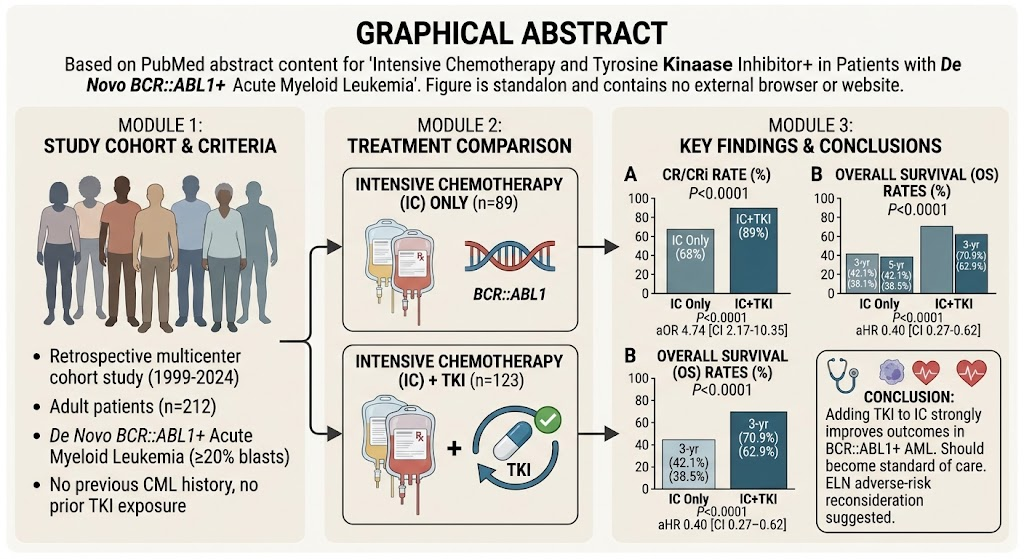
This comprehensive retrospective study identifies that integrating tyrosine kinase inhibitors (TKIs) with intensive chemotherapy (IC) significantly enhances complete remission rates and overall survival in patients with de novo BCR::ABL1+ acute myeloid leukemia (AML). The findings challenge the current adverse-risk classification and support revising treatment guidelines to routinely include TKIs.
Study Background
BCR::ABL1+ acute myeloid leukemia represents a rare but aggressive leukemia subtype characterized by the presence of the Philadelphia chromosome, resulting from a t(9;22)(q34.1;q11.2) translocation that produces the BCR-ABL1 fusion gene. Traditionally, this entity was grouped under adverse-risk categories due to historically poor outcomes with standard intensive chemotherapy (IC). Tyrosine kinase inhibitors, well established in chronic myeloid leukemia (CML), specifically target the BCR-ABL1 oncoprotein. However, the impact of combining TKIs with IC in de novo BCR::ABL1+ AML has lacked definitive large-scale analysis, driving a substantial unmet clinical need to clarify optimal therapeutic strategies.
Study Design
This retrospective cohort study analyzed 212 adult patients diagnosed with de novo BCR::ABL1+ AML, defined by at least 20% bone marrow blasts and confirmed BCR::ABL1 fusion or Philadelphia chromosome positivity. Patients had no prior history of CML or prior exposure to BCR-ABL1 TKIs. The patients, treated between 1999 and 2024, were divided into two groups: 89 received intensive chemotherapy alone (IC group), and 123 received IC combined with a TKI (IC+TKI group). Key endpoints were complete remission (CR) or complete remission with incomplete hematologic recovery (CRi), overall survival (OS), and relapse-free survival (RFS). Multivariate analyses were conducted to adjust for confounders.
Key Findings
The integration of TKIs with IC resulted in a statistically significant improvement in remission rates and survival outcomes. Specifically, CR/CRi rates were achieved in 89% of the IC+TKI group versus 68% in the IC-alone group (P<0.0001). The median follow-up duration was 66.7 months. Median OS was 20.5 months for IC alone but was not reached for IC+TKI patients, reflecting marked survival benefit. At 3 and 5 years, OS rates were 42.1% and 38.5% in the IC group, respectively, versus 70.9% and 62.9% in the IC+TKI group (P<0.0001), indicating sustained long-term benefit.
Multivariate logistic regression identified the addition of TKI as an independent predictor for achieving CR/CRi (odds ratio 4.74; 95% CI: 2.17-10.35; P<0.001). Correspondingly, TKI addition independently improved OS with a hazard ratio of 0.40 (95% CI: 0.27-0.62; P<0.001). Furthermore, combining TKI with allogeneic hematopoietic stem cell transplantation (alloHSCT) during first remission (CR1) conferred additional improvements in relapse-free survival (HR 0.42 and 0.31 respectively; P values well below 0.005), underscoring the synergistic benefits of integrating targeted agents with established curative procedures.
These findings strongly advocate that the incorporation of TKIs should become the standard of care strategy in managing de novo BCR::ABL1+ AML.
Expert Commentary
This landmark study by Bertoli et al. provides critical long-term data supporting the paradigm shift in treating de novo BCR::ABL1+ AML. Given the rarity of this AML subset, the large cohort and extended follow-up notably strengthen the evidence base. Prior heterogeneous outcomes likely reflected variable TKI use or exclusion. Importantly, this study also suggests reconsideration of BCR::ABL1+ AML classification as strictly adverse-risk, as survival outcomes now parallel improved targeted treatment-responsive malignancies.
While retrospective, the consistency across multiple centers and adjustments for potential confounders enhance generalizability. Prospective trials may further define optimal TKI choice and duration. The biological rationale is compelling: TKIs directly inhibit the oncogenic BCR-ABL1 tyrosine kinase driving leukemogenesis, which is not fully eradicated by cytotoxic chemotherapy alone. This targeted intervention reduces residual leukemic burden and resistance.
Conclusion
The integration of tyrosine kinase inhibitors into intensive chemotherapy regimens demonstrates clear superiority in complete remission rates, overall survival, and relapse-free survival in patients with de novo BCR::ABL1+ AML. These results should prompt the revision of clinical guidelines and risk stratifications, promoting TKIs adoption as a frontline treatment component. Future research should focus on optimizing TKI selection, timing, and integration with transplantation to further improve outcomes and quality of life for this high-risk patient population.
Funding and ClinicalTrials.gov
Funding sources and clinical trial registration details were not specified in the referenced publication.
References
Bertoli S, Landberg N, Bérard E, Gondran C, Largeaud L, Mansat-De Mas V, et al. Intensive Chemotherapy and Tyrosine Kinase Inhibitor in Patients with De Novo BCR::ABL1+ Acute Myeloid Leukemia. Blood. 2026 Sep 18. PMID: 42758645. Available from: https://pubmed.ncbi.nlm.nih.gov/42758645/
Additional relevant literature:
Jabbour E, et al. Tyrosine kinase inhibitors in Philadelphia chromosome-positive AML: New treatment directions. Leuk Lymphoma. 2020;61(7):1616-1626.
Hoffman R, et al. Hematology: Basic Principles and Practice. 7th ed. Elsevier; 2018.