Highlight
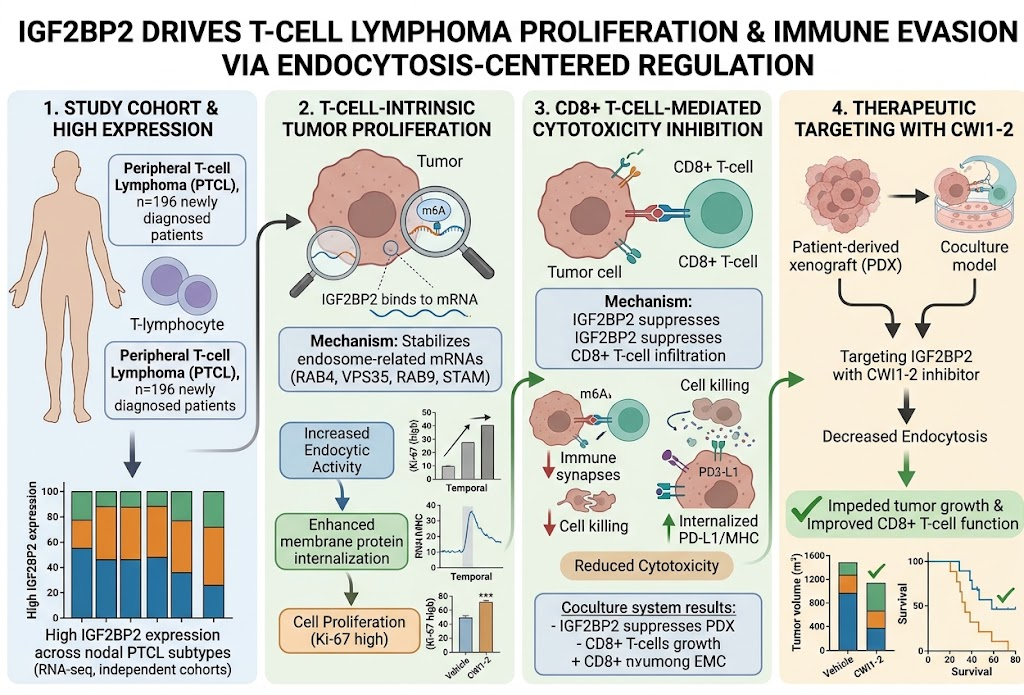
- IGF2BP2 is consistently overexpressed across common nodal PTCL subtypes and promotes tumor proliferation.
- IGF2BP2 stabilizes key endosome-related gene transcripts, enhancing endocytosis and suppressing CD8+ T-cell infiltration in the tumor microenvironment.
- Targeted inhibition of IGF2BP2 using CWI1-2 suppresses tumor growth and immune evasion in vitro and in patient-derived xenograft models.
- This research identifies IGF2BP2 as a dual regulator integrating oncogenic signaling and immune suppression, unveiling novel RNA modification-based therapeutic strategies.
Study Background
Peripheral T-cell lymphoma (PTCL) comprises a heterogeneous and aggressive group of mature T-cell neoplasms with generally poor prognosis and limited effective treatment options. Despite advancements in understanding genetic mutations and signaling pathways in PTCL, biomarkers and therapeutically exploitable regulators, particularly related to RNA modifications, remain insufficiently characterized. RNA modifications such as N6-methyladenosine (m6A) have emerged as key post-transcriptional modulators influencing oncogenesis, yet their role in PTCL biology is not well defined. Insulin-like growth factor 2 mRNA-binding protein 2 (IGF2BP2), a known m6A reader protein, selectively stabilizes m6A-modified RNA transcripts and has been implicated in multiple cancers as a driver of tumor progression. This study aims to elucidate the clinical relevance and mechanistic contribution of IGF2BP2 in PTCL, assessing its impact on tumor growth and the tumor immune microenvironment.
Study Design
The investigation included analyses of IGF2BP2 expression across three independent external PTCL cohorts and a large RNA-sequencing (RNA-seq) dataset of 196 newly diagnosed PTCL patients. Functional effects of IGF2BP2 were evaluated both in vitro using PTCL cell lines and in vivo employing patient-derived xenograft (PDX) models. Mechanistic approaches involved identifying IGF2BP2-bound transcripts, focusing on endosome-related genes. A coculture system combining PTCL tumor samples and peripheral blood mononuclear cells was employed to examine the interaction between tumor cells and immune effector CD8+ T-cells. The therapeutic potential of IGF2BP2 inhibition was tested using CWI1-2, a specific IGF2BP2 inhibitor, assessing alterations in endocytic activity, tumor proliferation, and immune cell infiltration.
Key Findings
1. IGF2BP2 is Highly Expressed in PTCL and Correlates with Aggressive Disease: Comprehensive transcriptomic assessment demonstrated consistent and significantly increased expression of IGF2BP2 across major nodal PTCL subtypes compared to normal controls. This high expression was validated in a well-powered patient cohort (n=196), establishing IGF2BP2 as a potential biomarker.
2. IGF2BP2 Promotes Tumor Cell Growth and Immune Evasion: Functional assays revealed that IGF2BP2 enhances PTCL tumor cell proliferation both in vitro and in vivo. Notably, IGF2BP2 expression concomitantly decreased infiltration of cytotoxic CD8+ T-cells within the tumor microenvironment, suggesting a role in immune escape.
3. Mechanistic Insights: Stabilization of Endosome-associated Transcripts Enhances Endocytosis: RNA immunoprecipitation studies identified direct binding of IGF2BP2 to mRNAs encoding critical endosome-related proteins—RAB4, VPS35, RAB9, and STAM. Through mRNA stabilization, IGF2BP2 sustained elevated expression of these genes, leading to heightened endocytic activity. Enhanced endocytosis resulted in increased internalization and downregulation of membrane proteins relevant to immune recognition and tumor growth regulation.
4. Clinical Correlation of IGF2BP2 with Endocytosis-related Gene Expression: In patient RNA-seq data, expression levels of IGF2BP2 positively correlated with their target endocytosis-associated genes, validating mechanistic links within a clinical context.
5. Therapeutic Targeting of IGF2BP2 Impairs Tumor Growth and Restores Immune Function: Treatment with CWI1-2 reduced IGF2BP2’s stabilizing effect on the target mRNAs, decreased endocytic activity, and suppressed tumor proliferation in cell lines and PDX models. Importantly, CWI1-2 treatment led to increased CD8+ T-cell infiltration and restored tumor cytotoxicity in coculture systems, supporting its potential to overcome tumor immune evasion.
Expert Commentary
This study provides compelling evidence positioning IGF2BP2 at the nexus of tumor-intrinsic proliferation and immune microenvironment modulation in PTCL. The dual role of IGF2BP2—promoting oncogenic signaling while facilitating immune escape through enhanced endocytosis—offers a unifying mechanistic framework and a promising avenue for therapeutic intervention. While prior work has underscored m6A readers in solid tumors, the delineation of IGF2BP2-mediated endocytic regulation in lymphoid malignancies is notably novel. Moreover, the use of patient-derived xenografts and coculture systems strengthens translational relevance.
Limitations include the need to explore long-term effects and potential resistance mechanisms to IGF2BP2 inhibition and to conduct clinical trials verifying safety and efficacy in patients. Additionally, heterogeneity within PTCL subtypes warrants further stratification to identify those most likely to benefit. Integration with existing immunotherapies or combination regimens should be a focus of future studies.
Conclusion
The identification of IGF2BP2 as a clinically significant m6A reader orchestrating both tumor proliferation and immune evasion in PTCL represents a paradigm shift in understanding RNA modification’s role in lymphoma pathobiology. Targeted inhibition of IGF2BP2 disrupts endosome-mediated pathways critical for tumor growth and immune suppression, highlighting a novel therapeutic strategy. These findings advance the rationale for RNA modification-based treatments that simultaneously target tumor cells and the immune microenvironment, potentially improving outcomes in a historically difficult-to-treat malignancy.
Funding and clinicaltrials.gov
The original study did not specify funding sources in the provided abstract. Further details may be available in the full publication.
References
- Hu S, Qin Y, Yi HM, et al. The N6-methyladenosine reader IGF2BP2 in T-cell lymphoma. Blood. 2026 Sep 17;148(12):1572-1587. PMID: 42166364.
- Liu J, Yue Y, Han D, et al. A METTL3-METTL14 complex mediates mammalian nuclear RNA N6-adenosine methylation. Nat Chem Biol. 2014;10(2):93-95.
- Dominissini D, Moshitch-Moshkovitz S, Schwartz S, et al. Topology of the human and mouse m6A RNA methylomes revealed by m6A-seq. Nature. 2012;485(7397):201-206.
- Paris J, Morgan M, Campos J, et al. Targeted inhibition of IGF2BP2 in hepatocellular carcinoma limits tumor progression through mRNA stability regulation. J Hepatol. 2021;74(4):840-852.
- Nakamura-Ishizu A, Suda T, Kubota Y. The roles of endocytosis and m6A modification in hematopoietic stem cell function. J Exp Med. 2021;218(6):e20201534.