Introduction
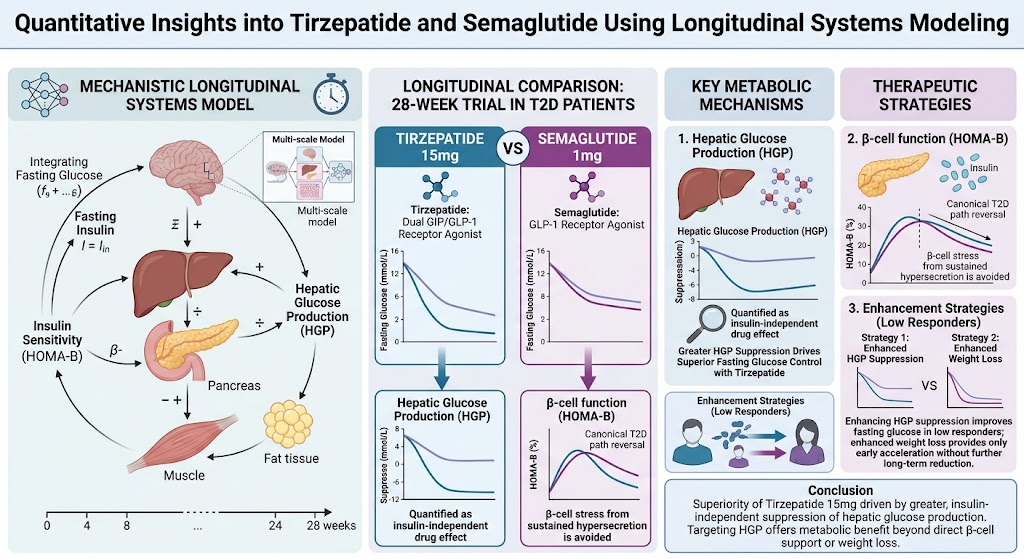
Type 2 diabetes (T2D) is a chronic metabolic disease characterized by elevated blood glucose due to insulin resistance and progressive β-cell dysfunction. Managing fasting glucose levels is critical to reducing the risk of complications. Among newer therapeutic agents, tirzepatide, a dual receptor agonist targeting glucose-dependent insulinotropic polypeptide (GIP) and glucagon-like peptide-1 (GLP-1) receptors, and semaglutide, a GLP-1 receptor agonist, have been effective in enhancing glycemic control. A 28-week clinical trial showed that tirzepatide at 15 mg outperformed semaglutide at 1 mg in lowering fasting glucose, although the metabolic mechanisms underlying this superiority remain incompletely understood.
Objectives
This study aimed to quantitatively compare the longitudinal effects of tirzepatide and semaglutide on fasting glucose metabolism by developing and applying a mechanistic systems model. The goals included elucidating the pathways responsible for their differential efficacy, understanding how these therapies affect insulin sensitivity and β-cell function over time, and suggesting strategies to improve treatment outcomes in patients with suboptimal response.
Methods
A mechanistic longitudinal model was constructed using data from patients with T2D enrolled in a randomized trial comparing tirzepatide and semaglutide. The model incorporated fasting glucose and insulin levels, insulin sensitivity, and β-cell function measurements over the 28-week period. It enabled detailed quantification of hepatic glucose production (HGP), differentiating drug effects that are dependent or independent of insulin. This approach allowed for isolating how much of the glucose-lowering effect was mediated via suppression of HGP versus improvement in insulin dynamics.
Results
The model demonstrated that β-cell function initially increased as treatment began, as measured by the Homeostatic Model Assessment for β-cell function (HOMA-B), but then declined as insulin sensitivity improved. This pattern contrasts with typical T2D progression where β-cell function steadily declines. Notably, tirzepatide led to superior fasting glucose reduction primarily through greater insulin-independent suppression of hepatic glucose production compared to semaglutide.
Patients who exhibited a low response to treatment showed deficient suppression of HGP. Simulation experiments indicated that enhancing HGP suppression could improve fasting glucose further without causing β-cell stress related to excessive insulin secretion, which is a common concern in diabetes management.
The study also simulated augmented weight loss to assess its impact. The results suggested that while increased weight loss accelerated early glycemic improvement, it did not significantly affect long-term fasting glucose levels beyond the effects of HGP suppression.
Discussion
This analysis highlights the critical role of hepatic glucose production in determining the efficacy of incretin-based therapies for T2D. The greater efficacy of tirzepatide may be attributed substantially to its ability to suppress HGP independent of insulin, a mechanism not as pronounced with semaglutide.
Understanding this mechanism can guide therapeutic strategies, especially for patients who do not respond adequately to current treatments. Targeting hepatic glucose output directly or via agents that act independently of insulin secretion might provide metabolic benefits in improving fasting glucose control and potentially reduce β-cell workload.
Furthermore, while weight loss remains an important component of diabetes management for its broad metabolic benefits, its role in fasting glucose control might be more limited, especially in the long-term context.
Clinical Implications
The findings suggest that clinicians should consider therapies like tirzepatide for patients requiring potent fasting glucose control, particularly if conventional GLP-1 receptor agonists like semaglutide provide inadequate results. Additionally, therapeutic focus on reducing hepatic glucose production could complement approaches aimed at improving insulin sensitivity and preserving β-cell function.
Future research should explore pharmacological agents that enhance hepatic glucose suppression without increasing β-cell stress and investigate personalized treatment algorithms that incorporate these mechanistic insights.
Conclusion
In patients with type 2 diabetes, tirzepatide’s superior fasting glucose control compared to semaglutide can be largely ascribed to its greater insulin-independent suppression of hepatic glucose production. Targeting this pathway offers a promising direction to enhance diabetes treatment beyond direct stimulation of insulin secretion or weight loss. Longitudinal systems modeling provides a valuable framework to dissect complex metabolic drug effects and tailor therapeutic strategies.
References
Yang B, Cabrera O, Mather KJ, Sherman AS. Quantitative Insights into Tirzepatide and Semaglutide Using Longitudinal Systems Modeling. The Journal of Clinical Endocrinology and Metabolism. 2026 Sep 21. PMID: 42764204. Available at: https://pubmed.ncbi.nlm.nih.gov/42764204/