Highlight
This large individual participant data meta-analysis from six US prospective cohorts demonstrates that vascular risk factors—current smoking, hypertension, diabetes, chronic kidney disease, and history of stroke—significantly increase the risk of developing late-onset epilepsy (LOE) in adults aged 65 years or older. Additionally, genetic predisposition conferred by the apolipoprotein E (APOE) ε4 allele elevates this risk independently. The findings imply that LOE may often be a manifestation of underlying cerebrovascular disease burden rather than idiopathic causes.
Study Background
Late-onset epilepsy (LOE), defined by seizure onset at age 65 or older, is an increasingly recognized clinical entity in the aging population. Despite an aging demographic worldwide, the epidemiology and risk determinants for LOE remain incompletely characterized. Prior studies have suggested a vascular contribution to the pathogenesis of epilepsy in older adults, but evidence has been limited by small cohorts, inconsistent definitions, and lack of longitudinal follow-up. The rising prevalence of vascular risk factors (VRFs) such as hypertension, diabetes mellitus, chronic kidney disease (CKD), and stroke with advancing age prompts investigation into their role in precipitating LOE. Understanding these risk relationships is critical for early identification, risk mitigation, and appropriately targeting preventive strategies in this vulnerable population.
Study Design
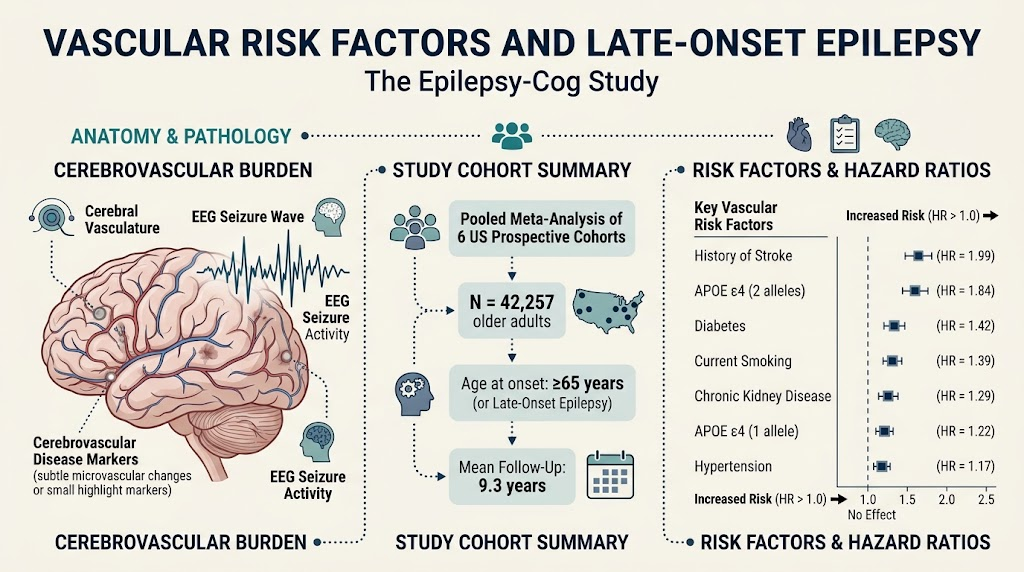
This investigation was an individual participant data meta-analysis combining six large, US population-based prospective cohorts collectively known as the Epilepsy-Cog Study. The included cohorts were ARIC (Atherosclerosis Risk in Communities), CHS (Cardiovascular Health Study), MESA (Multi-Ethnic Study of Atherosclerosis), REGARDS (Reasons for Geographic and Racial Differences in Stroke study), WHICAP (Washington Heights/Inwood Columbia Aging Project), and NOMAS (Northern Manhattan Study). Except for NOMAS, epilepsy case ascertainment relied on Medicare claims data linked to study participants, enabling robust longitudinal surveillance from age 65 onward, with continuous fee-for-service enrollment required to maintain follow-up integrity. NOMAS employed cohort-based epilepsy ascertainment methods with follow-up extending to 2024.
Sociodemographic data and VRFs were ascertained via self-report, clinical examinations, laboratory analyses, and medication usage history. The primary endpoint was incident LOE ascertained during follow-up. Multivariable Cox proportional hazards models were utilized to estimate hazard ratios (HRs) for incident LOE associated with individual VRFs and genetic factors, adjusting for relevant confounders. The comprehensive data spans from 1991 to 2024, totaling over 42,000 participants with a mean age of 71.4 years and an average follow-up of 9.3 years.
Key Findings
Among 42,257 participants without prevalent epilepsy at baseline, 1,500 (3.5%) developed incident LOE, corresponding to an incidence rate of 3.8 per 1,000 person-years. The analysis revealed significant independent associations between multiple VRFs and LOE risk as follows:
- Current smoking: HR = 1.39 (95% CI: 1.18–1.64)
- Hypertension: HR = 1.17 (95% CI: 1.04–1.31)
- Diabetes mellitus: HR = 1.42 (95% CI: 1.25–1.62)
- Chronic kidney disease: HR = 1.29 (95% CI: 1.13–1.48)
- History of stroke: HR = 1.99 (95% CI: 1.63–2.43)
- APOE ε4 genotype: 1 ε4 allele: HR = 1.22 (95% CI: 1.07–1.39), 2 ε4 alleles: HR = 1.84 (95% CI: 1.36–2.50)
The associations remained consistent across age groups, sex, and racial/ethnic subpopulations, indicating generalizability despite demographic differences. The strongest risk factor was prior stroke, nearly doubling LOE risk. Other VRFs imparted moderate but statistically significant incremental risks, supporting a cumulative vascular burden hypothesis in LOE pathogenesis.
Expert Commentary
This meta-analysis provides compelling evidence linking vascular risk factors and cerebrovascular disease to incident LOE, supporting the notion that LOE often represents a clinical sequela of underlying brain vascular pathology. The robust cohort design and Medicare claims linkage strengthen confidence in case ascertainment and longitudinal validity. The identification of APOE ε4 as an independent genetic risk factor aligns with its established role in neurodegeneration and vascular pathology, suggesting overlapping mechanisms involve amyloid metabolism and cerebrovascular integrity.
Limitations include potential misclassification inherent to claims-based epilepsy diagnosis and residual confounding despite multivariate adjustments. Additionally, medication adherence and VRF control over time could not be dynamically modeled, which may influence risk magnitude. Future studies should explore mechanistic biomarkers linking VRFs to epileptogenesis in older adults, emphasizing neuroimaging and molecular pathways.
Clinically, these findings underscore the importance of aggressive vascular risk management—including smoking cessation, blood pressure control, glycemic regulation, and kidney function monitoring—in reducing LOE risk and associated morbidity in seniors. The results also highlight the potential value of screening for epilepsy symptoms in patients with significant cerebrovascular disease burden.
Conclusion
This pooled analysis of six major US cohorts involving over 42,000 older adults confirms that multiple modifiable vascular risk factors and a history of stroke are significantly associated with increased risk of late-onset epilepsy. The additive contribution of APOE ε4 genotype further indicates genetic susceptibility that interacts with vascular health. These data illuminate the vascular etiology of LOE, advocating for integrated vascular and neurological risk assessment to improve detection and prevention strategies in this growing patient population.
Enhanced clinical vigilance and rigorous management of vascular comorbidities may mitigate the incidence of LOE, ultimately improving quality of life and reducing healthcare burden for older adults. Further translational research is warranted to dissect the precise pathophysiological links and identify novel therapeutic targets.
Funding and ClinicalTrials.gov
Funding sources, study support, and clinical trials registry identifiers were not specified in the provided data. Readers are encouraged to consult original publications for detailed funding disclosures and trial registrations related to the Epilepsy-Cog study cohorts.
References
- Choi H, Gutierrez J, Wang T, et al. Vascular Risk Factors and Late-Onset Epilepsy. JAMA Neurol. 2026;doi:10.1001/jamaneurol.2026.42895730
- Baumann CR, Stockinger EA, Lacroix M, et al. The Spectrum of Seizures in Elderly Patients with Stroke. Acta Neurol Scand. 2017;135(3):338-344.
- Annegers JF, Hauser WA. The epidemiology of late-onset epilepsy. Epilepsy Res. 2016;129:1-3.
- Rocca WA, Hauser WA. The burden of neurologic disease in older adults. Neurol Clin. 2018;36(3):611-624.
- Carro E, Serratosa JM, Thom M. Neuropathologic studies of epilepsy: Past, present and future. Epilepsia. 2019;60(11):2144-2159.