Highlight
This prospective study reveals a distinct laryngeal cancer microbiome characterized by significant enrichment of the genera Parvimonas and Campylobacter, microbes previously linked to gastrointestinal and cervical cancers. Conversely, control samples exhibit unique presence of Corynebacterium and Alloprevotella. These findings suggest microbiome profiling as a promising avenue for identifying novel microbial targets in laryngeal cancer therapy.
Study Background
Laryngeal cancer constitutes approximately 40% of head and neck malignancies and accounts for 1% of all cancer-related deaths globally. Despite advances in diagnostic and therapeutic strategies, the prognosis of laryngeal cancer remains suboptimal due to late diagnosis and limited targeted treatments. Emerging evidence links microbial dysbiosis to oncogenesis in various cancers, including gastrointestinal and cervical malignancies. Understanding the laryngeal cancer microbiome could reveal novel microbial biomarkers and therapeutic targets, potentially improving patient outcomes.
Study Design
This prospective cohort study enrolled 57 laryngeal mucosal samples obtained from 24 treatment-naive patients diagnosed with laryngeal cancer and 33 control patients undergoing otolaryngological surgeries unrelated to oral or laryngeal diseases, between January 2023 and September 2025. The study population was predominantly male and characterized by a high prevalence of smoking among cancer patients (83.3%) and to a lesser extent among controls (54.5%). DNA was extracted from mucosal samples and subjected to triplicate amplification targeting the V3/V4 region of the 16S rRNA gene, followed by high-throughput paired-end 2 × 300 bp sequencing using the Illumina NextSeq 2000 platform. Amplicon sequence variants (ASVs) were analyzed via the DADA2 pipeline and taxonomically classified to the genus level using a naive Bayes classifier. Two samples with zero classified reads were excluded from analysis.
Key Findings
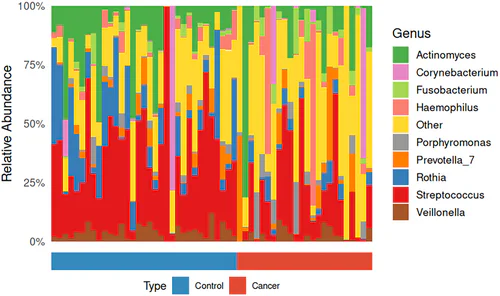
The core laryngeal microbiomes demonstrated marked compositional differences between cancer and control groups. In patients with laryngeal cancer, the genera Parvimonas (mean relative abundance 3.67%, 95% CI: 0.70%-6.64%) and Campylobacter (1.12%, 95% CI: 0.60%-1.63%) were uniquely present, whereas Corynebacterium (2.97%, 95% CI: 0.00%-7.67%) and Alloprevotella (1.34%, 95% CI: 0.64%-2.04%) were exclusive to controls.
Quantitative comparisons showed that cancer samples harbored a significant enrichment of 19 genera, most notably Peptococcus (2.93-fold increase, q=0.0003), Campylobacter (1.68-fold, q=0.009), and Parvimonas (2.02-fold, q=0.03), relative to control mucosa. These genera have prior associations with gastrointestinal and cervical cancers, as well as inflammatory conditions, suggesting a potential role in laryngeal carcinogenesis or tumor microenvironment modulation.
Additionally, the cancer-associated microbiome exhibited a reduction in taxa considered immunoprotective, hinting at microbial dysbiosis that may contribute to immune evasion and tumor progression.
Expert Commentary
The study presents compelling evidence that the laryngeal cancer microbiome is distinctly altered compared to non-cancerous controls, with specific microbial signatures potentially contributing to or reflecting tumor biology. The identification of Parvimonas and Campylobacter, genera implicated in other malignancies, underscores possible shared oncogenic mechanisms mediated by microbial communities.
These findings open avenues for translational research focusing on microbial modulation as adjunct cancer therapy. Targeting these enriched genera might disrupt tumor-promoting inflammation or microbial metabolite production, offering a novel therapeutic dimension beyond conventional surgery, radiation, and chemotherapy.
However, some limitations should be acknowledged. The study’s observational design precludes causal inferences between microbiome alterations and laryngeal cancer development. The relatively small sample size and male predominance may limit generalizability. Smoking, a major confounder due to its effects on both microbiota and cancer risk, was more prevalent among cancer patients and may partially influence findings. Future longitudinal and mechanistic studies incorporating microbial functional analyses are warranted to clarify causal pathways and therapeutic potential.
Conclusion
This investigation underscores distinct microbial dysbiosis in laryngeal cancer, with enrichment of Parvimonas and Campylobacter as plausible microbial contributors or biomarkers. The loss of immunoprotective taxa alongside these changes suggests complex microbiome-host interactions influencing tumorigenesis. Microbiome profiling emerges as a promising diagnostic adjunct and therapeutic guide in laryngeal cancer management. Further research is essential to validate these targets and develop microbiome-based interventions that could enhance existing treatment protocols and improve patient outcomes.
Funding and Clinical Trials
The study was conducted with institutional support from participating otolaryngological centers. No specific external funding or clinical trial registration was disclosed.
References
1. Lad H, Shah A, Thompson ER, et al. Laryngeal Cancer Microbiome Study Reveals Parvimonas and Campylobacter as Potential Therapy Targets. Laryngoscope. 2026 Nov 5. PMID: 42989377.
2. Garrett WS. Cancer and the microbiota. Science. 2015;348(6230):80–86.
3. Zitvogel L, Ma Y, Raoult D, Kroemer G, Gajewski TF. The microbiome in cancer immunotherapy: Diagnostic tools and therapeutic strategies. Science. 2018;359(6382):1366–1370.
4. Gao S, Li S, Ma Z, et al. Alterations, interactions, and diagnostic potential of gut bacteria and viruses in colorectal cancer. Gut. 2020;69(6):1120–1130.
Specialty calculators
For clinical reference; use professional judgment.