Highlights
- Despite clear evidence and guidelines discouraging routine preoperative testing before cataract surgery, low-value testing rates remain high in practice.
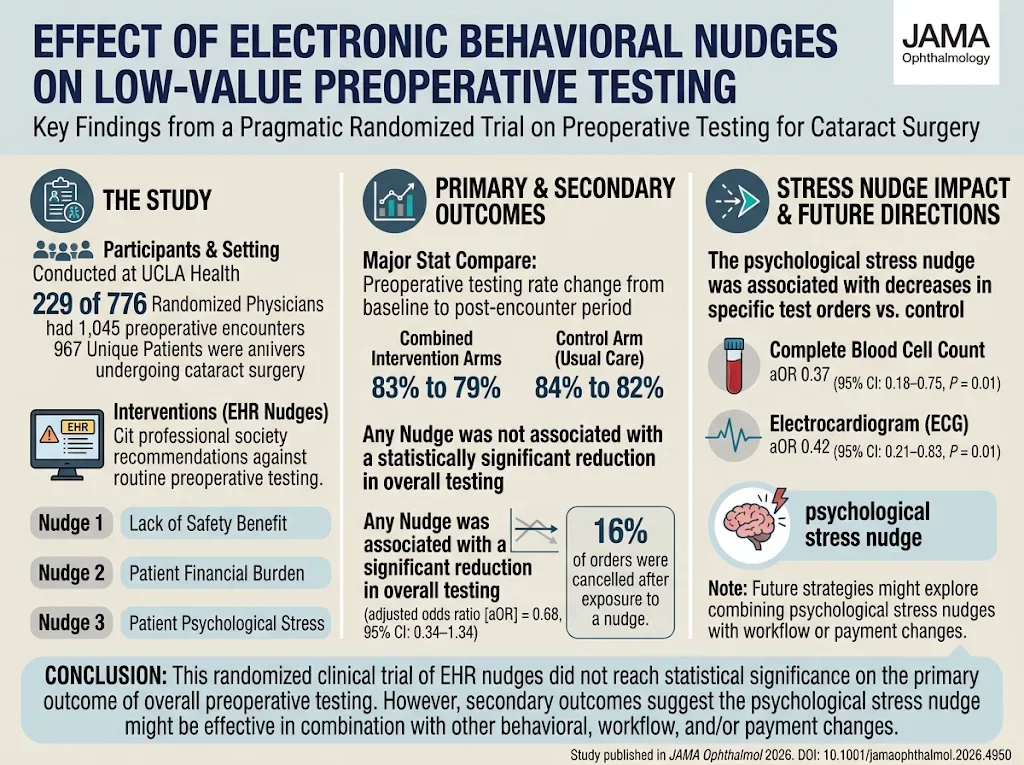
- This pragmatic randomized clinical trial at UCLA Health evaluated EHR-embedded behavioral nudges addressing safety, financial, or psychological harms to reduce unnecessary testing.
- The intervention showed no statistically significant reduction in overall preoperative testing rates but achieved significant decreases in specific tests, notably complete blood cell count and electrocardiograms, when psychological stress nudges were used.
- Secondary analyses revealed ~16% of test orders were canceled after nudge exposure, suggesting behavioral nudges impact clinician behavior and warrant combination with other systemic approaches for broader effect.
Background
Preoperative testing prior to low-risk surgeries such as cataract extraction remains a persistent example of low-value medical care. Robust randomized trials and professional society guidelines — including recommendations since 2002 — consistently show that routine preoperative testing does not improve surgical or patient outcomes in cataract surgery. However, real-world clinical data reveal that most patients undergoing cataract surgery still receive at least one preoperative test, including laboratory panels, electrocardiograms (EKGs), or chest X-rays. This discordance represents a crucial patient safety and healthcare cost challenge. Excess testing contributes to unnecessary patient burden, increased financial costs, delayed procedures, and potential psychological stress. Behavioral science offers novel methods, including ‘nudges,’ to subtly guide clinical decision-making without restricting provider autonomy. Embedding these nudges within electronic health record (EHR) systems is a promising approach to influence clinician behavior at the point of care.Key Content
Chronological Development and Rationale for the Study
Prior to this pragmatic trial, multiple randomized trials and guidelines had clearly established the lack of benefit of routine preoperative testing in cataract surgery (e.g., Specialty Society Recommendations, ASA, AAO). Nonetheless, entrenched clinical practice and systemic inertia maintained high testing rates. In 2021, Sarkisian et al. initiated a pragmatic randomized clinical trial at UCLA Health aiming to test the effectiveness of EHR-embedded behavioral economics-informed nudges within the preoperative workflow. The study ran from June 2021 to April 2023 with follow-up data collection through April 2024.Trial Design and Interventions
This trial randomized 776 physicians performing preoperative evaluations into four arms: three receiving distinct EHR interruptive alerts (behavioral nudges) and one control arm providing usual care. Each nudge alert referenced professional society recommendations against routine testing but emphasized different potential patient harms to maximize psychological impact:- Safety nudge — highlighting the lack of safety benefit from routine testing.
- Financial burden nudge — emphasizing out-of-pocket costs to patients.
- Psychological stress nudge — alerting clinicians to the possible psychological harm preoperative testing may impose on patients.
Primary and Secondary Outcomes
The primary outcome measured the change in the proportion of encounters with any signed preoperative testing order comparing the 12 months before each physician’s enrollment to the 12 months following enrollment. Secondary outcomes evaluated:- Order cancellation rates after nudges.
- Comparative efficacy across the three different nudge types.
- Changes in ordering specific categories of tests (e.g., complete blood count, electrocardiograms, chest X-rays).
Results
Among 229 physicians with eligible encounters, 1045 preoperative visits involving 967 unique patients were analyzed. Patients had a mean age of 72.1 years; 56.9% were female. Baseline signed preoperative testing rates were high (83% in intervention arms vs 84% in control) and decreased modestly post-intervention to 79% and 82%, respectively. Mixed-effects modeling showed no statistically significant association between receiving any nudge and overall order reduction (adjusted odds ratio [aOR], 0.68; 95% confidence interval [CI], 0.34 to 1.34). Notably, 16% of orders were canceled following an alert exposure. The psychological stress nudge specifically was associated with statistically significant reductions in the ordering of complete blood counts (aOR, 0.37; 95% CI, 0.18-0.75; P = .01) and electrocardiograms (aOR, 0.42; 95% CI, 0.21-0.83; P = .01) compared to controls. Chest X-ray orders did not significantly differ across arms.Integration with Prior Evidence
This study corroborates earlier findings on the persistence of low-value preoperative testing despite long-established evidence and suggests modest effect sizes from behavioral nudges alone. The differentiation among nudge types underscores the importance of message framing in influencing clinician behavior, aligning with behavioral economics literature which emphasizes tailoring interventions to cognitive and emotional clinician decision factors.Expert Commentary
While this trial did not find a statistically significant primary outcome reduction, the nuanced effect observed with the psychological stress nudge reveals important lessons. Psychological framing that highlights patient-centered potential harms may more effectively engage clinician empathy and promote evidence-aligned decision-making. Limitations include the single academic health system setting, potentially limiting generalizability. The minimalist intervention—limited to interruptive EHR alerts—may be insufficient alone to change established clinical habits without complementary changes in workflow design, policy incentives, or peer norm interventions. Furthermore, the high baseline testing rates reflect systemic and cultural practice patterns deeply ingrained over decades. Nudges might serve best as components within multifaceted approaches including institutional policies, education, performance feedback, and payer-driven changes. Mechanistically, nudges leverage automatic cognitive processes and social norms to influence behavior subtly rather than mandating change. The differential impact among nudges suggests that psychological stress framing taps into affective decision-making pathways more effectively than purely informational or cost-based framing.Conclusion
This pragmatic randomized clinical trial provides valuable real-world evidence on the limited yet discernible impact of EHR-embedded behavioral nudges to reduce low-value preoperative testing before cataract surgery. Although the primary outcome was not statistically significant, secondary data indicate that psychological stress-related messaging may reduce specific test orders and prompt cancellations. Future directions should explore combination strategies incorporating behavioral nudges, institutional workflow redesign, financial incentives, and clinician education. Broader multi-institutional studies are warranted to confirm external validity. This study advances the translational application of behavioral economics within EHR systems, offering a pathway to curb unnecessary medical testing and improve high-value care delivery.References
- Sarkisian CA, Villaflores CW, Vangala SS, et al. Effect of Electronic Behavioral Nudges on Low-Value Preoperative Testing: A Pragmatic Randomized Clinical Trial. JAMA Ophthalmol. 2026 Nov 5;doi:10.1001/jamaophthalmol.2026.4950. PMID: 42986635. https://pubmed.ncbi.nlm.nih.gov/42986635/
- Mafi JN, Sarkisian CA, Vangala SS, et al. Protocol for pragmatic randomised trial: integrating electronic health record-based behavioural economic ‘nudges’ into the electronic health record to reduce preoperative testing for patients undergoing cataract surgery. BMJ Open. 2021 Nov 3;11(11):e049568. doi: 10.1136/bmjopen-2021-049568. PMID: 34732478. https://pubmed.ncbi.nlm.nih.gov/34732478/
Specialty calculators
For clinical reference; use professional judgment.