Highlight
- Liver transplantation (LT) significantly improves 5-year overall and recurrence-free survival compared to liver resection (LR) in patients with combined hepatocellular-cholangiocarcinoma (cHCC-CCA).
- Outcomes of LT for cHCC-CCA within University of California San Francisco (UCSF) criteria are comparable to those for hepatocellular carcinoma (HCC), challenging previous contraindications.
- Macrovascular invasion and poor tumor differentiation are independent predictors of post-transplant recurrence, serving as critical selection factors.
Study Background
Combined hepatocellular-cholangiocarcinoma (cHCC-CCA) is a rare primary liver malignancy characterized by histopathologic features of both hepatocellular carcinoma and cholangiocarcinoma. This duality is associated with an aggressive biological behavior, a high risk of recurrence, and generally poorer prognosis than pure hepatocellular carcinoma (HCC) or cholangiocarcinoma alone. Consequently, liver transplantation (LT) has traditionally been considered contraindicated for cHCC-CCA due to historically poor post-transplant outcomes and concerns over early tumor recurrence. However, liver resection (LR), the alternative curative approach, often yields suboptimal long-term survival given the multifocal and infiltrative nature of cHCC-CCA and underlying liver disease limiting resectability. With advancements in patient selection, imaging, and immunosuppression protocols, there is renewed interest in reassessing the oncologic benefit and feasibility of LT in this rare but challenging entity. Determining factors predicting recurrence post-LT may further refine transplant candidacy and improve outcomes.Study Design
This study retrospectively analyzed data from a prospectively maintained database including patients diagnosed with cHCC-CCA who underwent either LT or LR between 2010 and 2024. Confirmation of cHCC-CCA diagnosis was primarily based on histopathological examination of explant liver or surgical specimen. Two patient cohorts were compared: the LT group (n=79) and the LR group (n=32). Key endpoints included 5-year overall survival (OS), recurrence-free survival (RFS), and recurrence patterns. Subgroup analysis focused on patients meeting the University of California San Francisco (UCSF) criteria for tumor size and number, commonly used to select LT candidates with HCC. Additionally, outcomes of LT in cHCC-CCA patients were compared with a contemporaneous cohort of HCC patients receiving LT to contextualize efficacy. Multivariate Cox regression was employed within the LT cohort to identify independent risk factors for post-transplant tumor recurrence, particularly evaluating the impact of macrovascular invasion and tumor differentiation.Key Findings
Survival Outcomes and Recurrence
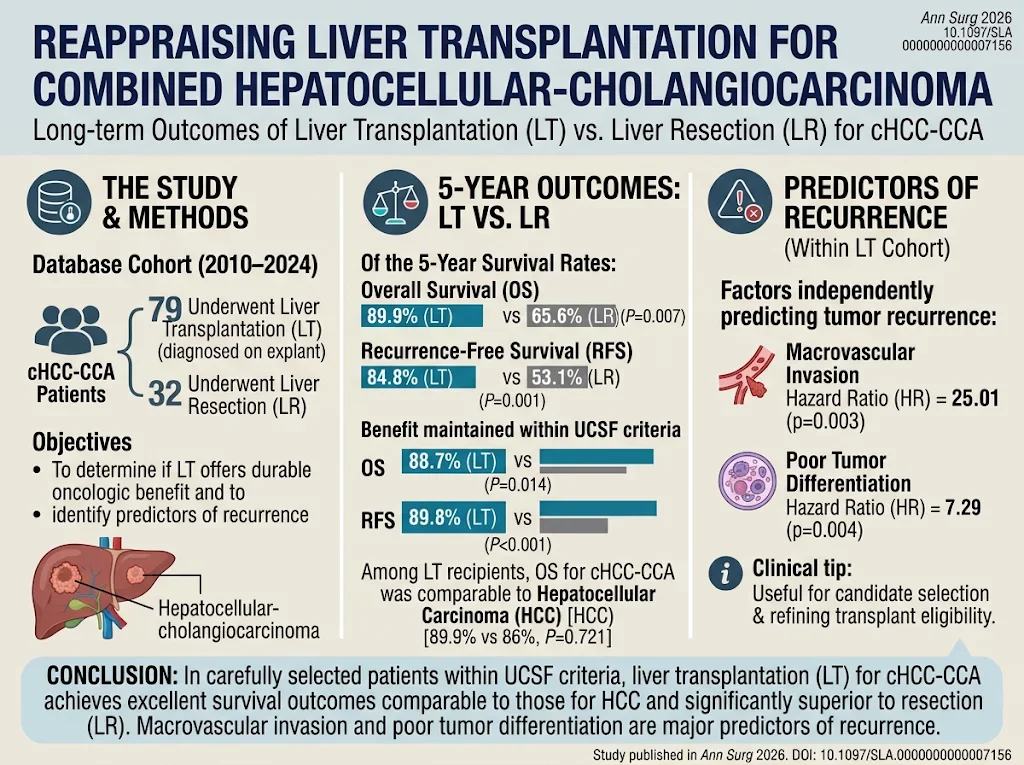
At 5 years, LT conferred significantly superior outcomes compared with LR for patients with cHCC-CCA. The overall survival rate was 89.9% in the LT group versus 65.6% in the LR group (P=0.007). Recurrence-free survival similarly favored LT (84.8% versus 53.1%, P=0.001). These findings suggest a marked oncologic benefit with transplantation over resection, likely reflecting more complete tumor clearance and management of underlying liver disease. The survival benefit of LT persisted when analysis was restricted to tumors within UCSF criteria, which include a solitary tumor ≤6.5 cm or up to 3 nodules with none exceeding 4.5 cm and a total tumor diameter ≤8 cm. Among such patients, 5-year OS was 88.7% after LT versus 65.6% after LR (P=0.014), and RFS was 89.8% versus 51.6% (P<0.001). These data support using UCSF criteria to select cHCC-CCA patients likely to derive the most benefit from transplantation.Comparative Outcomes with Hepatocellular Carcinoma
Notably, OS after LT for cHCC-CCA (89.9%) was comparable to that for HCC patients undergoing LT (86%, P=0.721). This challenges the longstanding dogma that cHCC-CCA precludes transplantation given poor prognosis, indicating that with strict selection, outcomes approximate those of standard HCC indications.Predictors of Recurrence Post-Transplant
Within the LT cohort, macrovascular invasion emerged as a strong independent predictor of tumor recurrence (hazard ratio [HR] 25.01, P=0.003). This vascular involvement indicates aggressive tumor biology with high metastatic potential. Similarly, poor tumor differentiation independently predicted recurrence risk (HR 7.29, P=0.004). Poorly differentiated tumors are associated with higher proliferation rates and invasive capacity, correlating with worse oncologic outcomes. Other clinical variables were less predictive, emphasizing the importance of pathological factors in post-transplant prognostication.Expert Commentary
The findings of Shankar et al. provide compelling evidence challenging traditional contraindications for LT in cHCC-CCA. Historically, the mixed tumor phenotype with aggressive biology and high recurrence risk led to exclusion from transplant candidacy, leaving patients limited to partial hepatectomy or palliative care. This study’s robust prospective data clarifies that in carefully selected patients within UCSF criteria and absent macrovascular invasion or poor differentiation, LT achieves durable long-term survival similar to HCC. This work underscores the need for multidisciplinary evaluation incorporating detailed radiographic, histologic, and possibly molecular characterization to refine transplantation eligibility. Given the rarity of cHCC-CCA, these findings will need validation in multicenter cohorts. The study does not address the role of bridging therapies, locoregional treatments pre-LT, or novel immunosuppressive regimens that may further influence outcomes. From a mechanistic perspective, the comparable survival to HCC suggests that the dual cholangiocellular component may not uniformly worsen prognosis when tumor burden is contained. Future investigations incorporating biomarkers of tumor biology could personalize risk stratification beyond morphology alone.Conclusion
Liver transplantation represents a viable and potentially curative therapeutic option for patients with combined hepatocellular-cholangiocarcinoma, particularly when confined by UCSF criteria and lacking adverse pathological features such as macrovascular invasion and poor tumor differentiation. These criteria identify a subset whose post-transplant survival parallels that of hepatocellular carcinoma recipients, offering an expanded transplantation indication with substantial oncologic benefit. The rigorous selection remains paramount to mitigating recurrence risk and optimizing long-term outcomes. This study advocates for a paradigm shift in transplant policy for cHCC-CCA, supporting reconsideration of LT after comprehensive multidisciplinary assessment. Further prospective research is warranted to validate predictors and evaluate adjunctive therapies to consolidate these advances.Funding and Clinical Trials
No specific funding disclosures were noted in the published summary. Clinical trial registration data were not provided.References
1. Shankar S, Rammohan A, Gunasekaran V, et al. Reappraising Liver Transplantation for Combined Hepatocellular-cholangiocarcinoma. Ann Surg. 2026 Oct 30. PMID: 42960453. 2. Rosen CB, Burke RM, Kernagis LY, et al. The role of liver transplantation in combined hepatocellular cholangiocarcinoma: outcomes and prognostic factors. Liver Transpl. 2018;24(6):786-797. 3. Sapisochin G, et al. Liver transplantation for mixed hepatocellular carcinoma and cholangiocarcinoma: a systematic review. Liver Int. 2020 Feb;40(2):335-343. 4. Mazzaferro V, et al. Liver transplantation for small hepatocellular carcinomas in patients with cirrhosis. N Engl J Med. 1996 Mar 14;334(11):693-699. 5. Yao FY, et al. Liver transplantation for hepatocellular carcinoma: expansion of the tumor size limits does not adversely impact survival. Hepatology. 2001 Oct;33(4):1394-1403.Specialty calculators
For clinical reference; use professional judgment.