Highlight
- Immune thrombocytopenia (ITP) is linked to impaired regulatory T-cell (Treg) function mediated by defective T-cell receptor (TCR) signaling.
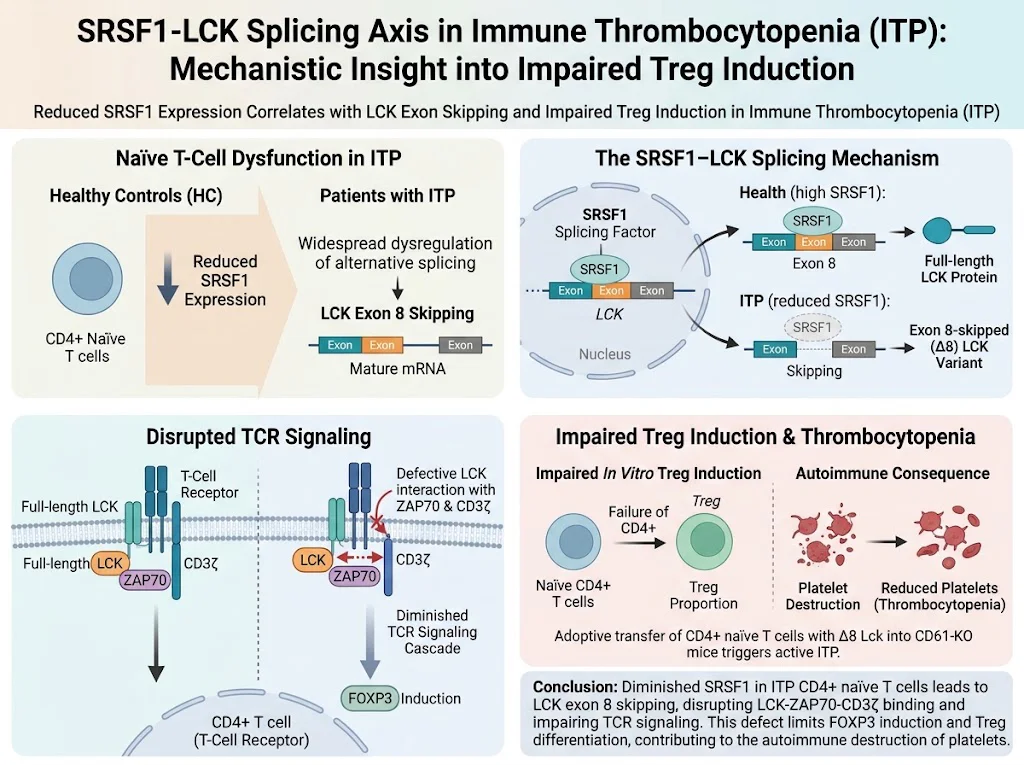
- RNA sequencing of CD4+ naive T cells from ITP patients revealed aberrant alternative splicing with prominent exon 8 skipping in LCK, a key kinase in TCR signaling.
- The splicing factor SRSF1 directly regulates LCK exon 8 inclusion; its reduced expression in ITP correlates with impaired Treg induction.
- Functional studies indicate that exon 8-skipped LCK compromises TCR activation, reducing FOXP3 induction and Treg differentiation, highlighting a novel pathogenic axis in ITP.
Study Background
Immune thrombocytopenia (ITP) is a common autoimmune hematologic disorder characterized by low platelet counts due to antibody-mediated platelet destruction and defective megakaryopoiesis. Beyond platelet destruction, T-cell immune dysregulation, particularly diminished regulatory T-cell (Treg) function, has been implicated in ITP pathogenesis. However, the molecular mechanisms that link T-cell receptor (TCR) signaling defects to impaired Treg development in ITP remain incompletely understood. This knowledge gap hampers targeted therapeutic innovation aimed at restoring immune tolerance and ameliorating disease.
Study Design
This investigative study analyzed CD4+ naive T cells isolated from patients with ITP and healthy control subjects to characterize TCR signaling and Treg induction capacity in vitro. Comprehensive RNA sequencing (RNA-seq) was employed to delineate transcriptomic and alternative splicing differences between groups. Functional assays included the use of an LCK minigene reporter system, RNA pull-down combined with mass spectrometry, and RNA immunoprecipitation to identify splicing regulatory factors. Complementary cellular and murine models evaluated the biological effects of specific LCK exon skipping events on Treg differentiation and platelet counts in an active ITP setting.
Key Findings
The study demonstrated that CD4+ naive T cells from ITP patients had significantly lower TCR signaling responsiveness and impaired induction into FOXP3+ Tregs in vitro compared to healthy controls. Transcriptome analysis revealed widespread alternative splicing dysregulation, with LCK exon 8 skipping identified as a prominent aberration. LCK encodes a tyrosine kinase integral to TCR proximal signaling and Treg development.
Using an LCK minigene system and RNA pull-down assays, the serine/arginine-rich splicing factor 1 (SRSF1) was identified as a direct regulator of LCK exon 8 inclusion. Importantly, SRSF1 expression was markedly reduced in CD4+ naive T cells from ITP patients. Restoration of SRSF1 expression rescued exon 8 inclusion and improved Treg induction in vitro, demonstrating causality.
Antisense oligonucleotide-mediated inhibition of SRSF1 binding sites on LCK enhanced exon 8 skipping in Jurkat T cells, leading to attenuated TCR activation signals. Mechanistic investigations revealed that the exon 8-skipped LCK variant exhibited diminished binding to ZAP70 and CD3ζ chains, key adaptor molecules transmitting activation signals downstream of the TCR. This impaired signaling reduced FOXP3 induction, critical for Treg lineage commitment.
In contrast to humans, mouse Lck lacks equivalent splicing elements for exon 8 skipping; however, adoptive transfer of murine CD4+ naive T cells engineered to express the exon 8-skipped Lck variant into CD61-knockout mice in an active ITP model led to decreased Treg frequencies and reduced platelet counts. These in vivo data reinforced the pathogenic relevance of aberrant LCK splicing in ITP.
Expert Commentary
This study elucidates an unexpected regulatory axis involving the splicing factor SRSF1 and LCK alternative splicing that contributes to defective Treg induction in ITP. By linking altered RNA splicing to impaired TCR signaling and immune tolerance breakdown, these findings advance our understanding of ITP pathogenesis beyond classical antibody-mediated platelet destruction. The identification of SRSF1 as a modulator of LCK splicing opens avenues for therapeutic targeting to restore Treg function and immune homeostasis.
Limitations include the reliance on in vitro and murine models to approximate human disease and the complexity of alternative splicing regulation in heterogeneous immune populations. Furthermore, the clinical implications of manipulating SRSF1 or LCK splicing require validation in larger cohorts and translational studies. Nevertheless, these data provide a compelling rationale for further exploration of RNA-based therapeutics in autoimmunity.
Conclusion
This investigation uncovers a novel molecular mechanism underlying impaired Treg induction in ITP centered on reduced SRSF1 expression and consequent exon 8 skipping of LCK. The resulting defects in TCR signaling compromise FOXP3 expression and Treg development, fostering autoimmune platelet destruction. Therapeutic strategies aiming to restore SRSF1 function or correct LCK splicing may represent innovative approaches to re-establish immune tolerance in ITP.
Future research should focus on validating these findings across diverse patient populations, elucidating additional splicing factors involved, and developing splicing-modulatory interventions with therapeutic potential in ITP and related autoimmune disorders.
Funding and ClinicalTrials.gov
No specific funding source or clinical trial registration is referenced for this study.
References
- Hu X, Leng S, Liu Y, et al. Reduced SRSF1 expression correlates with LCK exon skipping and impaired Treg induction in immune thrombocytopenia. Blood. 2026;148(18):2239-2250. PMID: 42607060.
- Zheng SG. Regulatory T-cell therapy in autoimmune diseases: opportunities and challenges. Immunology. 2021;162(2):131-140.
- Smith-Garvin JE, Koretzky GA, Jordan MS. T cell activation. Annu Rev Immunol. 2009;27:591-619.
- Fu XD, Ares M Jr. Context-dependent control of alternative splicing by RNA-binding proteins. Nat Rev Genet. 2014;15(10):689-701.
- St–Laurant J, Barber DL. Kinases regulating T cell activation and memory development. Adv Exp Med Biol. 2015;850:35-59.
Specialty calculators
For clinical reference; use professional judgment.