Highlight
1. Admission dysphagia screening with a nurse-led protocol significantly lowers the risk of hospital-acquired aspiration pneumonia (HA-AP).
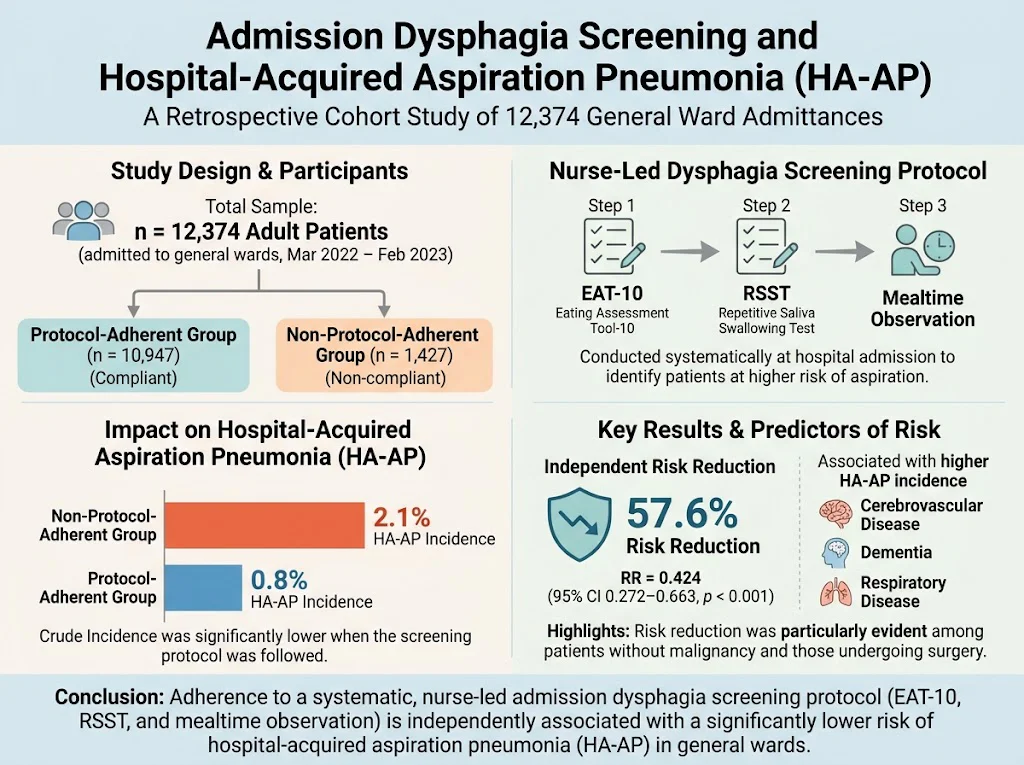
2. Protocol adherence reduced HA-AP incidence from 2.1% to 0.8% in a large general ward patient cohort.
3. Higher HA-AP risk was associated with cerebrovascular disease, dementia, and respiratory illness.
4. Risk reduction was consistent across disease categories, notably in patients without malignancy and those undergoing surgery.
Study Background
Aspiration pneumonia, caused by inhalation of oropharyngeal contents into the lower respiratory tract, represents a serious and potentially preventable complication in hospitalized patients. Its incidence has increased alongside global aging populations, leading to higher morbidity, mortality, and healthcare costs. Identifying patients at risk for aspiration pneumonia upon hospital admission could promote timely interventions and reduce hospital-acquired cases, especially in general ward settings where dedicated respiratory monitoring is less intensive than in critical care.
Dysphagia, or impaired swallowing, is a key risk factor for aspiration pneumonia but is often underdiagnosed or underassessed in routine clinical practice. Systematic screening tools administered early upon admission could allow healthcare providers to identify at-risk patients and implement preventive measures such as diet modification, swallowing therapy, or enhanced monitoring.
Study Design
This retrospective cohort study was conducted at a Japanese hospital analyzing records from 12,374 adult patients admitted to general wards between March 2022 and February 2023. The intervention arm comprised 10,947 patients who adhered to a nurse-led dysphagia screening protocol upon admission. This protocol included an initial swallowing risk questionnaire—the Eating Assessment Tool-10 (EAT-10)—followed by the repetitive saliva swallowing test (RSST), and real-time mealtime observation. The comparator group included 1,427 patients for whom the screening protocol was not adhered to.
The primary outcome was the incidence of hospital-acquired aspiration pneumonia (HA-AP), initially identified using ICD-10 codes J69.0-J69.9 documented for reimbursement purposes. Diagnosis was subsequently verified by a researcher through thorough medical chart review to ensure accuracy. Covariates adjusted in the modified Poisson regression included age, sex, body mass index (BMI), dysphagia-related comorbidities (e.g., cerebrovascular disease, dementia), malignancy status, history of surgery, endoscopic procedures, radiotherapy, chemotherapy, and month of admission to account for seasonal variations.
Key Findings
The study found a statistically significant reduction in HA-AP incidence among patients screened according to protocol compared with those unscreened: 0.8% vs. 2.1%, respectively. This more-than-50% risk reduction remained significant after adjusting for confounding factors (risk ratio [RR] 0.424, 95% confidence interval [CI] 0.272–0.663, p < 0.001).
Important risk factors identified included cerebrovascular disease, dementia, and respiratory diseases, consistent with their known association with impaired swallowing and pulmonary vulnerability.
The protective effect of protocol adherence was consistent across various patient subgroups. Notably, patients without malignancy and those undergoing surgery benefited particularly from the screening protocol. This suggests that early dysphagia detection and intervention may be especially impactful in patients whose risk might otherwise be underestimated.
The nurse-led screening utilized EAT-10, a validated patient-reported swallowing difficulty questionnaire, complemented by objective RSST and observational assessments during mealtime. This multi-step approach allows for effective triage and identification of dysphagia without requiring specialized speech-language pathology resources at admission.
Expert Commentary
This study substantiates the clinical value of systematic dysphagia screening on hospital admission as a practicable strategy to prevent aspiration pneumonia. While previous guidelines have recommended swallow assessment in high-risk populations, this large cohort demonstrates feasibility and efficacy in a general ward setting with a nurse-led model.
However, as a retrospective observational study, it is subject to potential residual confounding and protocol adherence bias. The non-randomized design limits causal inference, although robust risk adjustment was performed. Generalizability beyond this single-center Japanese cohort requires confirmation in diverse healthcare systems and populations.
Mechanistically, early identification of dysphagia enables interventions such as modified diets, swallowing therapy, or heightened monitoring, which collectively reduce aspiration risk. The significant benefit observed in surgical patients underscores the importance of perioperative swallowing risk assessment to prevent postoperative pulmonary complications.
Future prospective studies and randomized trials could quantify the cost-effectiveness and long-term outcomes related to swallowing screening protocols, including impacts on length of stay, readmission, and mortality.
Conclusion
Admission dysphagia screening using a structured nurse-led protocol significantly reduces the risk of hospital-acquired aspiration pneumonia in general ward patients. Implementation of systematic swallowing assessments at hospital admission represents a pragmatic and effective preventive measure, especially in aging populations with growing dysphagia risk.
This study highlights the value of integrating simple, validated screening tools like EAT-10 and RSST with clinical observation into routine nursing workflows. Healthcare institutions should consider adopting such protocols to improve inpatient safety and reduce aspiration pneumonia-related morbidity.
Clinical practice guidelines may benefit from formally endorsing admission dysphagia screening beyond traditionally high-risk groups to encompass broader general ward populations. Additional research is warranted to refine screening criteria, optimize intervention strategies, and evaluate economic benefits.
Funding and ClinicalTrials.gov
The original study did not specify funding sources or clinical trial registration. Future prospective studies should consider formal trial registration to enhance methodological transparency.
References
- Yamauchi T, Ikebuchi M, Toyoda H, et al. Admission Dysphagia Screening and Hospital-Acquired Aspiration Pneumonia in General Wards: A Retrospective Cohort Study. Journal of general internal medicine. 2026-10-26. PMID: 42934351.
- Langmore SE. Dysphagia Management in the Elderly. Gastroenterol Clin North Am. 2018;47(2):317-329.
- Marik PE. Aspiration Pneumonia and Dysphagia in the Elderly. Chest. 2001;120(3):577-578.
- Clavé P, Shaker R. Dysphagia: Current Reality and Scope of the Problem. Nature Reviews Gastroenterology & Hepatology. 2015;12(5):259-270.
- Rofes L, Arreola V, Mukherjee R, Clavé P. Diagnosis and Management of Oropharyngeal Dysphagia Among Older Persons, State of the Art. J Am Med Dir Assoc. 2019;20(3):269-275.
Specialty calculators
For clinical reference; use professional judgment.