Highlight
This large longitudinal study establishes that respiratory effort during sleep, objectively measured by negative esophageal pressure (PES), independently predicts all-cause mortality in patients with suspected obstructive sleep apnea (OSA). This adds prognostic value beyond conventional markers like apnea-hypopnea index (AHI) and hypoxemia severity. Increased time spent with high negative PES correlates with elevated mortality risk, highlighting the clinical significance of evaluating respiratory effort in sleep-disordered breathing.
Study Background
Obstructive sleep apnea (OSA) is a prevalent disorder characterized by recurrent upper airway obstruction during sleep, leading to intermittent hypoxia, arousals, and increased respiratory effort. It affects a significant portion of the adult population worldwide and is associated with increased cardiovascular morbidity, metabolic dysfunction, and mortality. Current diagnostic metrics, primarily the apnea-hypopnea index (AHI) and oxygen saturation parameters, capture frequency of breathing interruptions and hypoxemia but do not reflect the mechanical load on the respiratory system due to exaggerated negative intrathoracic pressures.
Negative esophageal pressure (PES) reflects the degree of inspiratory effort against airway obstruction. Exaggerated respiratory effort can exacerbate cardiovascular stress through mechanisms such as increased afterload, sympathetic activation, and negative intrathoracic pressure swings. Despite this plausible pathophysiology, the prognostic implications of respiratory effort measured via PES have not been well delineated in large clinical cohorts.
Study Design
This retrospective cohort study included 16,083 patients referred for suspected OSA between 2003 and 2016 who underwent overnight respiratory polygraphy with esophageal manometry to directly measure respiratory effort. The cohort was predominantly middle-aged (median 48 years) and included both sexes (26% females). Recorded parameters included median PES during sleep, mean oxygen saturation (mSpO2), apnea-hypopnea index (AHI), total time in bed (TiB), and duration spent above various PES thresholds from 10 to 60 cmH2O.
Patients’ clinical data and mortality status were tracked up to June 2024, with a median follow-up of 15 years. The primary endpoint was all-cause mortality. Multivariable Cox regression analysis was employed to assess associations of respiratory effort indices with mortality, adjusting for confounders including age, sex, BMI, comorbidities, AHI, and mSpO2.
Key Findings
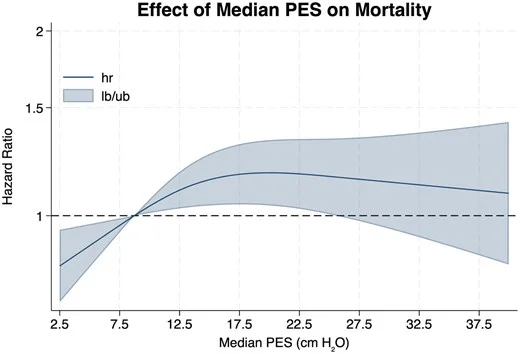
Median PES across the cohort was 12.8 cmH2O, with the median AHI at 10 events/hour and median mSpO2 at 94%. Notably, 16% met criteria for severe OSA (AHI ≥30). During follow-up, 9.3% of patients died.
Mortality risk increased substantially in patients within the upper quartiles of median PES compared with the lowest quartile. After adjusting for demographic and clinical variables, including AHI and hypoxemia measures, the third quartile of median PES had a 21% increased hazard of death (HR 1.21; 95% CI 1.03-1.43; P=0.024). Furthermore, the greater the duration of time spent above higher PES thresholds during sleep, the higher the mortality risk. The risk escalated progressively with increasing intensity of respiratory effort, suggesting a dose-response relationship.
Importantly, these findings persisted independent of traditional OSA severity markers, indicating that respiratory effort represents a distinct and clinically relevant pathophysiological dimension.
Expert Commentary
The study rigorously highlights the prognostic relevance of respiratory effort during sleep, emphasizing that negative intrathoracic pressure swings are not merely epiphenomena but active contributors to long-term outcomes. This supports integrating metrics of respiratory mechanics into clinical evaluations of OSA. Given that existing risk assessment heavily relies on AHI and oxygen desaturation indices, which capture frequency but not mechanical strain, respiratory effort provides complementary information about the physiological burden.
Nonetheless, esophageal manometry is not routinely implemented in clinical practice due to invasiveness and technical demands. Future directions should explore validated surrogate measures of respiratory effort that are less burdensome and can be widely adopted.
Moreover, understanding potential mechanisms such as cardiovascular load, sympathetic activation, and structural remodeling caused by exaggerated negative PES could guide therapeutic decisions. It raises the question of whether interventions specifically targeting respiratory effort, alongside apnea frequency and hypoxemia, could improve survival for OSA patients.
Limitations include the study’s observational design, potential residual confounding, and lack of cause-specific mortality data. The relatively young median age may limit generalizability to older populations. However, the large sample size and long follow-up considerably strengthen the validity of the findings.
Conclusion
This landmark study establishes respiratory effort measured by negative esophageal pressure during sleep as an independent predictor of all-cause mortality in suspected OSA patients. Respiratory effort adds prognostic value beyond traditional OSA severity indices such as AHI and hypoxemia, suggesting it should be incorporated into comprehensive clinical assessments. The clear dose-response relationship between magnitude and duration of elevated PES and mortality highlights the pathophysiological significance of respiratory mechanics in OSA-related outcomes.
These insights pave the way for refinements in risk stratification and personalized management approaches in OSA, potentially including new diagnostic tools and therapeutic targets focused on respiratory effort to mitigate long-term mortality risk.
Funding and Registration
The original study did not specify funding sources or clinical trial registration numbers.
References
- Punjabi NM. The epidemiology of adult obstructive sleep apnea. Proc Am Thorac Soc. 2008 Feb 15;5(2):136-43. doi: 10.1513/pats.200709-155MG.
- Koletsky RJ et al. Cardiovascular consequences of obstructive sleep apnea and diagnostic considerations. Mayo Clin Proc. 2021 Sep;96(9):2475-2486.
- Younes M. Role of respiratory effort in the pathogenesis of obstructive sleep apnea: understanding the physiologic consequences. Respir Physiol Neurobiol. 2008 Jul 31;160(1):1-8.
- Nahoui H, Schirmer H, Einvik G, et al. Respiratory effort during sleep predicts mortality in patients with suspected obstructive sleep apnea. Am J Respir Crit Care Med. 2026 Nov 1;212(11):2803-2811. PMID: 42371748.
Specialty calculators
For clinical reference; use professional judgment.