Highlight
- Syndecan-4 (SDC4) plasma levels are elevated in patients with deep vein thrombosis (DVT) and its deficiency aggravates thrombus formation.
- SDC4 promotes endothelial-to-mesenchymal transition (EndMT) through a Piezo1-dependent mechanism, activating the PI3K/Akt signaling pathway in endothelial cells.
- A distinct endothelial cell subpopulation (C1) drives EndMT during DVT progression, with direct SDC4-Piezo1 protein interaction confirmed.
- Quercetin pharmacologically inhibits Piezo1, reducing EndMT and thrombus burden, suggesting a promising therapeutic avenue for DVT management.
Study Background
Deep vein thrombosis (DVT), characterized by blood clot formation in deep veins—most commonly in the lower extremities—remains a significant and potentially life-threatening cardiovascular condition. It contributes substantially to morbidity and mortality, especially due to complications such as pulmonary embolism and post-thrombotic syndrome. Despite advances in anticoagulation therapies, limitations including bleeding risk and recurrent thrombosis highlight a pressing need to delineate molecular mechanisms underpinning DVT pathogenesis and to identify novel therapeutic targets.
Endothelial dysfunction is increasingly recognized as central in DVT development. Endothelial-to-mesenchymal transition (EndMT) is a phenotypic transformation of endothelial cells (ECs) that propels inflammation, fibrosis, and pro-thrombotic states. However, key mediators regulating EndMT in DVT remain poorly understood. Syndecan-4 (SDC4), a transmembrane heparan sulfate proteoglycan, modulates cellular adhesion and signaling but its role in DVT pathophysiology has not been fully explored. Similarly, Piezo1, a mechanosensitive ion channel implicated in vascular homeostasis, might contribute downstream of SDC4 in promoting EndMT.
The present study by Chen et al. aims to elucidate the mechanistic interplay between SDC4 and Piezo1 in DVT progression and to evaluate the translational potential of targeting Piezo1 with quercetin, a bioactive flavonoid compound.
Study Design
This rigorous investigation employed an integrative experimental approach combining clinical plasma proteomics, transgenic murine models, cell lineage tracing, single-cell transcriptomics, molecular biology, and network pharmacology.
Clinical plasma specimens from DVT patients and healthy controls underwent liquid chromatography-tandem mass spectrometry (LC-MS/MS) to identify differential protein expression, focusing on SDC4. Genetically engineered SDC4 knockout (SDC4-/-) mice and endothelial cell-specific lineage tracing models allowed in vivo assessment of EndMT and thrombus formation. Single-cell RNA sequencing (scRNA-seq) of endothelial populations revealed specific subpopulations contributing to EndMT.
In vitro, human umbilical vein endothelial cells (HUVECs) were used to model EndMT under inflammatory and hypoxic conditions. Protein interactions were validated by co-immunoprecipitation (Co-IP). Pharmacological inhibition of Piezo1 in vivo was applied to evaluate its role in modulating thrombus burden.
Network pharmacology guided identification of quercetin as a candidate Piezo1 inhibitor, subsequently tested for its mechanistic effects on Piezo1 expression, EndMT attenuation, and thrombus size reduction in murine DVT models.
Key Findings
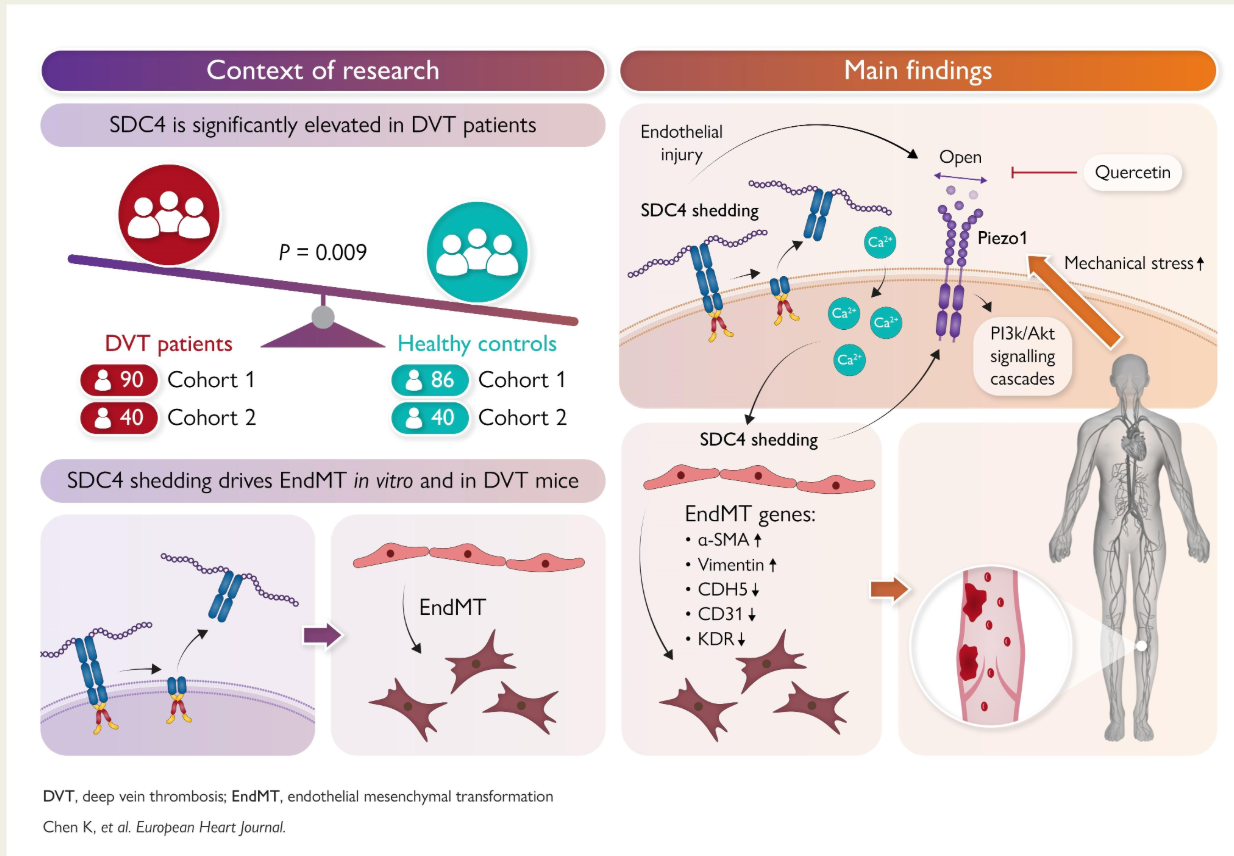
Plasma proteomics revealed significantly elevated SDC4 levels in DVT patients compared to controls, implicating SDC4 as a biomarker and potential mediator in thrombogenesis.
Functionally, SDC4-deficient mice exhibited exacerbated venous thrombus size, confirming a protective role of intact SDC4. Histological and molecular analyses demonstrated that SDC4 deficiency accelerates EndMT, characterized by a marked decrease of endothelial markers (e.g., CD31, VE-cadherin) and concomitant elevation of mesenchymal markers (e.g., α-SMA, N-cadherin).
scRNA-seq of endothelial cells identified a distinct subcluster, termed C1, enriched in EndMT hallmark genes, which was expanded in the context of DVT and SDC4 deficiency.
Mechanistically, Co-IP studies established a direct physical interaction between SDC4 and Piezo1, a mechanosensitive cation channel. Piezo1 expression was enhanced in EndMT-driving EC subpopulations, activating downstream PI3K/Akt signaling pathways—a crucial axis involved in cellular survival, proliferation, and differentiation.
Pharmacological inhibition of Piezo1 attenuated EndMT phenotypes both in vitro and in vivo, leading to reduced thrombus size and improved endothelial integrity.
Network pharmacology and molecular docking found quercetin directly binds to Piezo1, suppressing its expression in a dose-dependent manner. Treatment of DVT mice with quercetin significantly decreased thrombus burden and mitigated EndMT, supporting its therapeutic potential.
Expert Commentary
This comprehensive study fills a critical gap in understanding DVT pathobiology by identifying SDC4 shedding as a driver of maladaptive EndMT through Piezo1-dependent signaling. The multidisciplinary approach—from patient samples to sophisticated mouse models and cell systems—strengthens the biological plausibility of findings.
By pinpointing the novel signaling axis SDC4–Piezo1–PI3K/Akt in DVT pathogenesis, this work offers new mechanistic insights that may catalyze development of molecularly targeted therapies.
Quercetin, a widely available flavonoid with an established safety profile, emerges as a promising Piezo1 inhibitor. Nevertheless, translation requires clinical validation, detailed pharmacokinetic studies, and evaluation of long-term efficacy and safety.
Limitations include the need to confirm whether SDC4 shedding is a causal event or a consequence of thrombus formation in humans, and extrapolation from murine models to human physiology warrants caution.
Despite these caveats, the study presents a compelling framework to refine DVT therapeutic strategies beyond conventional anticoagulation, potentially reducing adverse events and improving patient outcomes.
Conclusion
Chen et al. have elucidated a novel pathogenic mechanism in deep vein thrombosis whereby syndecan-4 shedding exacerbates thrombus formation by promoting Piezo1-dependent endothelial-to-mesenchymal transition via activation of the PI3K/Akt pathway. The identification of a specialized endothelial cell subset driving EndMT enriches mechanistic understanding. Importantly, quercetin represents a viable pharmacological intervention to inhibit Piezo1, attenuate pathological EndMT, and reduce thrombus burden.
These findings pave the way for innovative targeted therapies that may complement or supplant existing anticoagulants, potentially transforming DVT management. Future research should focus on clinical trials assessing Piezo1 inhibitors and exploring the broader roles of endothelial mechanotransduction in vascular thrombotic diseases.
Funding and Clinical Trials
The original publication does not specify funding sources or registered clinical trial identifiers for this study. Further clinical translation is anticipated to require collaborative research initiatives and well-designed trials in human subjects.
References
1. Chen K, Chen ZZ, Tian JW, et al. Deep vein thrombosis exacerbated by syndecan-4 shedding and piezo1-dependent endothelial-mesenchymal transition. Eur Heart J. 2026 Oct 5. PMID: 42830553.
2. Kahn SR, Hirsch A. Deep vein thrombosis and pulmonary embolism. Lancet. 2017;390(10091):1838-1849.
3. Piera-Velazquez S, Jimenez SA. Endothelial to mesenchymal transition: role in physiology and in the pathogenesis of human diseases. Physiol Rev. 2019; 99(2): 1281-1324.
4. Li J, Hou B, Tumova S, et al. Piezo1 integration of vascular architecture with physiological force. Nature. 2014;515(7526):279-82.
5. Li Y, Guo S, Guo J, et al. Regulation of endothelial function by quercetin: molecular mechanisms and therapeutic potential. Front Pharmacol. 2021;12:617648.